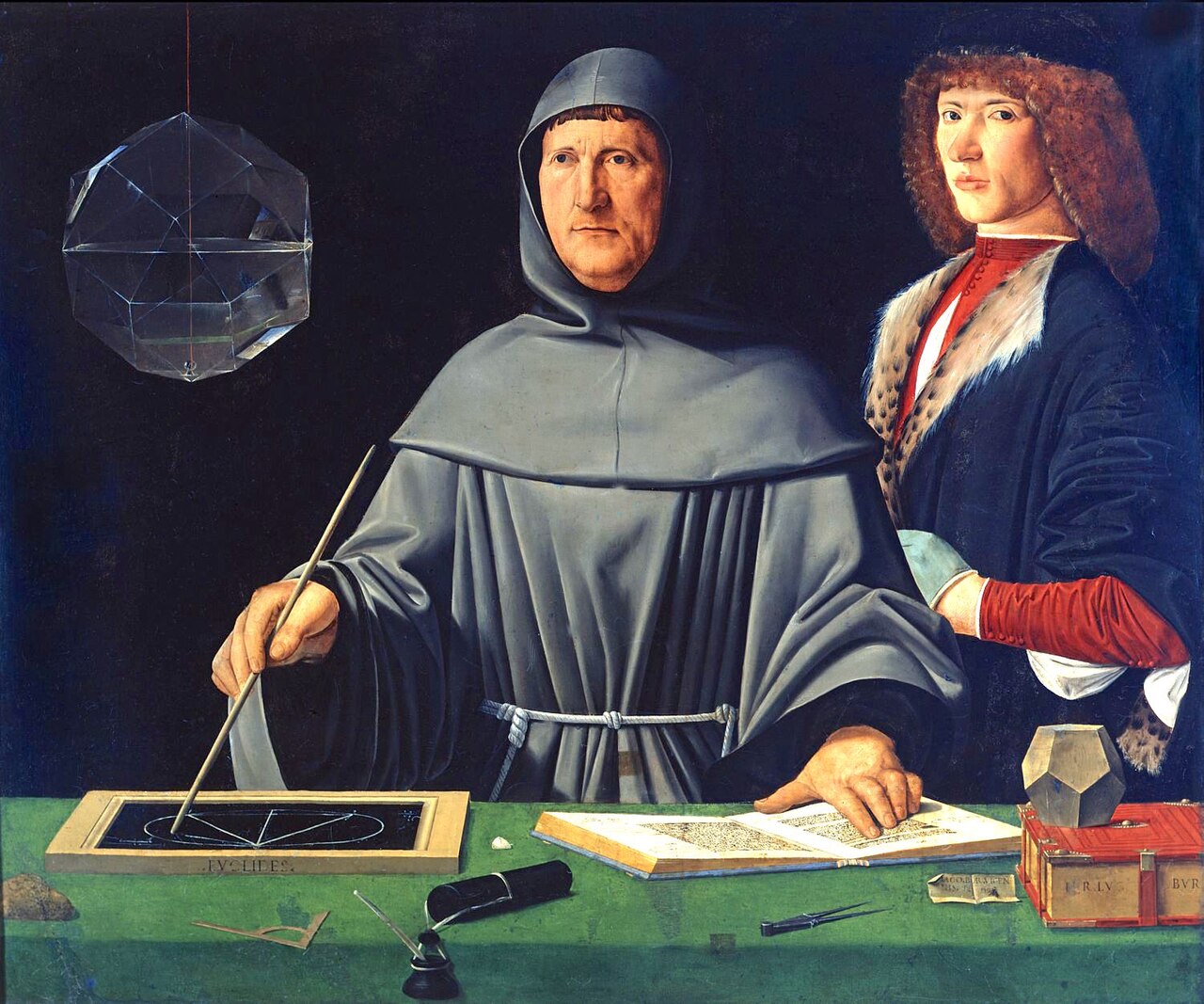
The Franciscan friar, mathematician and friend of Leonardo da Vinci – Luca Pacioli – died on 19 June 1517 in the Tuscan town of Sansepolcro where he had been born. He left behind a legacy that still shapes the way the world does business.
Five hundred and nine years ago today, Luca Bartolomeo de Pacioli died in Sansepolcro, the small town in eastern Tuscany where he had spent his earliest and final years. He was around 70 years old. The title history has given him — the Father of Accounting — says much about his practical influence, but rather less about the full range of a mind that ranged freely across mathematics, geometry, philosophy, art and architecture, and that placed him at the centre of Renaissance intellectual life.
From Sansepolcro to Venice
Pacioli was born between 1446 and 1448 in Sansepolcro, the son of Bartolomeo Pacioli. His father died when he was around 11 or 12, and he was taken into the care of a local wealthy merchant family, the Bofolci, who gave him an education grounded in mathematics and commerce. It was practical preparation for a mercantile world, delivered in the vernacular rather than Latin.
Around 1464, he moved to Venice, continuing his studies and working as tutor to the three sons of a prosperous merchant, Antonio Rompiasi. From Venice he went to Rome, where he struck up a friendship with the architect, artist and mathematician Leon Battista Alberti. He returned to Sansepolcro in 1470 to enter the Franciscan Order, and thereafter spent decades travelling across Italy teaching mathematics in Perugia, Florence, Venice, Milan, Pisa, Bologna and Rome.
He was appointed the first chair in mathematics at the University of Perugia, an institution where he also produced a substantial 600-page textbook for his students covering merchant arithmetic, algebra, barter, profit, and exchange.
The Summa and the birth of modern accounting
In 1494, in Venice, Pacioli published the work for which he is most remembered: the Summa de arithmetica, geometria, Proportioni et proportionalita, known simply as the Summa. Printed in a city that was then the publishing capital of southern Europe, it was a comprehensive survey of all mathematical knowledge of the era, drawing on ancient and contemporary sources to produce the most complete treatment of the subject yet committed to print.
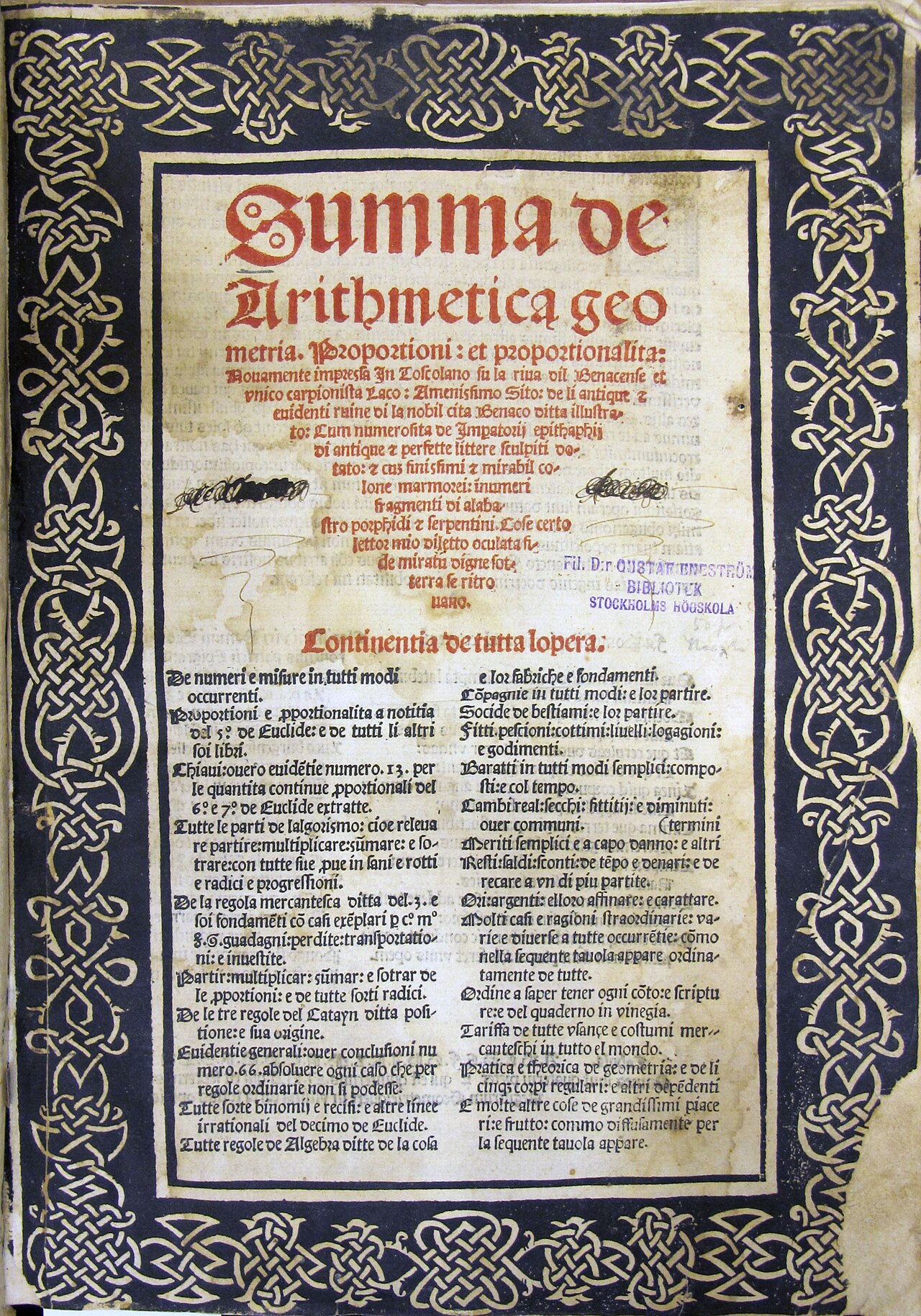
Within its pages was a 27-section treatment of what Venetian merchants already practised: double-entry bookkeeping, in which every transaction is recorded simultaneously as both a debit and a credit, and the ledgers cannot be closed until they balance. Pacioli did not invent the system — he was documenting practices already in use — but his codification of it, widely disseminated through print, transformed it from a local mercantile custom into the foundation of modern accounting. The principles he set down in the Summa remain at the core of financial practice today.
Leonardo, geometry and the Divine Proportion
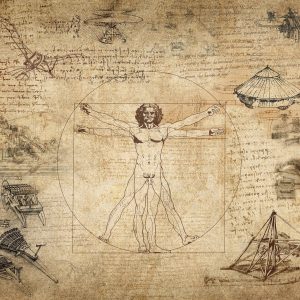
After the Summa, Pacioli accepted an invitation from Duke Ludovico Sforza to work in Milan, arriving in 1497. There he met Leonardo da Vinci, and the two men formed one of the great intellectual friendships of the Renaissance. Pacioli lived with Leonardo as a house guest, teaching him mathematics and geometry; Leonardo, in turn, drew the illustrations for Pacioli’s next major work, De Divina Proportione, written in Milan and published in Venice in 1509.
Divina proportione explored the mathematical and aesthetic properties of the golden ratio — the proportional relationship found throughout nature and applied across architecture and art — and its illustrations by Leonardo, including the first printed depiction of a rhombicuboctahedron, are among the finest scientific drawings of the Renaissance period. The influence of the golden ratio extended far beyond Pacioli’s own time; the Swiss-French architect Le Corbusier invoked it in the 1940s as the basis for his proportional system, the Modulor.
The partnership was cut short by politics. In 1499, Louis XII of France seized Milan, sending Ludovico Sforza into exile. Pacioli and Leonardo fled together — first to Mantua, then to Venice — before eventually going their separate ways.
The Plagiarism Question
Pacioli’s reputation was not uncontested. The 16th-century artist and historian Giorgio Vasari accused him of incorporating, without credit, the translated text of a work by Piero della Francesca — De quinque corporibus regularibus, a treatise on the geometry of polyhedra — into Divina proportione. Piero della Francesca was, like Pacioli, a native of Sansepolcro, and possibly his early mentor. Whether Pacioli had been a student of Piero’s remains uncertain, but the intellectual debt was substantial.
Some scholars, however, have argued that the edition of Divina proportione that Vasari read may have been appended to include Piero’s work after Pacioli’s death, muddying any attribution of wrongdoing to Pacioli himself.
Pacioli’s last university appointment was in Rome in 1514 and 1515. He returned to Sansepolcro as his health declined, and died there on 19 June 1517. By that time he was, by any measure, one of the most influential figures of his age — a counsellor to dukes, generals and popes, a friend of Leonardo, and the man who had given commercial civilisation the language of its own finances.