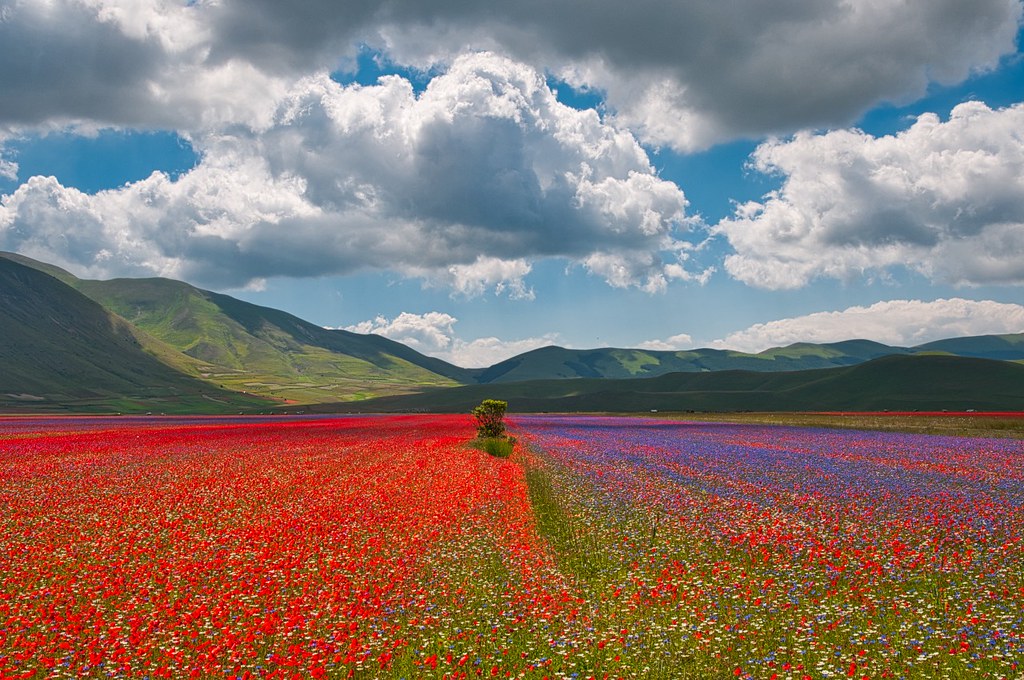
Every summer, the high plains beneath the Sibillini Mountains erupt into a sweep of red, purple, blue and yellow. The plant responsible for the Umbrian spectacle isn’t a flower at all, but the humble lentil.
Umbria is beautiful, but for a few weeks each summer, the plateau surrounding the hilltop village of Castelluccio di Norcia starts looking like a painting. Between late May and early July, the high-altitude plain around the village bursts into a rainbow of red, purple, blue and yellow. The cause isn’t a wildflower crop, it’s the lentil. Sown across the plain for generations, the growing conditions happen to be ideal for wildflowers to flourish alongside it. Locals call the event la fioritura, and it now draws visitors from across the world.
A humble legume
The Piano Grande, the vast bowl of flatland beneath the Sibillini Mountains, has been given over to lentil cultivation for centuries. It’s a demanding place to farm with the plateau sitting at roughly 1,350 metres, with a harsh microclimate and frost for much of the year. However, that difficulty is precisely what makes the lentils so prized. Small, thin-skinned and quick to cook, Castelluccio’s lentils earned Protected Geographical Indication (IGP) status in 1999, and are traditionally served simply, in soups or alongside local sausage.
What makes the fields so photogenic is something farmers elsewhere would consider a nuisance. Poppies, cornflowers, wild mustard and other weeds that would normally be stripped out of a cereal crop are instead left to seed freely among the lentils here, producing the layered colour that has made Castelluccio one of the most photographed landscapes in Italy.
A village still rebuilding
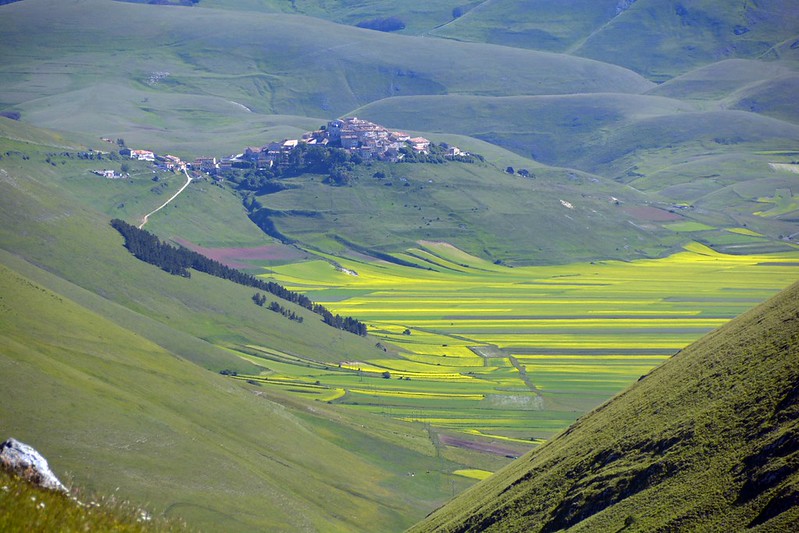
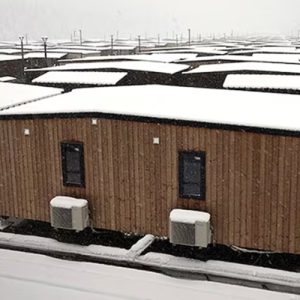
The fioritura’s growing fame carries a bittersweet edge. Castelluccio was badly damaged in the 2016 earthquake that struck central Italy, and the historic hilltop village now has only a handful of year-round residents. Many of the businesses that once operated from the old centre — bars, agriturismi, shops selling local produce — have since relocated to temporary premises lower down, with former residents commuting in daily from nearby Norcia to keep the village’s tourist economy running.
Despite the disruption, the crowds have never really stopped coming. Local tour operators report visitors arriving steadily from abroad through late spring, followed by a wave of domestic tourists as the season builds toward its colourful peak.
When to go and what to expect
Timing matters here. The bloom typically builds through June and reaches its most intense colour in the final days of the month and into early July, though the exact peak shifts slightly from year to year depending on the weather. Visitors typically head for vantage points above Pian Grande, where the patchwork of colour across the valley floor is best appreciated from a distance, before descending into the fields themselves on foot.
For anyone planning a trip to Umbria this summer, Castelluccio offers something increasingly rare: a genuinely wild-feeling natural spectacle that’s also, in its own quiet way, the product of centuries of careful farming.