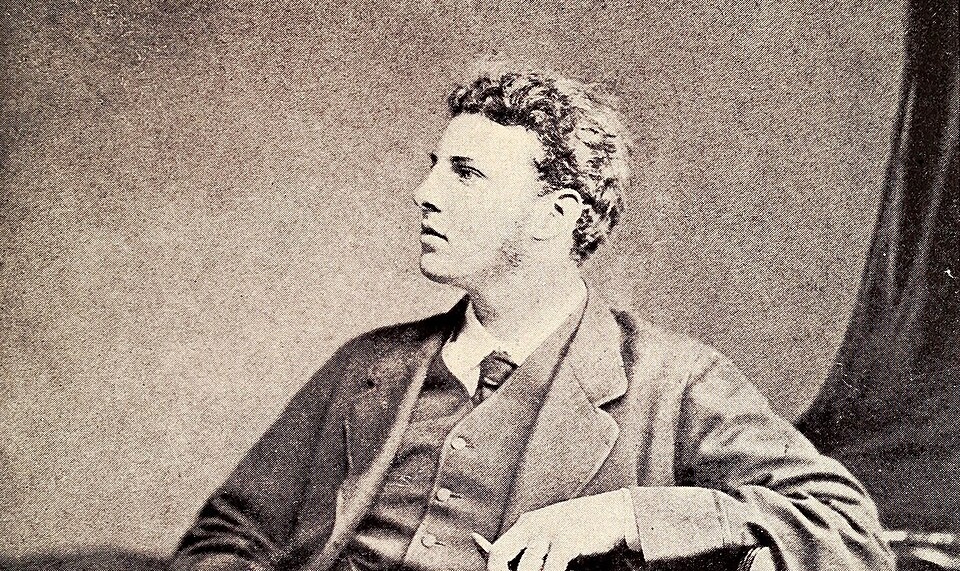
The American writer Francis Marion Crawford was born 2nd August 1854 in Bagni di Lucca, Tuscany. A prolific novelist, Crawford became known for the vividness of his characterisations and the realism of his settings, many of which were places he had visited and lived in across Italy.
Crawford was the only son of the American sculptor Thomas Crawford and Louisa Cutler Ward, and the nephew of the American poet Julia Ward Howe. Two of his sisters, Anne Crawford and Mary Crawford Fraser, also became novelists in their own right.
A childhood between two continents
Crawford spent his early years shuttling between Italy and America, and was educated at a string of American and European institutions, including St Paul’s School in Concord, New Hampshire, before going on to study at universities on both sides of the Atlantic. Despite building his adult life almost entirely in Italy, he remained a US citizen throughout, and returned to America regularly.
In 1879, Crawford travelled to India, where he studied Sanskrit and edited the Allahabad Indian Herald. The experience gave him the material for his first novel, Mr Isaacs, the story of a diamond merchant whose sale of a rare stone provokes protest from Britain. Published in 1882, it was an immediate success and launched his career as a novelist. He followed it a year later with Doctor Claudius: A True Story, further cementing his reputation. Mr Isaacs would go on to inspire the 1931 Hollywood film Son of India, starring Ramón Novarro.
Settling permanently on the Bay of Naples
In 1883, Crawford returned to Italy for good. He lived initially at the Hotel Cocumella in Sant’Agnello, just outside Sorrento, before buying a nearby farmhouse, which he developed into the Villa Crawford. The villa, a striking clifftop residence, is still easily identifiable from the sea today by the tall buttresses he added to guard against coastal erosion.
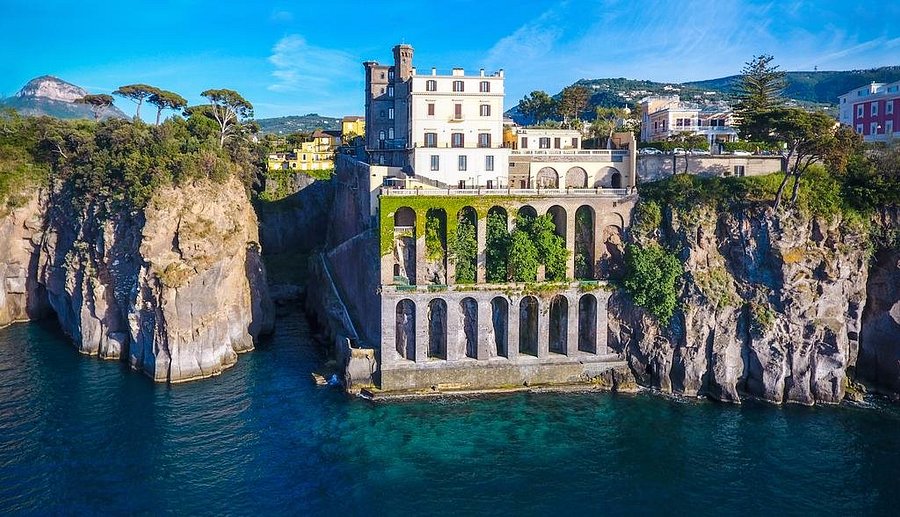
His connection to the town ran deep enough that a street, Corso Marion Crawford, was later named in his honour.
A prolific career built on Italian settings
Crawford was an enormously prolific writer, publishing dozens of novels over his career, alongside works of history and travel writing. He preferred romantic storytelling over the heavier moral realism fashionable among some of his contemporaries, and his richest, most celebrated work drew directly on the Italy he had made his home.
His Saracinesca trilogy — Saracinesca (1887), Sant’Ilario (1889) and Don Orsino (1892) — followed a Roman aristocratic family through the social upheavals of the late nineteenth century, and remains widely regarded as his finest achievement. An expert fencer himself, Crawford wrote its sword fights with evident relish. He also turned his hand to historical writing, producing works such as Ave Roma Immortalis (1898) and Gleanings from Venetian History (1905). The eerie and supernatural also received attention as he penned ghost stories including The Upper Berth and For the Blood Is the Life that are still anthologised today.
His books sold in the thousands across the United States, bringing him considerable fame and financial success, and he frequently returned to America to lecture on Italian history, a subject he had, by then, made very much his own.
Crawford’s personal life
Crawford married Elizabeth Christophers Berdan, daughter of American Civil War general Hiram Berdan, and the couple had two sons and two daughters. One daughter later became a nun and lived on at the Villa Crawford after her father’s death, when the property passed into the hands of the Daughters of Maria Ausiliatrice and was converted into a convent.
In more recent years, the villa has been refurbished once again, this time as a guesthouse. Its prime position overlooking the Bay of Naples draws visitors more than a century after Crawford first built it.
Francis Marion Crawford died at the Villa Crawford after suffering a heart attack in 1909, and was buried in the cemetery of Sant’Agnello.