
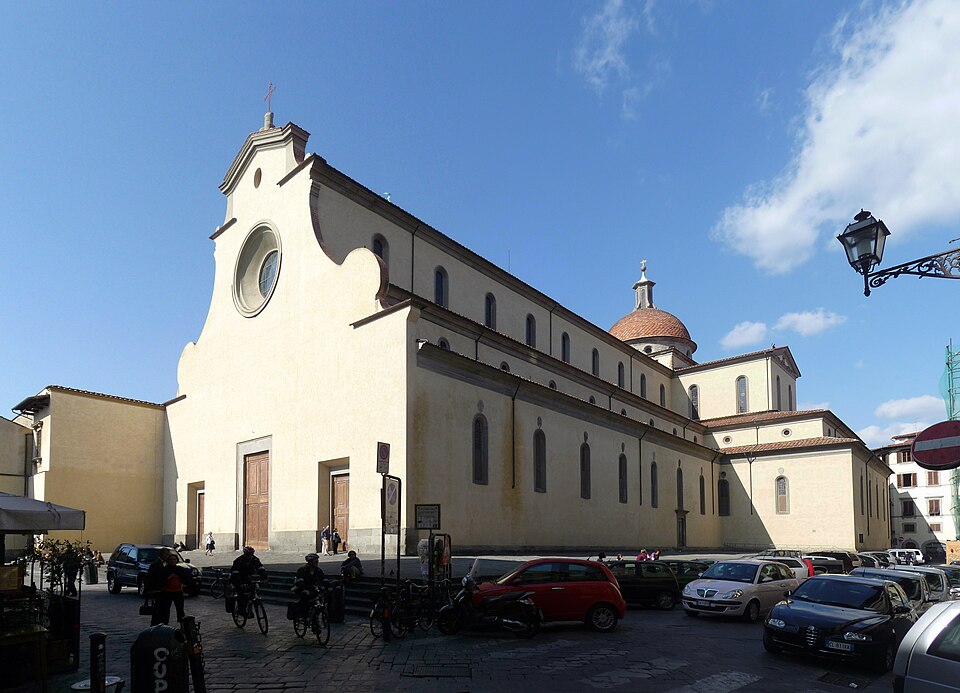
A limewood crucifix inside the Basilica di Santo Spirito, carved when Michelangelo was still a teenager, is drawing fresh attention after a New York Times feature named it one of the artist’s most affecting works. Discover more about one of Florence’s best-kept secrets.
Ask most visitors where to find Michelangelo in Florence and they’ll point you straight to the Accademia, towards the David and its endless queue. Cross the Arno, though, into the quieter streets of the Oltrarno, and there’s another Michelangelo waiting inside the Basilica di Santo Spirito.
A recent feature in the New York Times makes the case that the Santo Spirito Crucifix deserves to be spoken of in the same breath as Michelangelo’s later triumphs. It’s a piece we’re inclined to agree with, and one that gave us the perfect excuse to ask our own resident Florence expert, tour guide Sarah Cater of Floeasy, why this small wooden figure keeps pulling her back to Santo Spirito again and again.
A gift from an eighteen-year-old genius
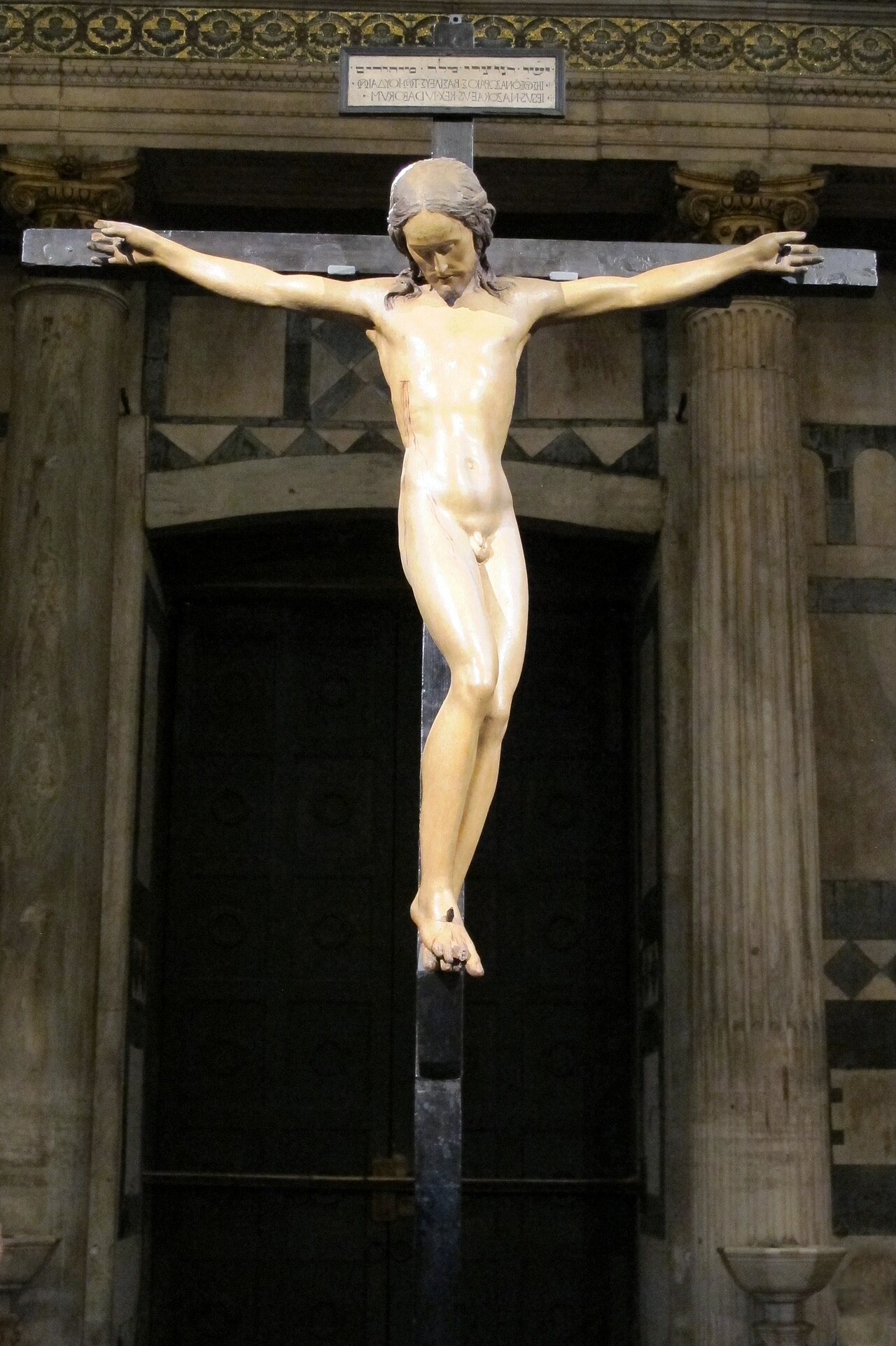
The crucifix was carved around 1493, when Michelangelo was roughly eighteen and still very much finding his feet. He was living at the Augustinian convent attached to Santo Spirito at the time, and the friars there had done him an extraordinary favour: giving him access to the infirmary so he could study human anatomy by dissecting corpses. It’s the kind of formative, slightly grim detail that tends to get glossed over in the official biography. However, it shaped everything that came after: his uncanny sense of the body under skin and muscle.
Historical accounts suggest the crucifix was Michelangelo’s way of saying thank you. A gift carved in gratitude for an opportunity most young artists of his era would never have been granted.
Lost for centuries
For all its significance, the crucifix nearly slipped through the cracks of history entirely. Early biographers Vasari and Condivi both mentioned it, but somewhere along the way it faded from view, hanging unremarked in a corner of the convent for generations.
It took a German art historian, Margrit Lisner, to bring it back into focus. In 1962, while researching Tuscan crucifixes, she spotted the work in its unassuming spot and recognised it for what it was. Her identification reignited scholarly interest, and the piece is now widely accepted as an authentic Michelangelo.
Even then, its story wasn’t quite settled. The crucifix spent decades shuttling between Santo Spirito and Casa Buonarroti amid restoration work and questions over ownership, before finally returning to the basilica for good in 2000. Today it hangs in the sacristy.
“It’s the Michelangelo nobody’s expecting”
For Sarah Cater, who has spent years guiding visitors through Florence’s less obvious corners, the crucifix is a favourite precisely because of what it isn’t. “People come to Italy braced for grandeur — for David, for the Sistine ceiling,” she says. “Then you bring them into this small, dim sacristy and show them a Christ figure that’s slender, almost fragile, carved by an eighteen-year-old who hadn’t yet found his own confidence.”
That fragility is part of what makes the piece so compelling to art historians. Its proportions are slighter and its anatomy less heroic than the ideal Michelangelo would later chase in his mature work. Rather than treating that as a weakness, most scholars now read it as a young artist finding his way, long before he had a reputation to protect.
A church worth the walk
Santo Spirito itself tends to get overlooked too, which is something of an injustice given it was designed by Filippo Brunelleschi and ranks among the purest expressions of early Renaissance architecture in the city. Unlike the Accademia or the Uffizi, it has no queues.
“You’re not fighting a crowd to have a moment with the work,” says Sarah. You can just stand there with it.”
The crucifix hangs in the basilica’s sacristy, accessible for a small admission fee, suspended beneath the high ceiling in a setting that only adds to its hushed, contemplative mood.
David isn’t going anywhere but for anyone willing to cross the river, Santo Spirito offers something the Accademia can’t: a private audience with Michelangelo before the world knew his name.


