San Marino residents celebrate the anniversary of their liberation from Fascism on 28th July, marking the moment a clandestine socialist resistance finally forced the ruling Fascist party from power.
San Marino residents celebrate the anniversary of their liberation from Fascism on this day every year, commemorating a demonstration in 1943 that brought two decades of one-party rule in the tiny republic to an end.
A wealthy veteran builds a party in Rome’s image
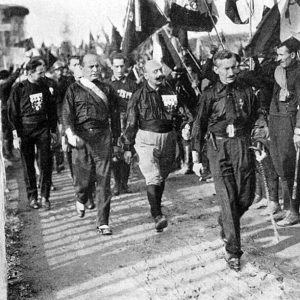
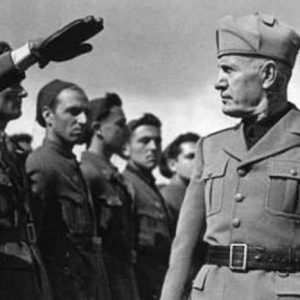
The Sammarinese Fascist Party was founded on 10th August 1922 by Giuliano Gozi, a veteran of the First World War who came from a wealthy and influential Sammarinese family. Gozi had studied law at the University of Bologna before joining the Royal Italian Army when Italy entered the war in 1915, serving with the Alpini on the Tofane front and earning a Bronze Medal for his service. The party he went on to found was modelled directly on Mussolini’s National Fascist Party across the border, and, like its Italian counterpart, made regular use of violence and intimidation against political opponents.
Gozi’s position within San Marino’s government gave him an unusually tight grip on the tiny republic. He held the role of Secretary for Foreign Affairs — a post that, uniquely in San Marino’s system, effectively made him head of the cabinet — alongside the role of Secretary for the Interior, giving him direct control over both the military and the police. He went on to serve as Captain Regent, San Marino’s head of state, on five separate occasions between 1923 and 1942, and remained in his foreign affairs post continuously until 1943.
Two decades without opposition
The Fascists held power for twenty years, banning all rival political parties outright, although a small number of independent politicians continued to sit in the Grand and General Council, San Marino’s parliament. Gozi’s government also followed Rome’s lead on racial policy, issuing its own Sammarinese racial law in the late 1930s that prohibited interracial marriage, including between Jewish and non-Jewish citizens.
A clandestine resistance takes root
Opposition to the regime began to organise in earnest in the early 1940s, when a group of Socialists who had returned to San Marino started building a clandestine anti-fascist movement within the republic. Support for the movement grew steadily over the following years, culminating in a political demonstration on 28th July 1943 that succeeded where two decades of scattered dissent had failed: it forced the dissolution of the Sammarinese Fascist Party and the calling of new elections.
The republic’s newfound freedom proved short-lived in its purest form. When Mussolini was freed by German forces shortly afterwards and Fascism was restored across the border in Italy, San Marino’s new government was forced to negotiate a fresh pacification pact with the resurgent regime, allowing the republic to maintain a careful neutrality between the two opposing sides for the remainder of the war.
That neutrality had real humanitarian consequences. Over the course of the war, San Marino became a safe haven for more than 100,000 refugees, and a number of Jewish refugees were saved from deportation to concentration camps as a result. When the war ended, British and American troops oversaw the gradual return of these refugees to their homes.
San Marino marks 28th July with a public holiday and festival every year, commemorating the day the republic finally freed itself from Fascist rule.
Travel tip
San Marino, perched on the border between Emilia-Romagna and Marche on the north-eastern side of the Apennines, remains an independent state entirely surrounded by Italy. Its romantic battlements and towers, most famously the Fortress of Guaita, are visible from miles around against the skyline.
The republic claims to be the oldest surviving sovereign state and constitutional republic in the world, and covers an area of just 61 square kilometres, a fraction of the size of many Italian provinces, yet with a history distinctly its own.