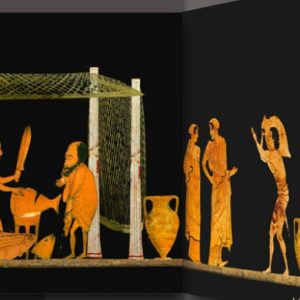
One of the greatest masterpieces of Etruscan painting returns to public ownership after more than 160 years in private hands. The François Tomb goes on display at Rome’s Villa Giulia from 25 June.
Italy has acquired the François Tomb — one of the most important works of Etruscan and ancient painting in existence — for €15 million. The deed of sale was signed at the Culture Ministry in Rome on Friday in the presence of Culture Minister Alessandro Giuli. The frescoes will be placed on permanent display at the National Etruscan Museum at Villa Giulia from 25 June, when a major exhibition dedicated to the monument will open.
The acquisition closes a process that began over a century ago: the Italian state first expressed an interest in acquiring the François Tomb as long ago as 1921. It was made possible through collaboration with the heirs of the Torlonia, Sforza Cesarini and Gaetani families, the monument’s previous owners, and was overseen jointly by the Directorate General of Museums, led by Massimo Osanna, and Villa Giulia’s director, Luana Toniolo.
What is the François Tomb?
Discovered on 1 May 1857 by archaeologist Alessandro François and Adolphe Noël des Vergers in the Ponte Rotto Necropolis of the ancient Etruscan city of Vulci, in Lazio, the tomb dates to between approximately 340 and 320 BC — the last quarter of the fourth century BC. Carved into the tufa rock, it comprised 37 painted panels and two stone cippi found in the entrance corridor.
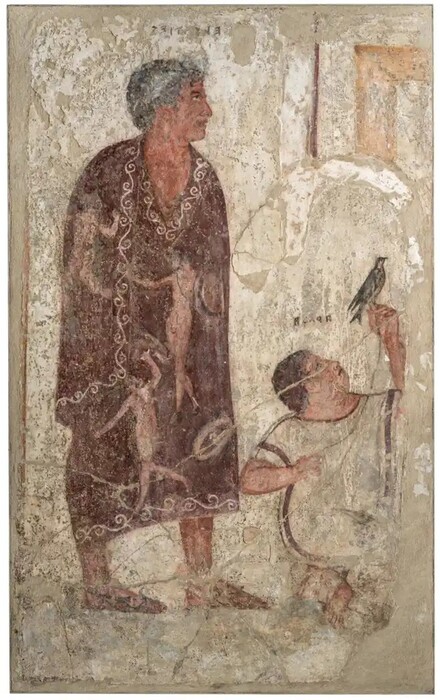
The tomb appears to have belonged to the Etruscan family of the Saties (or Seties). One of its principal figures, Vel Saties, is depicted alongside his dwarf, Arnza — an unusually intimate and individualistic image for ancient funerary art. Its frescoes are exceptional both iconographically and as documents of Etruscan historical consciousness and identity.
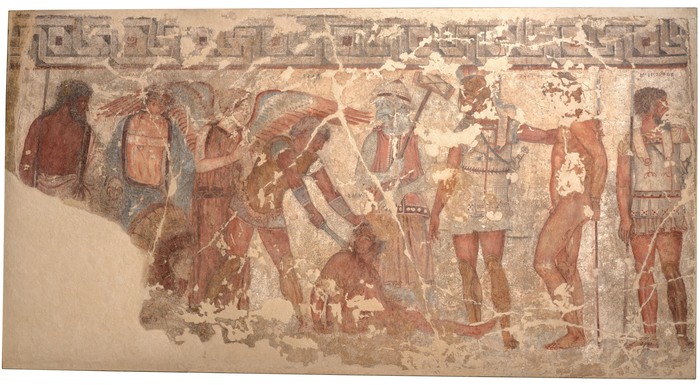
Among the most remarkable scenes is a depiction of Caelius Vibenna — the figure the Romans believed gave his name to the Caelian Hill — and Mastarna, a legendary character whom the Emperor Claudius identified with Servius Tullius, one of the early kings of Rome. Another panel shows a figure identified as Marce Camitlas (the Latin equivalent of Marcus Camillus) about to draw his sword against a crouching Cneve Tarchunies Rumach — Gnaeus Tarquinius of Rome — a character who appears nowhere in Roman historical sources. The latter particularly raises intriguing questions about the relationship between Etruscan and Roman traditions of early history.
A long journey out of private hands
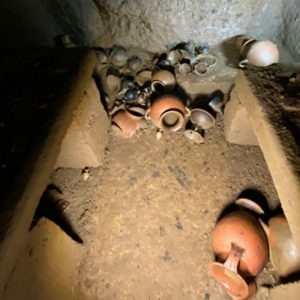
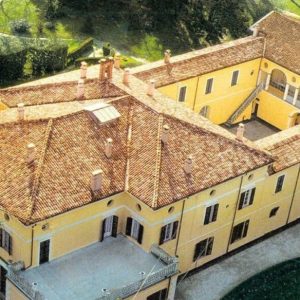
The frescoes were removed from the tomb shortly after their discovery by Prince Alessandro Torlonia, on whose land Vulci lay, and transferred to the Torlonia collection in Rome. Since 1946 they had been stored at the private Villa Albani, accessible to the public only on rare occasions during temporary exhibitions. Some ceramic vessels from the tomb passed into other collections; several are now in the British Museum.
To mark the acquisition, the exhibition opening at Villa Giulia on 25 June will draw on exceptional loans from some of the world’s most prestigious institutions to reconstruct the original context of the monument. The Louvre, the British Museum, the Royal Museum of Art and History in Brussels, the Cantonal Museum of Archaeology and History in Lausanne, the Vatican Museums and the German Archaeological Institute in Rome have all contributed loans of artefacts, documents, historic copies and works connected to the tomb or its collecting history.
Giuli described the François Tomb as “a testimony to the identity of Etruscan civilisation and the central role it played in the cultural formation of ancient Italy.” He added that the acquisition confirms the ministry’s commitment to investing in the protection, valorisation and public accessibility of cultural heritage.
The National Etruscan Museum of Villa Giulia, located near the Villa Borghese park in Rome, is Italy’s principal institution devoted to Etruscan civilisation.