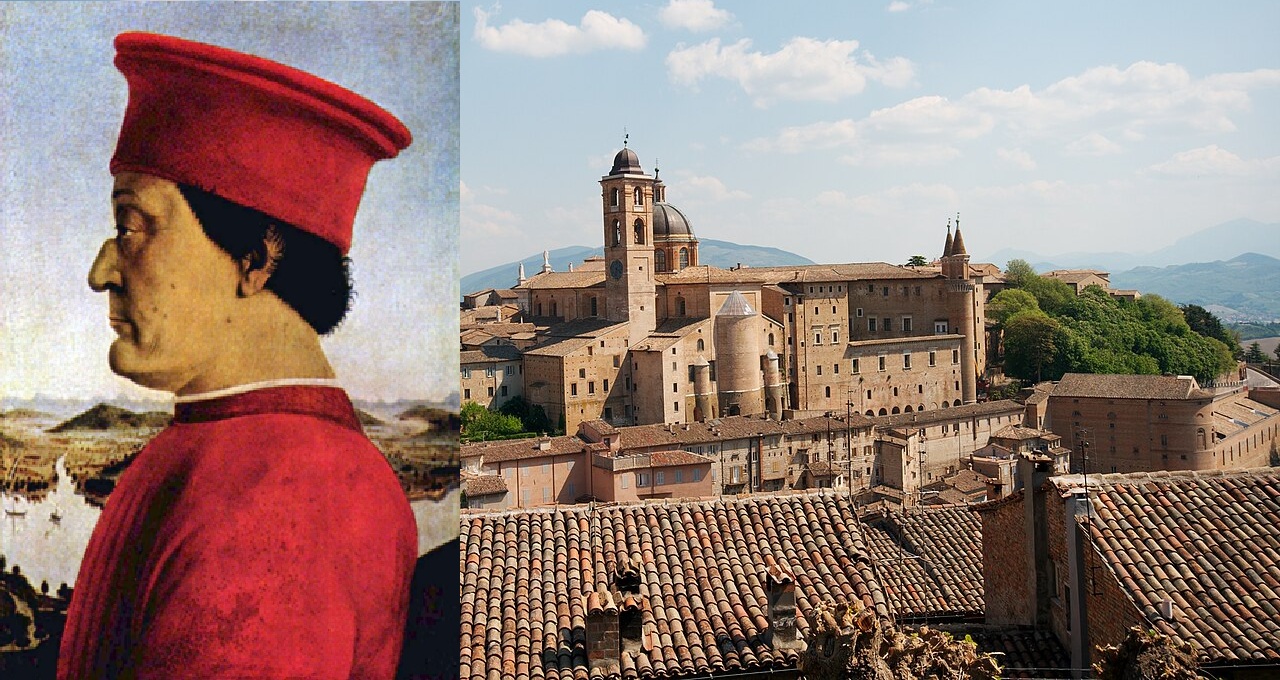
Born on 7th June 1422 in Gubbio, Federico da Montefeltro was the most celebrated condottiere of his age. He was a mercenary commander of formidable military skill who used the profits of war to create one of the finest courts of the Italian Renaissance at Urbino.
Federico was the illegitimate son of Guidantonio da Montefeltro, Count of Urbino, and was born in Gubbio on 7 June 1422. He was sent as a boy to be educated at the celebrated court of Gianfrancesco Gonzaga in Mantua. There he received both a humanist education and military training — a combination that would define his life. He learned the art of war under the condottiere Niccolò Piccinino, and showed an early aptitude for command.
His path to power was not straightforward. When his half-brother Oddantonio, who had inherited the rule of Urbino, was assassinated in 1444, Federico stepped into the breach. He was accepted by the people of Urbino as their new lord, and proved from the outset a very different ruler from his predecessor.
The art of war for hire
Federico’s genius lay in warfare, and he marketed it with extraordinary commercial success. As a condottiere — a professional mercenary commander — he served at various times the papacy, Naples, Milan and Florence. He won almost every engagement he fought.
He lost his right eye and the bridge of his nose in a tournament in 1450, an injury that is immortalised in the famous profile portrait by Piero della Francesca. It is one of the most recognisable images of the Italian Renaissance. Federico is depicted always from the left, his damaged right side turned away from the viewer.
Pope Sixtus IV awarded him the title of Duke of Urbino in 1474, in recognition of his military services to the papacy. He was also made a Knight of the Garter by Edward IV of England and a Knight of the Ermine by the King of Naples — an exceptional accumulation of honours for a ruler of a relatively small state.
Patron and builder
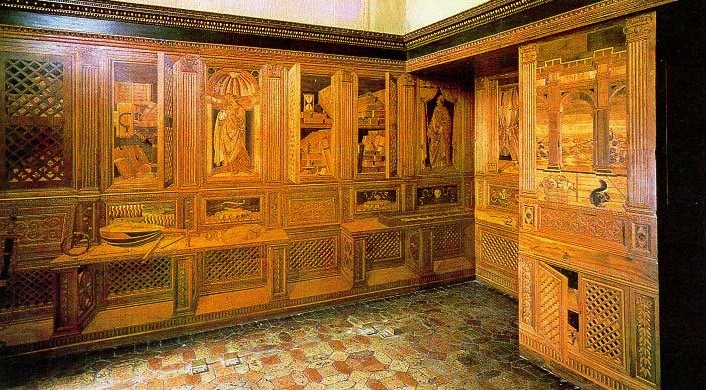
What distinguished Federico from many of his contemporaries was the use to which he put his considerable earnings from war. Urbino, under his rule, became one of the most cultivated courts in Europe. He commissioned the building of the Palazzo Ducale which remains one of the great architectural achievements of the fifteenth century. Its studiolo, a small private study inlaid with breathtaking intarsia woodwork depicting books, instruments and objects of learning, is among the most celebrated interiors of the Renaissance.
Federico assembled one of the finest libraries in Italy. He employed agents across Europe to acquire manuscripts, and kept a team of scribes permanently at work producing new copies. He refused, it was said, to own a printed book — only manuscripts were worthy of his shelves. The library was later absorbed into the Vatican collections, where much of it remains.
Among the artists he patronised were Piero della Francesca, Melozzo da Forlì, Paolo Uccello and the Flemish painter Joos van Gent. The court at Urbino attracted humanist scholars, musicians and architects. Federico himself was renowned for his accessibility, he was said to walk freely among his subjects and to eat in public with his courtiers.
Federico da Montefeltro died on 10 September 1482 in Ferrara, aged sixty, while on campaign. He was succeeded by his son Guidobaldo, whose court — described in Baldassare Castiglione’s Il Cortegiano — became the defining image of Renaissance courtly civilisation.

![The Battle of Molinella - La battaglia della Riccardina [1467]. Affresco nel Castello di Malpaga, già di Bartolomeo Colleoni. By Giorces - Own work, CC BY-SA 2.5 it, https://commons.wikimedia.org/w/index.php?curid=770054](https://italynews.online/wp-content/uploads/2025/07/960px-Malpaga5-300x300.jpg "On This Day in History: The Battle of Molinella, 1467")