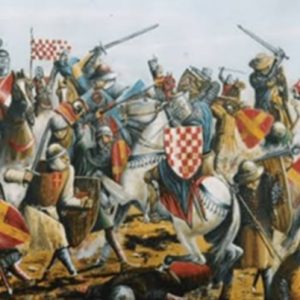
![The Battle of Molinella - La battaglia della Riccardina [1467]. Affresco nel Castello di Malpaga, già di Bartolomeo Colleoni. By Giorces - Own work, CC BY-SA 2.5 it, https://commons.wikimedia.org/w/index.php?curid=770054](https://italynews.online/wp-content/uploads/2025/07/960px-Malpaga5.jpg)
The Battle of Molinella, in 1467, was Italy’s first battle with gunpowder weapons. It marked a turning point in warfare and regional politics.
On 25 July 1467, the plains near the village of Molinella in Emilia-Romagna became the site of a historic and bloody confrontation. Known as the Battle of Molinella, it was the first significant engagement on Italian soil in which gunpowder artillery played a decisive role.
Though the battle ended inconclusively in military terms, it had lasting implications for both warfare and the balance of power among the Italian states of the Renaissance.
Power struggles and mercenaries
In the mid-15th century, Italy was a fragmented peninsula, with powerful city-states and regional powers constantly manoeuvring for influence and territory. These included the Duchy of Milan, the Republic of Florence, the Republic of Venice, the Papal States, and the Kingdom of Naples.
The conflict at Molinella was sparked by growing tension between the Duchy of Milan, then under the de facto control of Bartolomeo Colleoni, one of Italy’s most famous condottieri (mercenary commanders), and a league of forces led by Florence, allied with Naples and Bologna. Colleoni had long served Venice, but he also had ambitions of greater political power. In 1466, he began military operations against the territories of Milan, prompting a broader conflict.
The Republic of Florence, under the political influence of the Medici family, feared Colleoni’s expansion would destabilise northern Italy. Florence, Naples, and the Papal States formed a league and raised their own armies, led by another renowned condottiero, Federico da Montefeltro, Duke of Urbino.
Also read: Guidobaldo, Duke of Urbino
The Battle
The two forces met at Molinella on 25 July 1467. Colleoni’s army, largely made up of Venetian forces and his personal mercenaries, faced Montefeltro’s coalition of Florentine, Neapolitan, and Papal troops. The total number of men on both sides is estimated to have exceeded 20,000.
What made this battle extraordinary was the scale and use of gunpowder weaponry, including early field artillery and arquebuses. While previous Italian battles had seen limited use of firearms, Molinella marked the first time they were integrated into battlefield strategy on a significant scale.
Despite the introduction of this new technology, the battle was still largely fought by cavalry and infantry using traditional weapons. However, the noise, smoke, and destructive power of the guns left a lasting impression and signalled a shift in how wars would be fought in the coming decades.
The fighting was intense and lasted for most of the day. While no side emerged with a decisive victory, Colleoni’s army ultimately retreated, having failed to secure a strategic advantage.
Casualties and aftermath
Estimates suggest that around 600 men were killed and many more wounded. In the context of Renaissance warfare, where battles often resulted in relatively few deaths due to the practice of ransoming captured nobles, this was a substantial loss and contributed to the battle’s notoriety.
In the political aftermath, the lack of a clear victor allowed the existing balance of power to remain largely intact. However, it confirmed the effectiveness of gunpowder weapons and signalled the decline of the heavily armoured knight as the dominant force in battle.
Though Colleoni continued to wield influence, he never fully achieved his ambitions of independent rule. Federico da Montefeltro, meanwhile, emerged with an enhanced reputation and would go on to play a prominent role in Italian politics and warfare.
Legacy of the Battle of Molinella
The Battle of Molinella is often overshadowed by larger and more decisive conflicts of the Italian Wars that followed later in the 15th and 16th centuries. Yet its historical significance is considerable.
It represented a turning point in military history: the dawn of modern warfare in Italy, where the power of gunpowder began to eclipse the age of chivalry. It also revealed the complexities of Italian politics, where city-states relied on professional armies and shifting alliances rather than national unity or ideological causes.