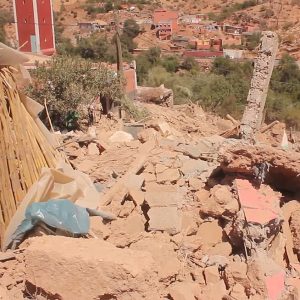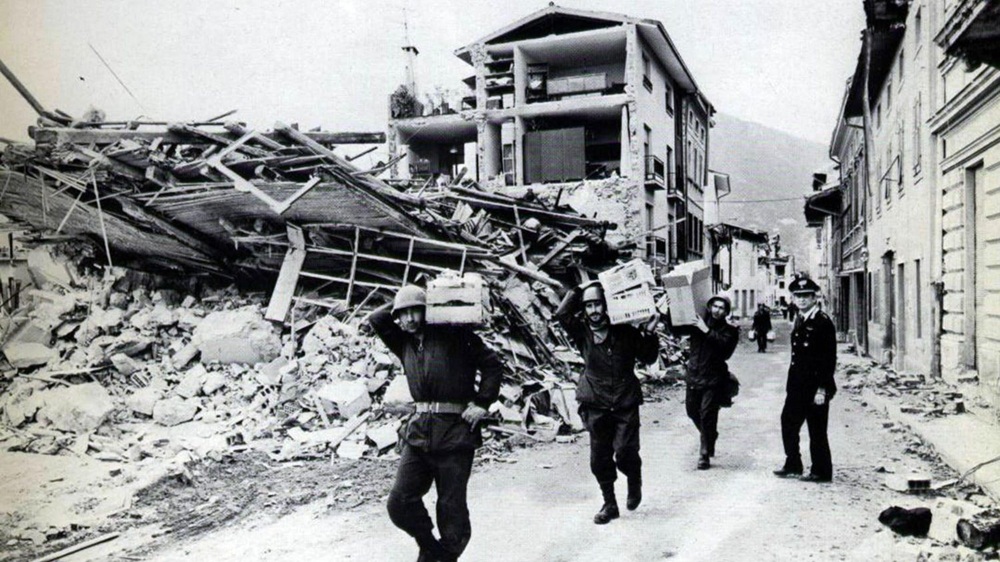
Speaking in Gemona, close to the epicentre of the 1976 quake that killed nearly a thousand people, Italy’s president called for disaster prevention to be a priority for authorities. The majority of Italy faces significant geological or environmental risk.
At 9.06 on the evening of 6 May 1976, the earth moved beneath the Friuli region of northeastern Italy. The earthquake, which reached magnitude 6.5, killed 990 people, injured 30,000 more and left over 157,000 homeless in one of the deadliest natural disasters in post-war Italian history. Entire villages were flattened. The historic town of Gemona del Friuli, close to the epicentre, was devastated; its medieval cathedral reduced to rubble, its streets buried under collapsed masonry.
Fifty years on, President Sergio Mattarella travelled to Gemona to mark the anniversary. His message went beyond commemoration.
Prevention not just response
“We must not limit ourselves to mitigating the effects of natural disasters, but must, as far as possible, prevent them,” Mattarella said. The distinction matters. Italy has a long and painful history of responding to natural disasters after the fact but a more troubling record when it comes to the sustained investment in risk reduction, building standards and land management that prevention requires.
Friuli itself became something of a model for post-disaster reconstruction in Italy. Unlike the slow and corruption-plagued rebuilding that followed other Italian earthquakes, the region’s recovery in the late 1970s and 1980s was widely praised for its speed, community involvement and respect for local architectural heritage. That example, Mattarella implied, should be a template not only for recovery but for the preparatory work that makes recovery less necessary.
The president also used the occasion to invoke a broader principle of national solidarity, linking it to the 80th anniversary of the 1946 referendum that established the Italian Republic. “On the 80th anniversary of the vote that established the Republic, today, here in Gemona, in the setting of the regional council, we reaffirm our commitment to never be led astray from the values of solidarity and cohesion that were embodied here,” he said.
A country on the edge
Mattarella’s call for disaster prevention carries particular weight in a country where the scale of geological and environmental vulnerability is extraordinary. According to data from ISPRA, Italy’s Institute for Environmental Protection and Research, more than 93% of Italian municipalities are exposed to at least one category of significant natural risk. This could be in the form of seismic activity, landslide, flooding, coastal erosion or volcanic hazard.
Italy sits at the meeting point of the Eurasian and African tectonic plates, generating seismic activity across much of the peninsula and its islands. The Apennine mountain chain that runs the length of the country is geologically young and inherently unstable. Centuries of deforestation, inappropriate building and unchecked urban expansion onto flood plains and hillsides have compounded the natural hazards considerably.
History of natural disasters
The human cost is correspondingly high. The 1976 Friuli earthquake was preceded by the 1968 Belice earthquake in Sicily, which killed over 300 people, and followed by a succession of devastating events: the 1980 Irpinia earthquake, which killed nearly 3,000; the 2009 L’Aquila earthquake, which killed 309; the 2012 Emilia quakes, which killed 27; and the catastrophic 2016 Central Italy sequence, which killed nearly 300 people across Lazio, Umbria and Le Marche and destroyed communities that are still rebuilding today. Flooding and landslides claim lives every year, particularly in the south and in mountain regions where hydrogeological instability is acute.
This year, Italy has suffered from numerous landslides which have caused havoc with transport links and seen a Sicilian town teetering on the edge of a cliff.
Italy spends billions each year in emergency response and post-disaster reconstruction. The persistent argument of urban planners, geologists and civil protection experts is that a fraction of that expenditure, invested systematically in prevention, seismic retrofitting of existing buildings and rigorous enforcement of planning regulations, would save both lives and money on a significant scale. The political will to sustain disaster prevention investment across electoral cycles has historically proved elusive.