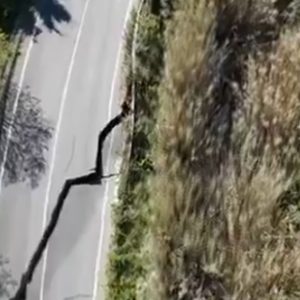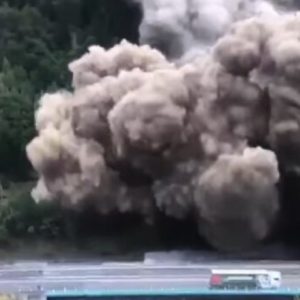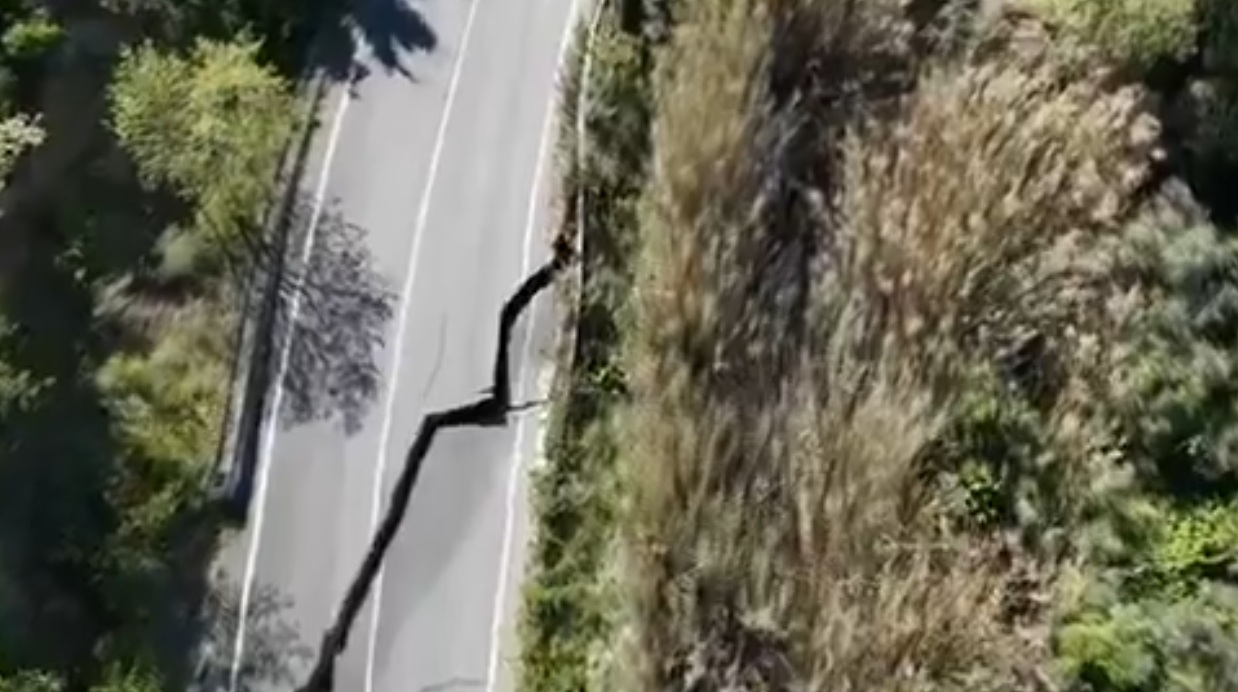
Two days after one of Europe’s largest landslides brought Italy’s main north-south Adriatic corridor to a standstill, motorists can once again travel through Molise on the A14. However, the railway line remains shut and the work of recovery is far from over.
A section of Italy’s A14 Adriatic motorway has partially reopened following the emergency closure triggered by the reactivation of the historic landslide at Petacciato on Tuesday, 7 April. Motorway operator Autostrade per l’Italia (ASPI) announced that the sections between Vasto Sud and Termoli in the direction of Bari, and between Poggio Imperiale and Vasto Sud in the direction of Pescara, had reopened shortly before 12:15 on Thursday.
The reopening was achieved not through full restoration of the damaged carriageway, but through the installation of a contraflow diversion lane along the northbound carriageway. This allows one lane of traffic in each direction, towards both Pescara and Bari. ASPI confirmed that since Wednesday, over 100 personnel and 40 company vehicles had been deployed around the clock, including overnight shifts, to carry out the restoration and safety works that made the partial reopening possible.
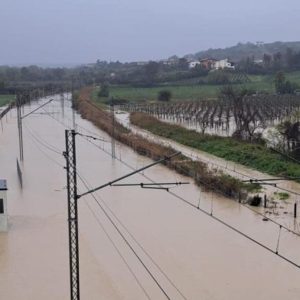
The Adriatic railway line, however, remains closed. Trenitalia has announced that some rail services on the Adriatic line will progressively resume from Friday, 10 April, though with speed restrictions in place.
The initial prognosis revised
The speed of the partial road reopening represents a significant departure from the timeline that authorities had outlined in the first hours of the crisis. When the landslide reactivated on Tuesday, Civil Protection chief Fabio Ciciliano had warned starkly that repairs would take weeks, if not months, and that nothing could be done until the ground stopped moving.
Speaking to Corriere della Sera on Thursday, Ciciliano revised that assessment substantially. “The latest geotechnical evaluations are showing that in practice the landslide is not moving and this allows us to make precise decisions about even a partial reopening of the motorway and railway. Fortunately, we have to revise the initial scenario, which forecast closures for weeks if not months. And this is a first piece of good news.”
The stabilisation of the landslide front, monitored continuously by sensors installed on both the road surface and the underlying terrain, was the essential precondition for any infrastructure work to begin. With movement effectively halted, engineers and technicians were able to carry out the inspections and safety works needed to restore at least limited passage.
Government funding unlocked
The reopening comes alongside a government pledge to release emergency funding for the wider recovery. Sources at Palazzo Chigi confirmed that the government would adopt a measure on Thursday for a first allocation of resources aimed at restoring the railway network, the A14 motorway and State Road 16. The decision was reached at a second emergency videoconference, following the morning meeting between Prime Minister Meloni, Infrastructure Minister Matteo Salvini, Defence Minister Guido Crosetto and Civil Protection chief Ciciliano.
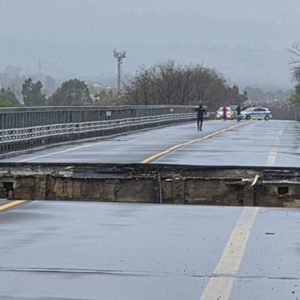
The SS16 Adriatica state road remains impassable in the section directly affected by the landslide, and the collapse of the Trigno bridge continues to sever the Abruzzo-Molise border road connection.
Economic impact
Ciciliano flagged that concerns over the tourism impact of an extended closure are legitimate. “A prompt reopening of traffic could mitigate what would otherwise be a devastating effect on tourism,” he said. “The beach season could be compromised by the state road closure: alternative local routes will need to be found, even if the resumption of regional and Intercity trains will bring important benefits.”