The Italian premier has shared a manipulated image of herself to highlight the dangers of AI-generated disinformation, warning that while she has the means to defend herself, most people do not.
Giorgia Meloni took to social media this week to sound the alarm about the growing threat of AI-generated deepfakes. She shared a fabricated image itself, where her face had been superimposed onto a woman’s body clad in underwear.
A social media user named Roberto had commented on the image calling it “shameful” that a prime minister should present herself in such a state, apparently unaware that the photograph was a fabrication.
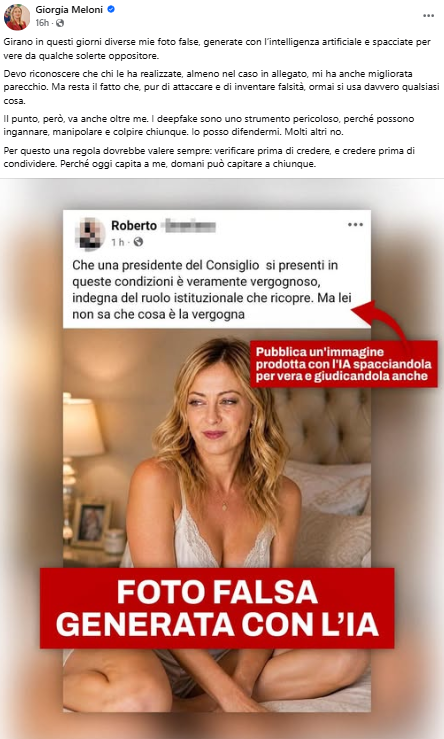
This is Meloni’s message translated into English.
“Several fake photos of me have been circulating these days, generated with artificial intelligence and passed off as real by some diligent opponents.
“I must admit that whoever created them, at least in the case attached, has also improved me considerably. But the fact remains that, in order to attack and invent falsehoods, people are now using anything and everything.
“The point, however, goes beyond me. Deepfakes are a dangerous tool because they can deceive, manipulate, and harm anyone. I can defend myself. Many others cannot.
“This is why one rule should always apply: verify before believing, and believe before sharing. Because today it happens to me, tomorrow it could happen to anyone.”
Not the first time for Meloni
This is not the first time Meloni has been the subject of this kind of manipulation. In 2024, a father and son from Sardinia were prosecuted for creating and distributing pornographic deepfake videos featuring her likeness. The case drew significant public attention and helped accelerate Italy’s legislative response to AI-generated content.
More recently, a fabricated video circulated in which she appeared to snub Israeli prime minister Benjamin Netanyahu at the United Nations General Assembly in New York. Last month she was also at the centre of a false story built around an old photograph from two decades ago, in which a man was misidentified as her estranged father whom she has not seen since childhood. The man in the image was in fact Marco Squarta, a member of her own Fratelli d’Italia party, who announced his intention to pursue legal action. Meloni’s reaction on social media at the time was characteristically terse: “We’re not even in the mud anymore. We’re at the cabaret.”
Political solidarity with caveats
The latest episode drew expressions of support from across the political spectrum. Senator Alessandra Maiorino of the opposition Movimento 5 Stelle called for mandatory digital identity regulations, arguing that the web “cannot remain the unregulated jungle it is now”. She also warned that “the most vulnerable always suffer first: minors and women.” Coalition members Simonetta Matone of the Lega and Mariastella Gelmini of Noi Moderati also voiced solidarity with the premier.
The sharpest response, however, came from Partito Democratico deputy Anna Ascani, who drew a pointed distinction between sympathy for Meloni personally and satisfaction with the government’s legislative record. While acknowledging that Italy introduced a criminal offence for the illicit distribution of AI-generated content in September 2025, Ascani noted that the government had rejected a PD bill that would have required platforms to remove such material rapidly. The issue, she said, “concerns everyone and is in everyone’s interest”.
AI regulation in Italy
Italy moved early on AI regulation. Last September it became the first EU member state to enact comprehensive legislation aligned with the bloc’s Artificial Intelligence Act. The Act introduced requirements for human oversight, traceability of AI decisions, and, crucially for the current debate, tough penalties for the distribution of harmful deepfakes. Under that legislation, spreading AI-generated content that causes harm carries a prison sentence of up to five years.
The law places Italy ahead of most European peers in formal legal terms. But as Ascani’s criticism suggests, the gap between legislation and enforcement remains a live political dispute. Meloni’s post this week illustrated both the scale of the problem and the limits of the remedy currently on offer.
ItalyNews.Online covers Italian politics, society, and culture for an international readership.