
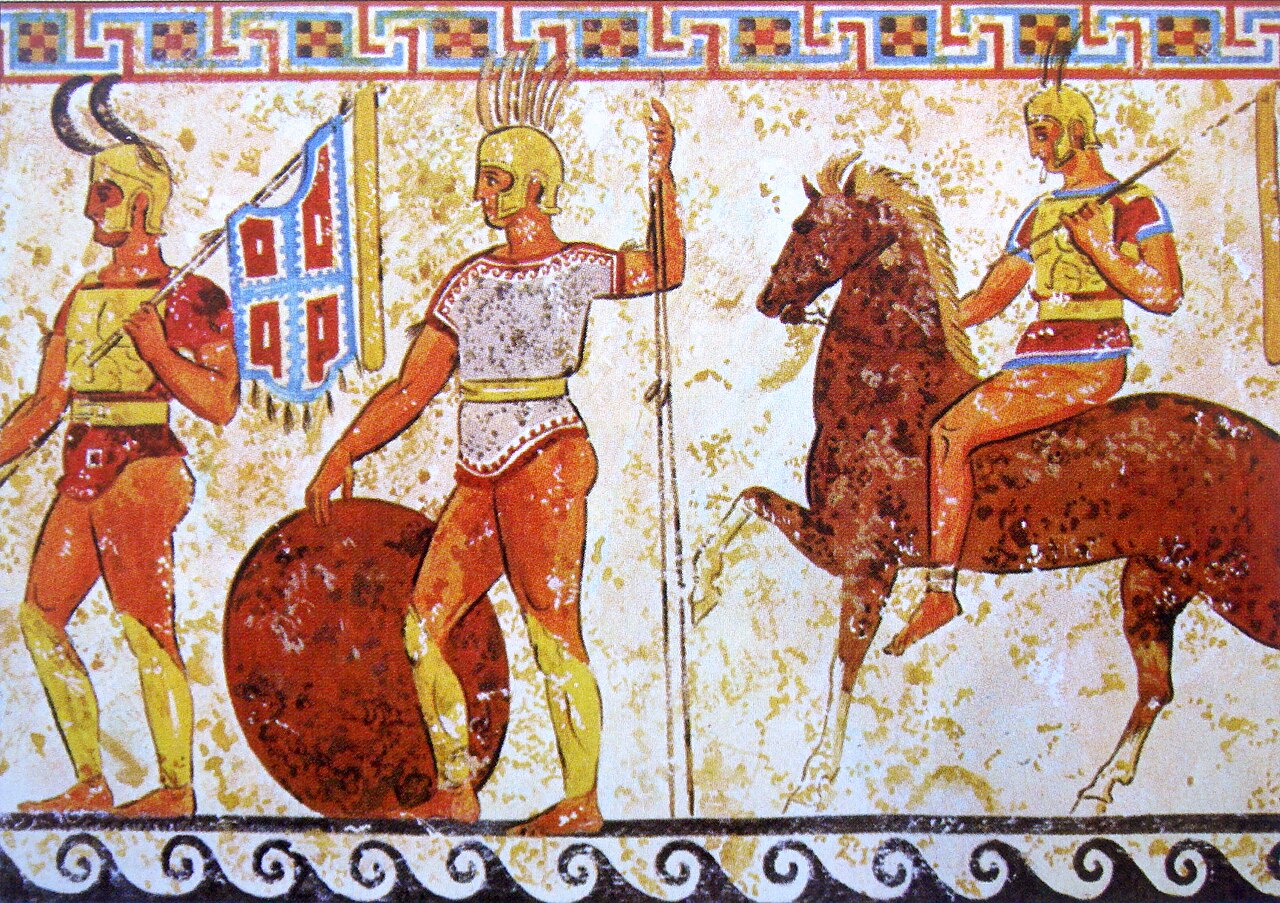
Long before the Roman Empire dominated the Mediterranean, the Roman Republic fought a series of conflicts that would determine its control of the Italian peninsula. Among the most decisive were the Samnite Wars, a set of three major wars fought between Rome and the Samnites during the fourth and early third centuries BC.
These wars transformed Rome from a regional power in central Italy into the dominant force on the peninsula, laying the foundations for the later expansion of the Roman Empire.
Who were the Samnites?
The Samnites were a confederation of Italic tribes who lived in the mountainous interior of southern and central Italy, particularly in the region known in antiquity as Samnium, covering parts of modern-day Molise, Campania, Abruzzo and Apulia.
They spoke the Oscan language and were known for their warrior culture and highly mobile infantry forces. Their society was organised around tribal communities rather than a single centralised state, but they were capable of forming powerful alliances during times of conflict.
From the fourth century BC, Samnite influence expanded westwards into the fertile plains of Campania, bringing them into direct competition with Rome.
The First Samnite War (343–341 BC)
The First Samnite War began when the wealthy Campanian city of Capua sought Roman assistance against Samnite expansion.
Rome intervened, defeating Samnite forces in several engagements. However, the conflict was relatively brief and ended with a negotiated peace. Soon afterwards, Rome became embroiled in another major conflict known as the Latin War.
Although short-lived, the first war marked the beginning of a long rivalry between the two powers.
The Second Samnite War (326–304 BC)
The Second Samnite War proved far more serious and lasted more than two decades. The conflict was triggered by Rome’s growing influence in Campania and the establishment of Roman colonies in areas the Samnites considered within their sphere of influence.
One of the most famous events of the war occurred in 321 BC at the Battle of the Caudine Forks. Samnite forces trapped a Roman army in a narrow mountain pass and forced the soldiers to surrender. The defeated Romans were compelled to march beneath a yoke in a humiliating ritual of submission — one of the most humiliating moments in Roman military history.

Despite this setback, Rome gradually adapted its tactics and strategy. The Roman army abandoned the rigid Greek-style phalanx formation and developed the more flexible manipular system that would later characterise Roman warfare.
After years of campaigning, Rome eventually regained the upper hand, and the war ended in 304 BC with the Samnites weakened but not fully defeated.
The Third Samnite War (298–290 BC)
The final phase of the struggle began when the Samnites formed a broad coalition against Rome that included the Etruscans, Umbrians and Gallic tribes. This alliance represented the greatest threat Rome had yet faced in Italy.
The decisive moment came in 295 BC at the Battle of Sentinum in central Italy. Roman forces defeated the coalition army in one of the largest battles fought on the peninsula up to that time. Following further campaigns, the Samnites were finally subdued in 290 BC.
Rome’s victory effectively ended large-scale resistance to Roman expansion in central Italy.
Why the Samnite Wars mattered
The Samnite Wars were a turning point in Roman history. By defeating the Samnites and their allies, Rome gained control of most of the Italian peninsula and established a network of alliances and colonies that secured its dominance in the region.
The conflicts also forced Rome to reform its military organisation, creating the adaptable army structure that later allowed it to defeat major Mediterranean powers such as Carthage.
In many ways, the Samnite Wars were Rome’s proving ground; the moment when the Republic developed the military strength, political organisation and strategic outlook that would eventually support the creation of a vast empire.
For many historians, these wars mark the beginning of Rome’s transformation from a regional Italian city-state into the power that would ultimately dominate the ancient Mediterranean world.

![The Battle of Molinella - La battaglia della Riccardina [1467]. Affresco nel Castello di Malpaga, già di Bartolomeo Colleoni. By Giorces - Own work, CC BY-SA 2.5 it, https://commons.wikimedia.org/w/index.php?curid=770054](https://italynews.online/wp-content/uploads/2025/07/960px-Malpaga5-300x300.jpg "On This Day in History: The Battle of Molinella, 1467")

