On 11 June 1289, two armies met on a Tuscan plain and fought a battle whose consequences would shape the Italian Renaissance. The horrors of the Battle of Campaldino would find their way into one of the greatest poems ever written.
The Battle of Campaldino was fought between the Guelph forces of Florence and the Ghibelline army of Arezzo on the plain of Campaldino in the Casentino valley of eastern Tuscany, roughly halfway between the two rival cities. The outcome was decisive: a crushing Florentine victory that ended Arezzo’s aspirations of regional dominance and established Florence as the supreme economic and military power in central Italy.
The foundations of the Italian Renaissance were laid, in part, on this battlefield.
Guelphs and Ghibellines
The conflict between the two factions was not simply an Italian affair. Its roots lay in Germany, in the struggle for imperial control between the House of Welf and the House of Hohenstaufen. When Hohenstaufen emperors — most notably Frederick Barbarossa and his grandson Frederick II — marched armies into northern Italy to reassert imperial authority over wealthy, semi-independent cities, they forced local populations to take sides. Those who welcomed imperial order backed the Hohenstaufens; those who resisted rallied to the Welfs. On Italian lips, the battle cries of the rival houses — Hie Welf! and Hie Waiblingen! — evolved into Guelph and Ghibelline.
The papacy, which controlled a vast swathe of central Italy through the Papal States, saw the Holy Roman Empire as an existential threat and backed the Guelphs. Italian city-states then weaponised these allegiances for their own purposes: if one city declared itself Ghibelline, its nearest rival would immediately declare for the Guelphs and claim papal support. Florence aligned against Ghibelline Siena and Ghibelline Arezzo. The labels hardened into identity long after the original German dynastic struggle had been resolved.
The Battle of Campaldino
By the late 1280s, Florence was expanding up the Arno valley to feed its growing population, directly threatening Arezzo’s trade routes and regional influence. After Arezzo expelled its Guelph residents in 1287 and the two sides exchanged raids, full-scale war became inevitable.
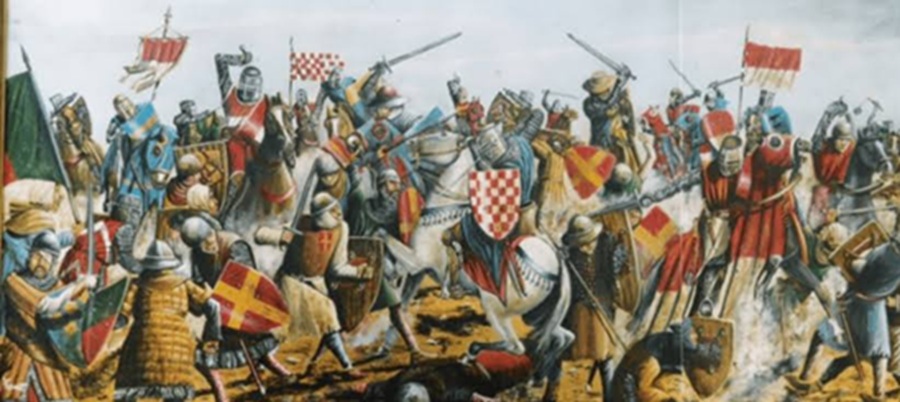
Florence assembled a coalition force from Pistoia, Lucca, Siena and Prato, commanded by the professional condottiero Amerigo di Narbona and his French military adviser Guillaume de Durfort. They numbered around 12,000 against the Aretine force of some 10,800 led by Bishop Guglielmino degli Ubertini and Bonconte da Montefeltro. Campaldino was also one of the last occasions when Italian city militias contested a pitched battle; the 14th century would see the rise of mercenary condottieri as the dominant military force
The fighting on the Campaldino plain between Pratovecchio and Poppi lasted several hours before a major storm struck. By the time it ended, roughly 1,700 Ghibelline soldiers lay dead. Another 2,000 had been taken prisoner. Florentine losses stood at around 300.
The poet in the cavalry
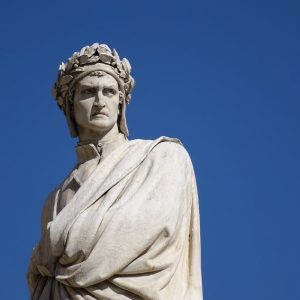
Among the Guelph forces that day was a 24-year-old Florentine cavalry scout – Dante Alighieri. Dante appears to have come through unscathed where others died or suffered severe wounds, but the memory of Campaldino lived with him and surfaces at various points in the Divine Comedy. The most horrific scenes in the poem — the gluttons slogging through muck, surrounded by dismembered bodies and filth — are thought to recall Dante’s experience with the looting of the bloated, rain-soaked bodies of the dead at Campaldino.
Most strikingly, he places Bonconte da Montefeltro — the Ghibelline commander slain at Campaldino, whose body was never recovered — not in Hell but in Purgatory, where the two men speak in the poem. Some over-excited commentators have even hypothesised that Dante might have killed Bonconte in single combat. However, this is considered highly improbable.
The irony of Campaldino is that it ultimately destroyed Dante personally. After the Guelph victory, Florence’s ruling factions turned on each other, splitting into White and Black Guelphs. Dante, a White Guelph, found himself on the losing side. When the Black Guelphs seized power in 1302, he was sent into permanent exile. It was in exile that he began writing the Divine Comedy.
![The Battle of Molinella - La battaglia della Riccardina [1467]. Affresco nel Castello di Malpaga, già di Bartolomeo Colleoni. By Giorces - Own work, CC BY-SA 2.5 it, https://commons.wikimedia.org/w/index.php?curid=770054](https://italynews.online/wp-content/uploads/2025/07/960px-Malpaga5-300x300.jpg "On This Day in History: The Battle of Molinella, 1467")