A deliberate ramming attack on a busy shopping street in the northern Italian city of Modena on Saturday left eight people injured, two of them requiring leg amputations. Investigators rule out terrorism and point to a history of psychiatric illness in the 31-year-old suspect.
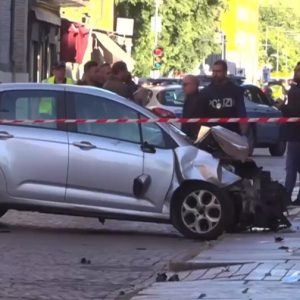
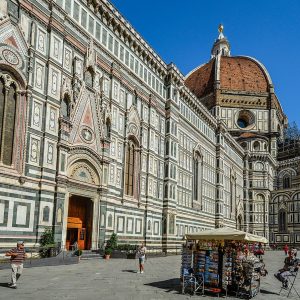
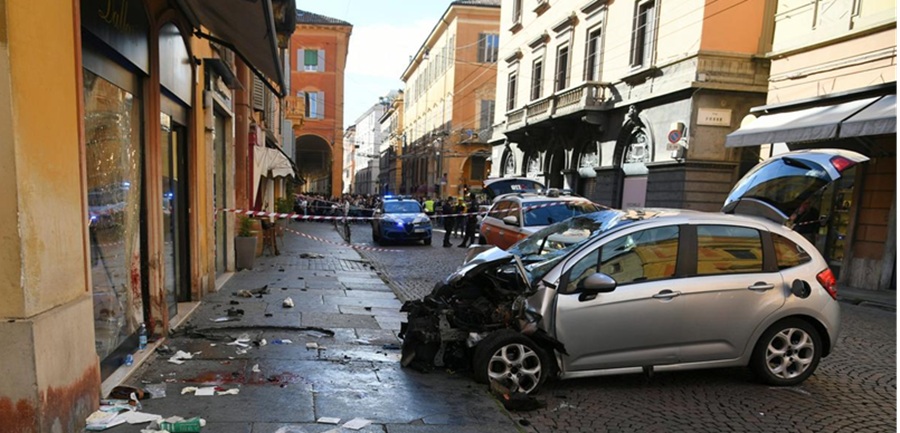
At approximately 16:30 on Saturday, a grey Citroën C3 drove at high speed — estimated at around 100 km/h — along Via Emilia, one of Modena’s main thoroughfares in the shadow of the city’s iconic cathedral. The vehicle first struck a cyclist on the road before mounting the pavement and ploughing into a group of pedestrians with sufficient force to throw people into the air. The car then crossed to the opposite side of the road before crashing into a shop window, crushing a woman against it.
According to Modena’s public prosecutor, two victims had to have their lower limbs amputated due to the violent impact of the car, one of whom remains in a life-threatening condition. The two women, aged 55 and 69, are among eight people taken to hospital in serious condition. A 53-year-old woman and the 69-year-old are being treated at Modena’s Baggiovara hospital, while the 55-year-old, the most critically injured, was airlifted to the Maggiore hospital in Bologna. Three other people, aged 27, 47, and 71, are being treated at Modena’s Policlinico with less serious injuries.
The suspect and the knife attack
After the car came to a halt, the driver emerged and attempted to flee on foot. He targeted three men who moved to block him, brandishing a knife. One of those who intervened, Luca Signorelli, told Italian media he had gone to help a woman when he noticed the driver trying to escape. He gave chase and was struck on the head and chest before he and other passers-by managed to subdue the attacker and hold him until police arrived.
Thousands of people gathered in Modena’s Piazza Grande on Sunday in a show of solidarity with the victims, after the mayor called for a public gathering against those who “sow hatred”.
The suspect: an Italian citizen with a psychiatric history
The driver has been identified as Salim El Koudri, a 31-year-old Italian citizen of Moroccan heritage, born in Bergamo and resident in the province of Modena. He is an economics graduate with no prior criminal record who had been through a period of psychological disturbance in 2022. Modena’s prefect confirmed he had been referred to a mental health centre that year for schizoid disorders, but had subsequently “disappeared from the radar”. He was not under any active treatment or supervision at the time of the attack.
At the time of his arrest, El Koudri was not found to be under the influence of psychotropic substances and appeared to be lucid. Italy’s Interior Minister Matteo Piantedosi said the suspect was not believed to have acted for terrorist motives and was dealing with mental health issues. The investigators echoed this position formally excluding terrorism as a factor.
El Koudri has been issued a detention order and is charged with assault and causing grievous bodily harm. Prosecutors noted that the chosen time of the attack, peak shopping hours, demonstrated clear intent to endanger public safety.
Meloni and Mattarella visit the hospital
Prime Minister Giorgia Meloni cut short her attendance at the Europe Gulf Forum in Greece to travel to Modena on Sunday. She and President Sergio Mattarella visited the injured at Baggiovara hospital and met Luca Signorelli, the man who intervened to stop the attacker despite being stabbed. Meloni thanked him publicly, writing on X: “What makes an ordinary person heroic is the moment when the heart chooses to do good, even when that involves a risk.”
Political divisions surface
The attack has reignited debate about immigration, despite the fact that El Koudri is an Italian-born citizen. Deputy Prime Minister Matteo Salvini, leader of the anti-immigrant League party, named the suspect on social media and called him a “second-generation criminal”. Salvini’s party, League, argued the incident justified legislation to revoke residency permits for immigrants who commit crimes.
However, speaking on the margins of a Forza Italia regional congress in Calabria on Sunday, Deputy Prime Minister and Foreign Minister Antonio Tajani moved swiftly to counter the narrative being pushed by his coalition partner. When asked about the League’s proposal to strip residence permits from those who commit crimes, Tajani pointed out the fundamental flaw in applying that argument to the Modena case: “Should we take away the residence permits of those who commit crimes? The person involved in yesterday’s event in Modena didn’t have a residence permit. He’s an Italian citizen.”
Modena’s mayor urged residents not to generalise, saying he saw “so much looting on social media” and asking people to reflect on the fact that “foreigners are not all similar to those who committed this act.” The local imam of Ravarino, where El Koudri was living, told the Gazzetta di Modena that he did not know the suspect. However, he does know his father well, describing him as a hard-working and educated man from a well-regarded family.
The most important question would seem to be how someone with apparently serious mental health issues was allowed to “fall off the radar.”