Centuries of superstition, millions of grinding heels, and one lucky bull in need of renovation. The Galleria Vittorio Emanuele II’s most intimate mosaic is back under repair.
Milan has begun restoring the testicles of its famous bull mosaic after tourist enthusiasm for the city’s most unusual good-luck ritual wore the artwork down to a small crater. The restoration work, which started this week in the Galleria Vittorio Emanuele II, is the latest chapter in an ongoing battle between civic heritage and the irresistible human urge to grind one’s heel into a bull’s private parts in the hope of getting rich.
As legend has it, visitors who place their right heel on the bull’s most delicate feature, spin clockwise three times, and make a wish are guaranteed good fortune and assured of returning to Milan. The tradition, popular among Milanese in the 19th century, has since become a fixture of the international tourist itinerary — with predictable consequences for the pink tiles in question. “Thousands of people every day have performed the famous heel-spinning gesture,” city councillors noted in a statement. “The pink tiles that make up its testicles are being worn away.”
Also read: A quick guide to Milan
The bull’s balls are being restored
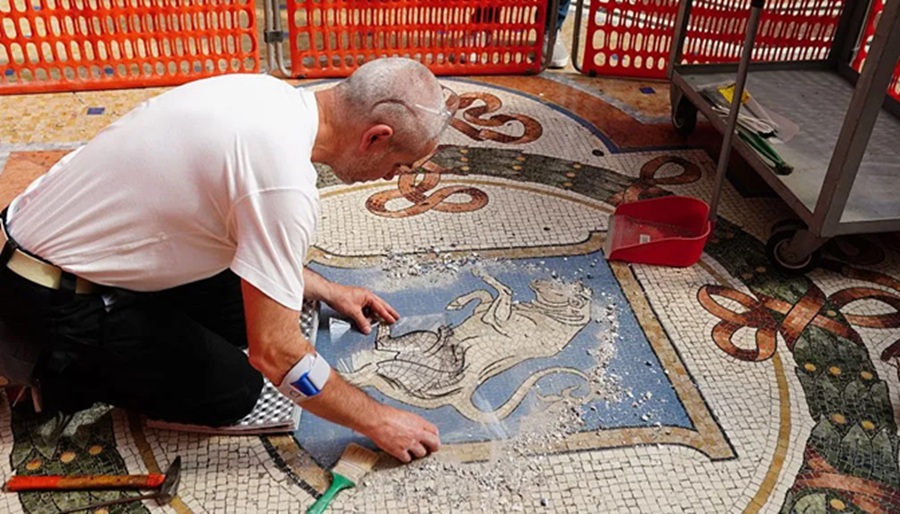
Artisan Gianluca Galli was photographed this week kneeling reverently before the mosaic — not in supplication, but with the rather more practical task of cutting new pieces of stone by hand while curious onlookers peered over the barrier. Of the ritual that has kept him in work, Galli offered a diplomatically balanced assessment to AFP: “It’s probably a charming gesture, but also quite damaging for a work of art.”
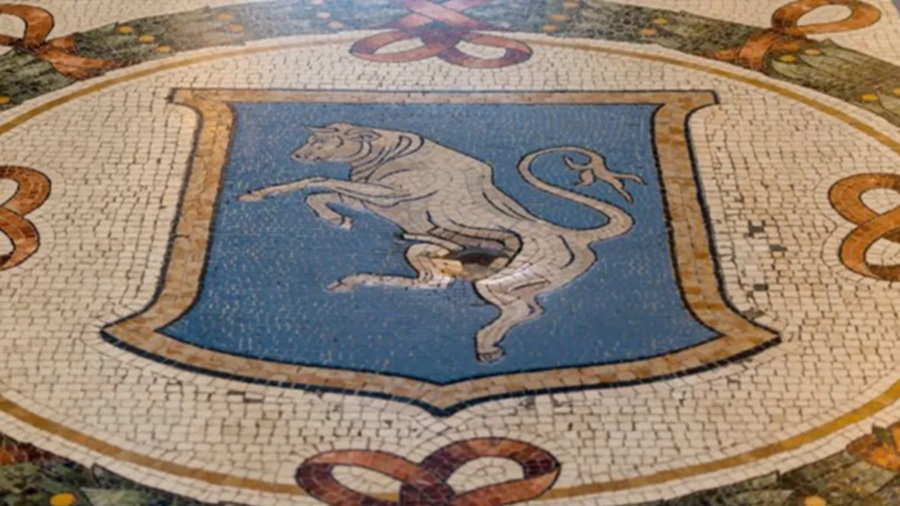
The bull mosaic — a beige and blue depiction of a prancing bull surrounded by a coat of arms — is one of four mosaics representing the original regions of unified Italy. Laid into the floor of the Galleria, the magnificent 19th-century covered arcade that connects Piazza del Duomo with Piazza della Scala, the bull represents Turin, Italy’s first capital. The other cities depicted — Florence, Rome and Milan itself — have largely been spared comparable indignity by posterity.
This is not the bull’s first restoration. City councillors Emmanuel Conte and Marco Granelli noted that the last repair work was carried out in 2017, suggesting that the current rate of attrition gives the mosaic roughly an eight-year lifespan between interventions. At current tourist volumes, it may need to pencil in the next appointment for 2033.
“The Galleria is a living heritage, which can wear away precisely because it is loved and experienced,” the councillors said. “We take care of it so that it continues to be so.” A sentiment the lucky bull, one imagines, would endorse, to a degree.