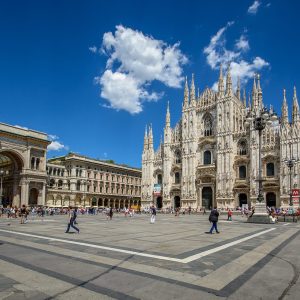
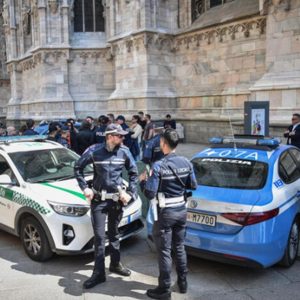
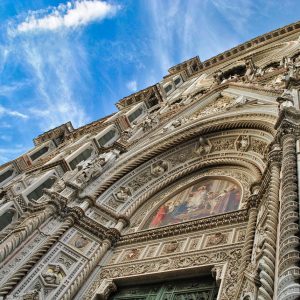
In our quick guide to Milan, we introduce you to a city which is often misunderstood as purely modern, but whose history runs deep and shapes every corner of the city. Founded by the Celts, later expanded by the Romans, Milan grew into a powerful medieval and Renaissance capital. Unlike Rome or Florence, Milan evolved continuously, blending historic authority with commercial ambition and modern design.
Duomo di Milano

The Duomo is Milan’s most recognisable symbol and one of Europe’s largest Gothic cathedrals.
Construction began in 1386 under Gian Galeazzo Visconti and continued for nearly six centuries.
Its white marble façade reflects Milan’s wealth, ambition, and long struggle for political influence.
The cathedral contains over 3,000 statues, making it one of the most decorated churches in the world. A little gruesome, but not to be missed, is the Renaissance statue of St Bartholomew depicted with his flayes skin draped over his shoulders.
Inside, the scale feels vast, with towering columns and dramatic stained-glass windows narrating biblical stories. The rooftop terraces allow visitors to walk among spires and carved figures, not merely observe them. On clear days, views extend across Milan’s rooftops to the Alps beyond.
Opening & practical:
- Cathedral interior open roughly 08:00–19:00, terraces 09:00–19:00 (last entry around 18:30).
- Tickets vary by access choice; terrace access costs extra and is best booked online to avoid queues.
Tip: Visit early or late afternoon for better light and smaller crowds, especially if you want photos of the city from the roof. Dress codes apply inside the cathedral, so shoulders and knees must be covered.
Galleria Vittorio Emanuele II

The Galleria sits beside the Duomo and acts as Milan’s ceremonial living room. Built between 1865 and 1877, it celebrated Italy’s unification and Milan’s rising national status.
Its iron-and-glass roof was revolutionary for its time and remains architecturally impressive today.
Luxury boutiques sit alongside historic cafés, blending commerce with social ritual.
Look down near the central octagon to find the famous bull mosaic. Spinning on its sensitive anatomy is said to bring luck, and locals still participate.
Opening & practical:
- The gallery itself is open 24 hours; shops and cafés mostly 10:00–20:00.
- Entry is free, but luxury shops can make window shopping feel like sightseeing.
Whether or not you buy anything, the Galleria’s architecture and energy make it a must-experience part of Milan.
Castello Sforzesco

Castello Sforzesco began as a 14th-century fortress before becoming a Renaissance court. The Sforza family transformed it into a symbol of ducal power and cultural patronage.
Leonardo da Vinci worked here, contributing to decorative schemes and engineering projects. Over time, the castle shifted from palace to military base, then finally to public museum complex.
Today, it houses several museums covering art, sculpture, musical instruments, and Milanese history. Michelangelo’s final sculpture, the unfinished Rondanini Pietà, remains one of its quiet highlights.
Behind the castle, Parco Sempione opens into green space and walking paths.
Opening & practical:
- Castle grounds are generally open daily.
- Museums inside typically 09:00–17:30, closed Mondays.
Prepare to spend at least 2–3 hours here if you want to explore both museum collections and the surrounding park.
Teatro alla Scala
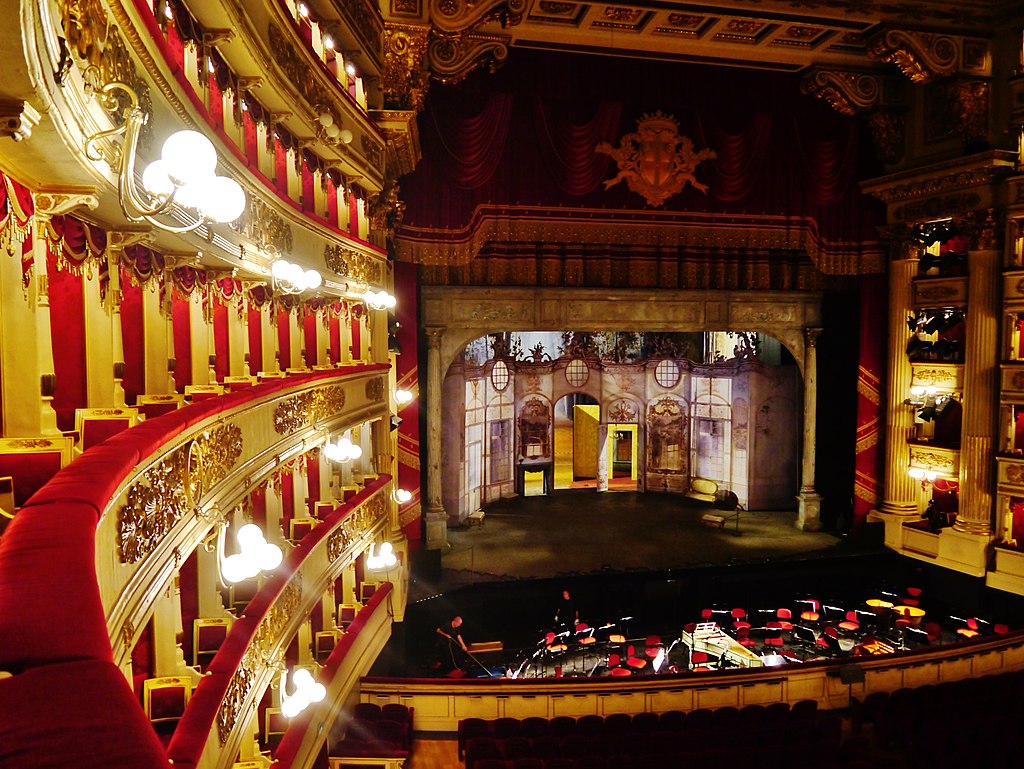
La Scala is more than an opera house; it is a global cultural institution. Opened in 1778, it quickly became Europe’s most influential operatic stage. Composers like Verdi premiered major works here, shaping Italian musical identity. The theatre also played a role in political expression during periods of unrest.
The attached museum offers insight into costumes, instruments, and famous performers. Visitors can sometimes view the auditorium from museum balconies during rehearsals.
Opening & practical:
- Museum often 09:30–17:30, usually closed Mondays.
- Show schedules vary by season; evening performances fill quickly.
Even if you don’t attend an opera, the museum and lobby are worth a brief stop.
Quadrilatero della Moda and Via Montenapoleone

Milan’s fashion district defines the city’s modern global reputation. The Quadrilatero formed naturally around aristocratic palazzi and central trade routes.
Via Montenapoleone anchors the district, lined with flagship stores from Italian and international designers. Fashion here feels institutional rather than trendy, rooted in craftsmanship and legacy.
Window displays receive as much care as museum exhibits.
Opening & practical:
- Shops generally open 10:00–19:30; many close Sundays.
Even if you don’t spend, this area reveals Milan’s global influence on style.
Rooftop Bars and City Views

Milan rewards visitors who look upward in the evening. Rooftop bars combine skyline views with distant mountain silhouettes on clear nights.
These spaces reflect Milan’s understated confidence rather than loud nightlife. They work best for aperitivos and dining, offering atmosphere without chaos.
Popular rooftops cluster near the Duomo and modern districts like Porta Nuova.
The Canals of Navigli

I Navigli is Milan’s historic canal district and one of its most atmospheric neighbourhoods. The area centres on two waterways — the Naviglio Grande and the Naviglio Pavese — remnants of a once‑extensive network that served commerce and transport for centuries. These canals date back to medieval and Renaissance periods, and Leonardo da Vinci contributed to the hydraulic engineering that refined them.
The canals converge at the Darsena, once Milan’s river port and now a restored public space ideal for strolling, people‑watching, or sitting by the water with an aperitivo.
Navigli feels different from the rest of Milan. Here, narrow streets and bridges connect cafés, restaurants, bars, galleries and independent shops. As evening approaches, the canal sides fill with locals and visitors enjoying Milan’s famous aperitivo culture.
The district also has quieter corners worth exploring, such as Vicolo dei Lavandai — a historic alley where Milan’s laundry guild once worked — and artisan studios and galleries tucked down side streets.
Guide to Milan – Practical Tips
Best times to visit: Spring and autumn offer mild weather and vibrant city life. October often ranks as Milan’s busiest month.
Stay duration: Two full days cover the highlights well; a third day suits fashion lovers or museum fans.
Crowds: The Duomo and Galleria see huge footfall daily, so early morning or late afternoon visits help.
A Practical Two-Day Milan Itinerary
Day One: Historic Heart
Morning
- Start at the Duomo di Milano. Explore the interior and then take the lift or stairs to the rooftop.
- Wander through the Galleria Vittorio Emanuele II next door for coffee and atmosphere.
Afternoon
- Walk to Teatro alla Scala, visit the museum, and soak up the theatre’s storied history.
- Depending on interest, wander through the high‑end Quadrilatero della Moda for window shopping and design heritage.
Evening
- Head to a rooftop bar near the Duomo for evening views and aperitivo.
Day Two: Castles, Canals and Cool
Morning
- Spend your morning at Castello Sforzesco. Explore the museums, see the Sala delle Asse with its Leonardo‑inspired decoration, and stroll in Parco Sempione.
Lunch
- Enjoy lunch in Brera or near the castle grounds before heading south.
Afternoon & Evening — Navigli
- Arrive in the Navigli district by early evening to catch sunset at the Darsena.
- Stroll the canals and explore side streets for artisan shops, galleries and historic alleys.
- Choose a canal‑side bar or osteria for aperitivo and dinner — this is where Milanese social life feels most authentic.
- After dinner, linger at one of the many bars lining the water. Navigli’s nightlife ranges from lively social venues to relaxed wine lounges, and many options stay open late into the evening.