A team of 20 restorers is to use laser technology on one of the most significant projects in the Vatican Museums’ history – Raphael’s Loggia.
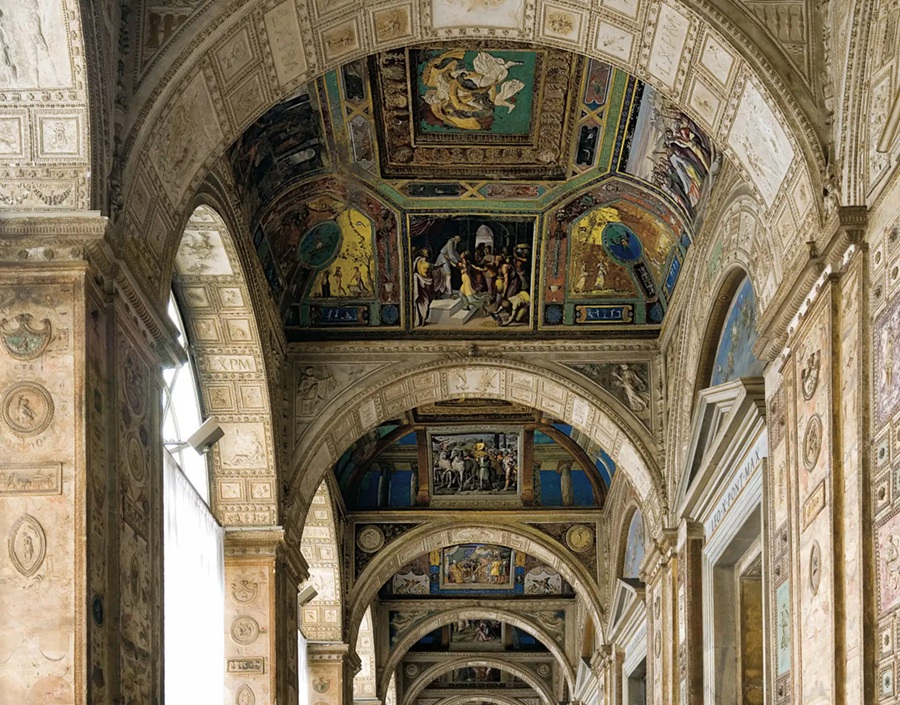
Work began on Wednesday on a five-year restoration of Raphael’s Loggia, one of the finest surviving examples of High Renaissance decorative art, located on the second floor of the Apostolic Palace in Vatican City.
The project, presented by Vatican Museums director Barbara Jatta, will focus initially on the west wing of the Second Loggia, which overlooks the San Damaso courtyard and forms part of a UNESCO-listed site.
The restoration
A team of 20 restorers from the Vatican Museums will work with laser technology on the Loggia’s 14 bays of frescoes and stuccoes. They were produced between 1517 and 1519 under Raphael’s direction by his collaborators — principally Giovanni da Udine — for Pope Leo X de’ Medici.
“This is a complex project and one of the most important ever undertaken in the Museums, which will keep us busy for five years,” Jatta said. The variety of techniques used in the original decoration makes the conservation work particularly demanding, with the restorers required to address both the painted surfaces and the delicate stucco ornament that surrounds them.
Designed by Raphael, the Urbino-born master who oversaw its decoration before his death in 1520, the Loggia was immediately recognised on its completion as among the highest expressions of Renaissance art applied to architecture, and it remains a benchmark of early sixteenth-century figurative painting.
The restoration has been funded by the Stephen A. Schwarzman Foundation, whose president attended Wednesday’s presentation alongside Bénédicte de Montlaur, president of the World Monuments Fund.
“We have participated in many projects in Italy, but this is the first in the Vatican,” de Montlaur said, with both organisations expressing strong commitment to the project.