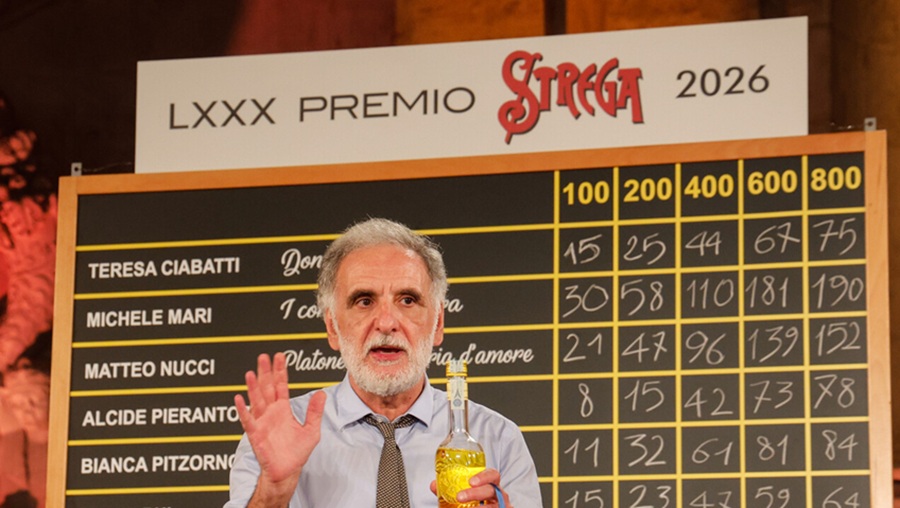
Michele Mari won the 2026 Strega Prize, Italy’s most prestigious literary award, with his novel I Convitati di Pietra (The Stone Guests) at a ceremony in Rome’s Piazza del Campidoglio on Wednesday. Votes cast by the prize’s jury of more than 600 members of the cultural world were counted live.
The story of the rivalries and misfortunes of a group of high-school students who reunite for a dinner every year, Mari’s 23rd book received 190 votes, ahead of Matteo Nucci’s Platone – Una Storia d’Amore (Plato – A Love Story) with 152. Third place at the 80th Strega prize went to Bianca Pitzorno’s La Sonnambula (The Sleepwalker) with 84 votes.
The rest of the six-book shortlist finished close behind Pitzorno. Fourth place went to Alcide Pierantozzi for Lo sbilico, published by Einaudi and put forward by fellow author Donatella Di Pietrantonio, with 78 votes. Fifth was Teresa Ciabatti for Donnaregina, published by Mondadori and proposed by Roberto Saviano, with 75 votes. Elena Rui rounded out the shortlist in sixth with 64 votes for Vedove di Camus, published by L’orma and proposed by Lisa Ginzburg. Culture Minister Alessandro Giuli was among those in the audience for the final of the 80th Strega Prize.
Mari had been the clear favourite from the moment the shortlist was announced at Benevento’s Roman theatre on 3 June. His win came despite weeks of controversy over alleged remarks he made about the physical appearance and intellectual integrity of the late writer and columnist Michela Murgia. The Piazza del Campidoglio hosted this year’s event rather than the traditional Ninfeo di Villa Giulia, following a tour that took the finalists across Italy and, for the first time, abroad to Mexico City.
The winning novel
I Convitati di Pietra follows a group of former classmates at a Milan high school who, after finishing their final exams in 1975, strike what the book calls a “wicked pact”. Every year on 22 July they meet for dinner and pay into a shared fund, with the money eventually going to whichever three of them live the longest. The novel, written in just over 150 pages that Mari has said took him a month to write, follows those classmates as they disappear one by one over the decades, building to a surprise ending in which the last three survivors, by then in their nineties, meet again in 2050.
The book draws on the literary influence of writers including Borges, Kafka, Calvino and Gadda, weaving a game with the paths of apparent chance into its structure. It is Mari’s first time competing for the Strega. He had already taken the associated Strega Giovani (Young Readers’) prize in May with the same book. Einaudi, the novel’s publisher, had last won the main prize in 2024.
The name Strega, which means “witch” in Italian, refers to the prize’s sponsors, producers of the famed yellow liqueur of the same name.