Italy’s president used a reception for the Strega Prize 80th anniversary to deliver a pointed message about the value of reading to world leaders. The country’s most prestigious literary award, meanwhile, prepares for its most symbolically charged finale yet.
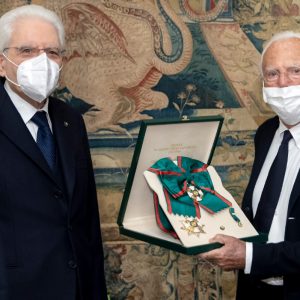
President Sergio Mattarella received a delegation from Italy’s most prestigious literary award, the Premio Strega, at the Quirinale Palace on Tuesday to mark the prize’s eightieth anniversary. He then used the occasion to deliver a remark that will resonate far beyond the world of Italian letters.
“If I may joke,” Mattarella said, “it is that if some of the world’s powerful people, instead of cultivating improbable and imaginary autobiographies, dedicated themselves to reading, we would probably all benefit greatly.”
The comment drew on a broader reflection the president had been developing throughout his address. The Strega Prize, he said, “sends a message that urges us to read, and therefore to reflect, and to seek to understand”, qualities, he suggested, “we feel the need for, very intensely, even in this period,” precisely because literature helps us “try to understand events and how to avoid temptations.”
Eighty years of Italian letters
The Premio Strega was founded in 1947 by Maria and Goffredo Bellonci, in the years of reconstruction that followed the Second World War. Mattarella placed the prize’s origins in that moment of national emergency, recalling the “decisive contribution of culture in accompanying the birth of the new Italy”, a contribution, in that period, “to taking weapons out of hands and putting a book in our hands.”
The prize takes its name from Strega liqueur, produced in Benevento and is awarded annually by the Fondazione Bellonci to a work of Italian fiction. Votes come from the Amici della domenica, a select jury of writers, critics and cultural figures. Since its first edition, the Strega has functioned as both a barometer of Italian literary taste and a record of the country’s evolving cultural identity.
In eighty years, it has crowned some of the most enduring works of Italian literature, from Elsa Morante to Giorgio Bassani, from Umberto Eco to Elena Ferrante’s publisher-house rivals. It remains the award that Italian authors most keenly covet and most hotly debate.
The Class of 2026
There is already considerable interest in this year’s edition. The twelve candidates for the 80th Premio Strega were announced on 1 April at Rome’s Sala del Tempio di Vibia Sabina e Adriano, presented by novelist Melania G. Mazzucco. The longlist was selected from 79 works initially proposed by the Amici della domenica.
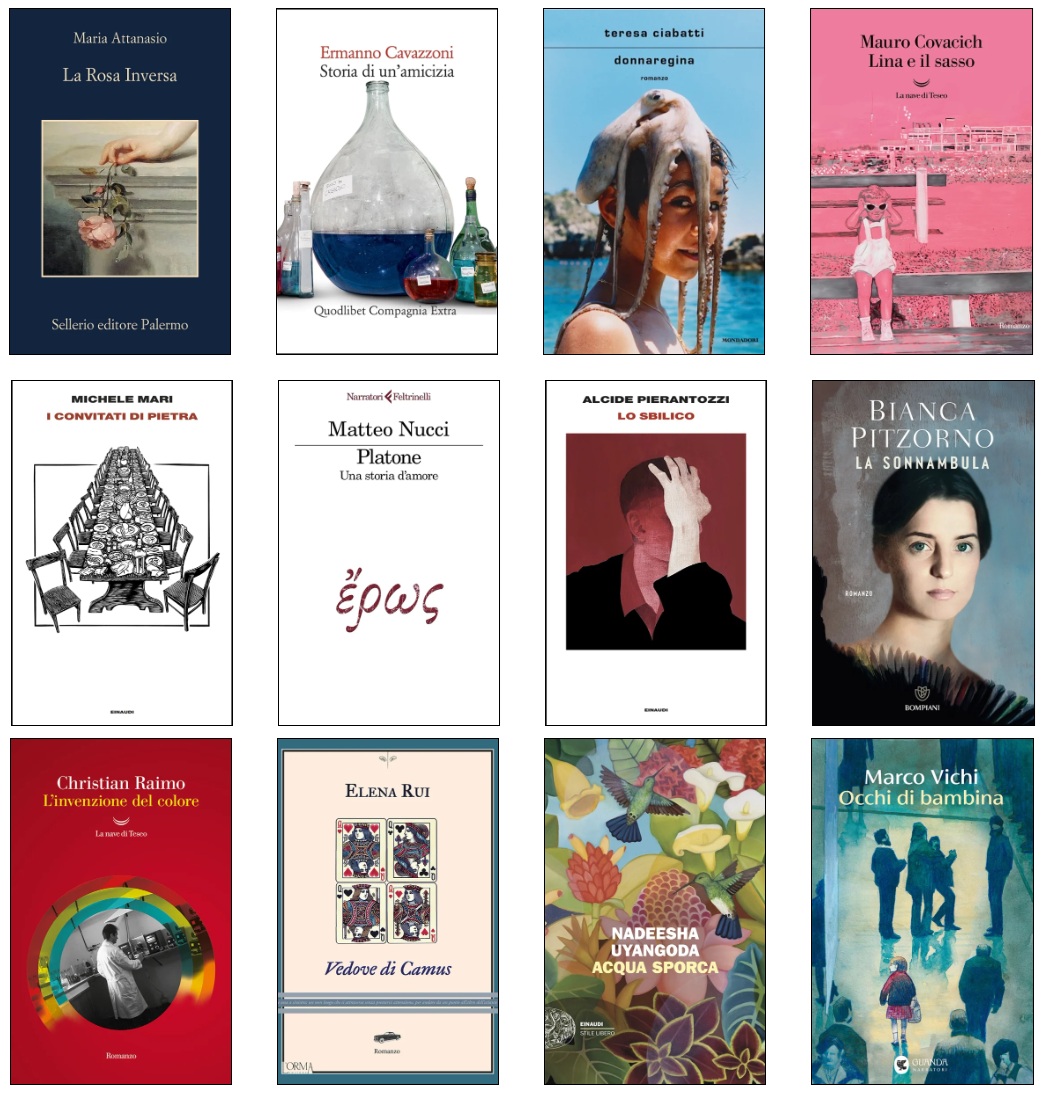
The twelve candidates are: Maria Attanasio, La Rosa Inversa (Sellerio); Ermanno Cavazzoni, Storia di un’amicizia (Quodlibet); Teresa Ciabatti, Donnaregina (Mondadori); Mauro Covacich, Lina e il sasso (La nave di Teseo); Michele Mari, I convitati di pietra (Einaudi); Matteo Nucci, Platone. Una storia d’amore (Feltrinelli); Alcide Pierantozzi, Lo sbilico (Einaudi); Bianca Pitzorno, La sonnambula (Bompiani); Christian Raimo, L’invenzione del colore (La nave di Teseo); Elena Rui, Vedove di Camus (L’orma); Nadeesha Uyangoda, Acqua sporca (Einaudi); and Marco Vichi, Occhi di bambina (Guanda).
Teresa Ciabatti, presented by Roberto Saviano, and Mauro Covacich are widely regarded as the major names in the running, with Ciabatti’s Donnaregina and Covacich’s Lina e il sasso considered strong contenders for the final five. Also attracting attention is the candidacy of 79-year-old Ermanno Cavazzoni, the Reggio Emilia-born novelist and former Fellini screenwriter known for his surrealist, eccentric prose, and Nadeesha Uyangoda, a 33-year-old novelist and podcaster of Sri Lankan origin whose Acqua sporca brings a distinctive new voice to the competition.
Critics have noted that the 2026 longlist is largely turned away from the conflicts and social crises of the present moment. Instead it is reaching toward historical narrative, autofiction, biographical surrealism and what one observer called “the magic of feminine thought.”
A historic award ceremony at the Campidoglio
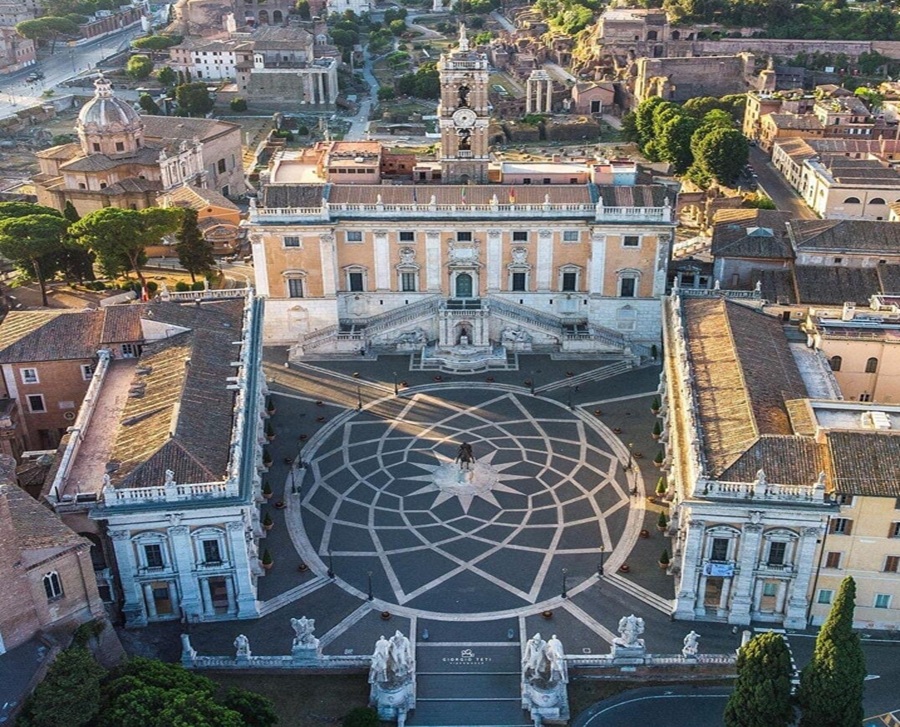
The road to the prize this year carries an extra charge of occasion. The shortlist of five finalists will be announced on 3 June at the Teatro Romano in Benevento. The winner will be proclaimed on 8 July, for the first time in the prize’s history, from the Piazza del Campidoglio in Rome, broadcast live on Rai 3.
The Campidoglio is the symbolic civic heart of Rome, designed by Michelangelo and overlooking the ancient Forum. Organisers describe the venue choice as a deliberate homage to the city where the Belloncis’ literary salon first imagined the prize into existence, and to the eightieth anniversary that makes this edition unlike any before it.
It is a fitting backdrop for a prize that has always understood itself as something more than a literary award. It is a mirror held up to Italy, and an argument, renewed each year, for the irreplaceable act of reading.