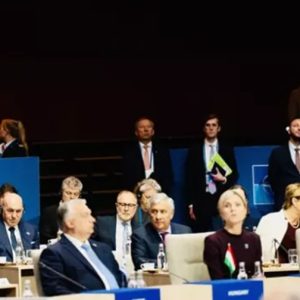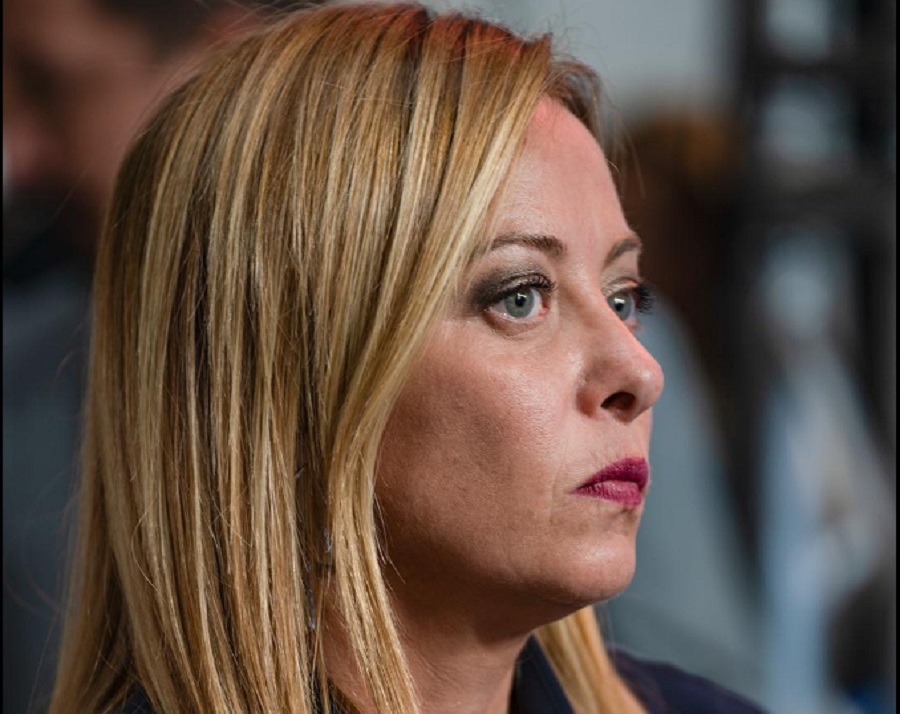
A cabinet press conference on Tuesday produced a cluster of significant economic signals. The prime minister recalibrated her defence ambitions in the face of economic headwinds, there is a targeted fuel tax cut in the works, and a damning assessment from Italy’s national statistics office. Add to that a sharp rebuke from Brussels over suggestions Italy might walk away from EU budget rules and it’s not a pretty picture.
Giorgia Meloni told reporters on Tuesday that defence spending, long presented as a non-negotiable commitment of her government, would have to yield to other pressing priorities, at least for now.
“I haven’t changed my mind on the issue of defence spending,” she said. “I take responsibility for it because I know it’s not a very popular issue. However, I think responsible people should also do what’s right, not just what’s immediately popular.” But, she added, defence remains “an absolute priority” only “not in the current context,” in which she must prioritise “what’s happening on the economic level, because if I no longer have a nation, there’s no need for me to defend it.”
The concession reflects the growing squeeze on Italy’s public finances as the Iran war continues to roil global markets and the country faces the twin pressures of sluggish growth and EU fiscal constraints. “Maybe we won’t do everything we could have done or should have done,” Meloni said. “Let’s try to make ends meet based on priorities.”
NATO has long pressed member states to reach the two percent of GDP spending target on defence, and the alliance’s current push has been for members to commit to three percent. Italy had previously signalled willingness to move in that direction. Tuesday’s remarks suggest the timetable has slipped considerably.
A targeted fuel tax cut
Meloni also indicated that the government is considering a further extension of excise tax cuts on fuel, but with a different design from previous rounds.
“We are considering a further extension of the excise tax cut, which could be shorter than previous ones,” she said. Meloni added that it would “no longer be horizontal.” Diesel, she explained, had seen a more significant price increase than petrol, and the cut “could impact diesel more than gasoline, for a better distributed impact.”
The shift toward a diesel-weighted, time-limited intervention reflects both the fiscal constraints the government is operating under and the particular exposure of hauliers, farmers and rural households to diesel price rises. The precise timing, she said, had not yet been finalised: “We are following the negotiating table. We are trying to stay fairly close to the evolution of the situation.”
Istat: Economy cooling and purchasing power eroded
The government’s economic balancing act is being complicated by sobering data from Italy’s national statistics agency, Istat. The organisation’s president, Francesco Maria Chelli, delivered a notably downbeat assessment to a parliamentary hearing on the government’s DFP economic blueprint on Tuesday.
“The data we have for the first months of 2026 seem to confirm a less positive trend for the Italian economy compared to the last quarter of 2025,” Chelli told lawmakers. He noted that Italy’s GDP had grown by 0.3% in the final three months of last year, a figure that may now represent a high-water mark. “Since the outbreak of the conflict in the Middle East on February 28, the international economic scenario has worsened and uncertainty has further increased,” he said. “At the moment, formulating hypotheses about the evolution of global scenarios and the reactions of economic operators is complex.”
The agency’s most striking finding concerned Italian households, whose financial position has deteriorated significantly over recent years. Contract wages have fallen by 7.8% in real terms between the first quarter of 2021 and the fourth quarter of 2025 — a period spanning the post-pandemic surge in inflation and the energy price shock — despite a partial recovery last year.
Purchasing power, Istat confirmed, has been declining for some time, a structural problem that the government’s employment decree and fair wage measures are designed, at least in part, to address.
Brussels: you cannot walk away from the Stability Pact
The most pointed exchange of the day, however, came from the European Commission. It moved swiftly to close down speculation, floated by some members of Meloni’s coalition, that Italy might consider unilaterally withdrawing from the Stability and Growth Pact if EU budget rules are not suspended in response to the economic impact of the Iran war.
“There is no possibility for a Member State to unilaterally withdraw from the Stability and Growth Pact,” a Commission spokesperson said flatly. “Fiscal rules are part of European Union law and are binding on all Member States. Member States under the excessive deficit procedure must adhere to the corrective path recommended by the Council, defined in terms of net expenditure growth.”
Italy is currently subject to the EU’s excessive deficit procedure, meaning it is already operating under an agreed fiscal correction path. The Commission acknowledged that member states retain the ability to take measures to support vulnerable households and businesses, but only “provided that net expenditure growth remains within the limit recommended by the Council and that such measures comply with EU law.”
The rebuke was direct and unambiguous. The suggestion that Italy might simply opt out of budget rules it finds inconvenient, whether as a negotiating tactic or a genuine policy position, has been firmly ruled off the table in Brussels. However, Rome continues to argue that the economic fallout from the Middle East conflict warrants greater fiscal flexibility across the eurozone.