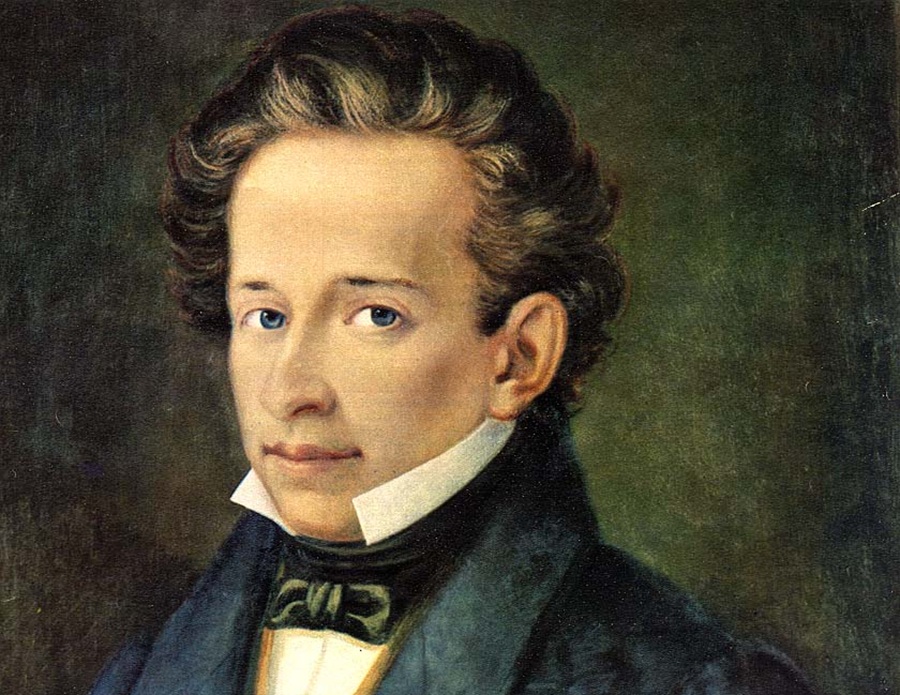
On 14 June 1837, Giacomo Leopardi — poet, philosopher and one of the most original literary minds in the Italian tradition — died in Naples aged 38. He was the victim of the cholera epidemic then sweeping the city. In a life marked by physical suffering, intellectual isolation and serial heartbreak, he produced a body of work that stands among the greatest of the 19th century.
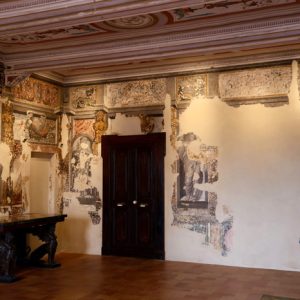
Giacomo Taldegardo Francesco di Sales Saverio Pietro Leopardi was born on 29 June 1798 in Recanati, a small hilltop town in the Marche region that was then part of the Papal States. His father, Count Monaldo Leopardi, was a conservative nobleman with a passion for books and a library to match. His mother, Adelaide Antici, was a cold, devoutly religious woman whose indifference to her son’s suffering would shadow his life and his poetry. The family was aristocratic but financially precarious, and Giacomo grew up in a household defined by austerity and intellectual repression.
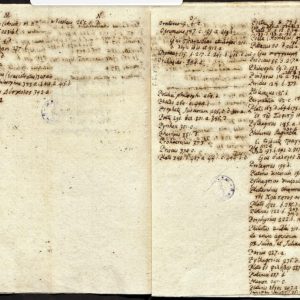
What filled the gap was his father’s library. Leopardi threw himself into it with an intensity that was both his making and, ultimately, his ruin. By the age of 16 he had independently mastered Greek, Latin, Hebrew and several modern European languages, producing translations of classical texts and original scholarly commentaries of a quality that astonished the philologists who encountered them. He later described the seven years between 1810 and 1817 as his period of “mad and desperate study” and his body paid the price. He lost the sight of one eye, developed severe spinal curvature and a cerebrospinal condition that caused him chronic pain for the rest of his life. Leopardi emerged from adolescence broken in health but formed as a thinker.
The early poems of Giacomo Leopardi
Forced to suspend his studies, Leopardi turned to poetry as a release for pain he could no longer contain. In 1816, still just 17, he composed Appressamento della morte (Approach of Death), a visionary canzone in terza rima — the metre of Dante and Petrarch — that poured out his sense of physical and existential desolation. The following year he fell briefly and painfully in love with his married cousin Geltrude Cassi, who was visiting Recanati, and wrote both a diary of the experience and the elegy Il primo amore (First Love). Then, in 1818, Teresa Fattorini, the young daughter of his father’s coachman, died of tuberculosis. Leopardi barely knew her, but her death lodged in him; a decade later, transfigured by time and grief, she would become Silvia.
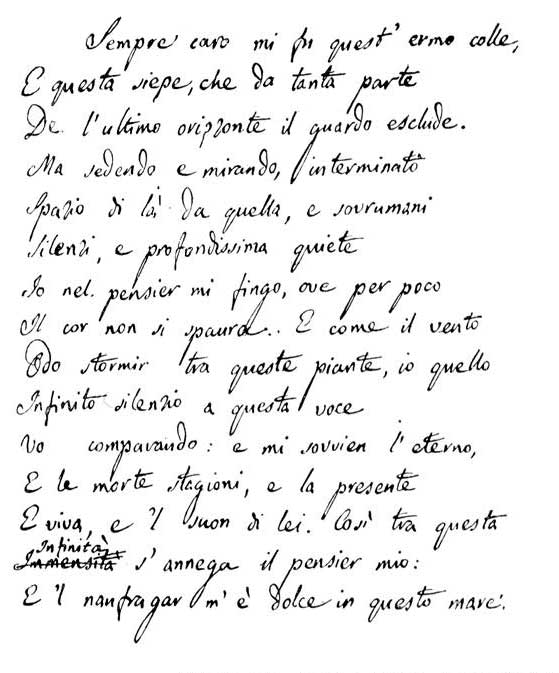
In 1819, in an extraordinary burst of lyric concentration, Leopardi composed L’Infinito (The Infinite). The poem is fifteen lines long. The speaker sits on a hill above Recanati, looking at a hedge that cuts off his view, and imagines, beyond it, infinite spaces and silences, eternal time past and present. The mind is overwhelmed. And the final image — “il naufragar m’è dolce in questo mare” (to sink in this sea is sweet to me) — became one of the most famous lines in all Italian literature. Composed as a private notation from a young man who could not leave his home, critics now regard it as one of the masterpieces of European Romanticism.
The Canti
L’Infinito formed a collection along with Leopardi’s other poems in the Canti, the work by which he is primarily known. The collection, first published in Florence in 1831 and expanded thereafter, spans his entire poetic career and charts a philosophical journey from patriotic canzoni to the profound lyric despair of his maturity. Among its most celebrated poems is A Silvia (1828), written in Pisa and drawing on the decade-old memory of Teresa Fattorini. In it, Leopardi addresses the dead girl directly, invoking her singing voice drifting from a nearby room in the summer of her youth. He uses her early death as an image of hope extinguished before it could be tested against reality. Silvia, hope, youth itself, all destroyed by the same indifferent fate. The poem’s musicality and emotional directness make it among the most moving elegies in any language.
The same productive period — the so-called canti pisano-recanatesi, written between 1828 and 1830 — produced Il sabato del villaggio (Saturday in the Village) and La quiete dopo la tempesta (The Calm After the Storm). Both poems follow the same structural method: they open with vivid, tender pictures of ordinary life before pivoting to a grim philosophical conclusion. In Il sabato, the anticipation of Sunday is sweeter than Sunday itself; by extension, all of life’s pleasure is merely the temporary relief of pain, and the best one can hope for is to enjoy expectation before reality arrives. In La quiete, the conclusion is starker still: the pleasures afforded by the calming of a storm are pleasures born of cessation of suffering. Joy, for Leopardi, was always the shadow of pain, not its opposite.
The Canto notturno di un pastore errante dell’Asia (Night Song of a Wandering Shepherd of Asia), also from this period, is among his most haunting achievements. A shepherd addresses the moon and asks, across 143 lines of extraordinary beauty, what purpose life serves and why suffering exists. The moon, as nature always does in Leopardi’s works, remains entirely silent.
The Zibaldone and the Operette Morali
Alongside his poetry, Giacomo Leopardi left two major prose works that secure his place in the history of European thought. The Zibaldone di pensieri (Hodgepodge of Thoughts) is a private notebook he kept from 1817 until 1832. It runs to 4,526 pages and reflects on language, aesthetics, ancient and modern literature, nature, happiness, boredom and the human condition. Published in 1898, decades after his death, it is now recognised as one of the most extraordinary intellectual documents of the 19th century. It is a one-man conversation with all of Western thought in the dark of a provincial library.
The Operette morali (Small Moral Works), published in 1827, are a collection of 24 prose dialogues. Nature speaks to an Icelander and tells him, without apology, that she has no interest in human happiness; the dead compare notes on the futility of life; History and Philosophy bicker. The tone is wry, controlled and devastating. These dialogues make the same argument as the poetry — that nature is indifferent, that suffering is universal, that human illusions are both necessary and doomed — but in the mode of philosophical comedy rather than lyric elegy.
Exile, love and Leopardi’s final years
After years of frustrated attempts to leave Recanati — a town he called a “borgo selvaggio” (savage village) and which he associated with everything narrow and provincial — Giacomo Leopardi finally escaped for good in 1830. In Florence he fell deeply, unhappily in love with the noblewoman Fanny Targioni-Tozzetti, who was charming, well-read, and entirely uninterested in him romantically. The experience produced some of his most bitter late poems, collectively known as the Aspasia cycle, including the searing A se stesso (To Himself), in which he renounces love and hope alike in five unsparing lines.
In Florence he also formed a deep friendship with Antonio Ranieri, a young Neapolitan political exile, who became his closest companion and eventual caregiver. In 1833, the two men settled in Naples together. Leopardi was by then in visible physical decline, his eyesight severely impaired, his breathing laboured. But in Torre del Greco, on the slopes of Vesuvius, he wrote his final and perhaps greatest poem – La Ginestra.
La Ginestra
La ginestra, o il fiore del deserto (Broom, or the Flower of the Desert), composed in 1836, is Leopardi’s testament. The poem takes its title from the broom plant that colonises the lava fields of Vesuvius. Leopardi uses it as an image of dignified, unsentimental endurance: the broom does not pretend that the lava will not come again; it simply flowers, and persists, on the slopes of the very force that will eventually destroy it.
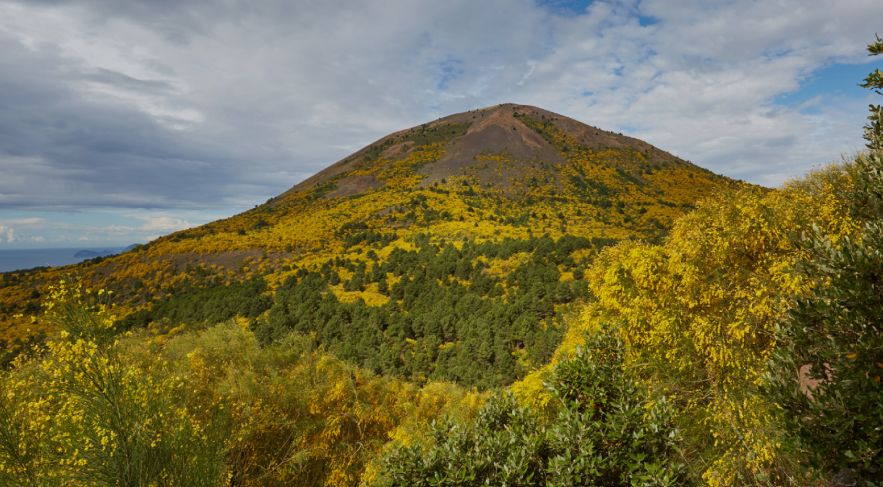
The poem is both a philosophical statement and a political one. Leopardi attacks the optimistic progressivism of his era — the liberal faith in reason, science and human improvement — as a new and particularly smug form of self-deception. His counter-proposal is not despair but solidarity: only by facing the reality of human fragility and nature’s indifference honestly, without consoling illusions, can human beings develop a genuine compassion for one another. La ginestra is long, discursive, prophetic and magnificent. Nowadays, it is considered one of the supreme achievements of Italian Romantic poetry.
Cholera killed Giacomo Leopardi the following year. He died on 14 June 1837, at the house in Naples he shared with Ranieri, who remained with him to the end. He was 38 years old.