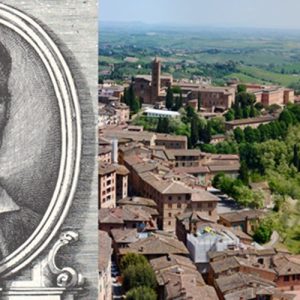
Lorenzo di Pietro di Giovanni — known to posterity as Vecchietta, ‘the little old one’ — died in Siena on 6th June 1480. He left behind a legacy in paint, bronze and stone that remains inseparable from the identity of one of Italy’s most artistically rich cities.
Born in Siena and baptised there on 11 August 1410, Vecchietta was a painter, sculptor, goldsmith and architect of considerable range and ambition. His early formation remains only partially documented, but his name has been associated with some of the leading figures of the Sienese tradition, among them Sassetta, Taddeo di Bartolo and Jacopo della Quercia. What is certain is that he became one of the most versatile and sought-after artists working in Tuscany during the mid-fifteenth century.
Painter of the hospital
Much of Vecchietta’s most significant work was carried out for the Hospital of Santa Maria della Scala in Siena. The hospital was one of the largest and most celebrated institutions of its kind in mediaeval Italy, with branches across many towns. So closely was he associated with it that he acquired the sobriquet pittor della spedale, painter of the hospital.
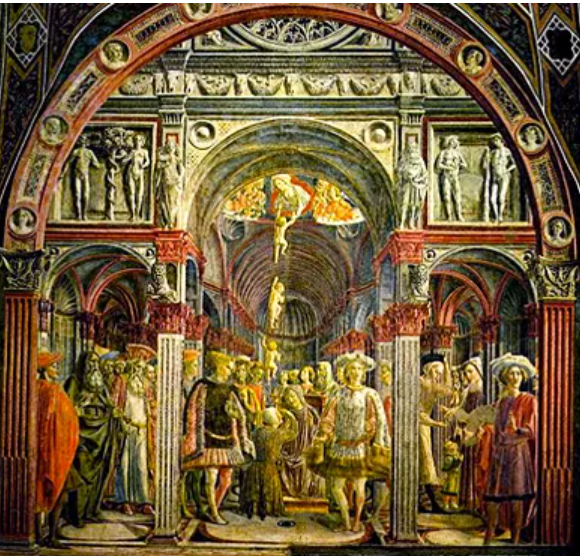
His contributions to the hospital’s celebrated Pellegrinaio — the Pilgrim Hall — included a series of frescoes executed alongside Domenico di Bartolo and Priamo della Quercia. Among them was The Vision of Santa Sorore, depicting a dream of the mother of the cobbler Sorore, the mythical founder of the hospital, and The Founding of the Spedale.
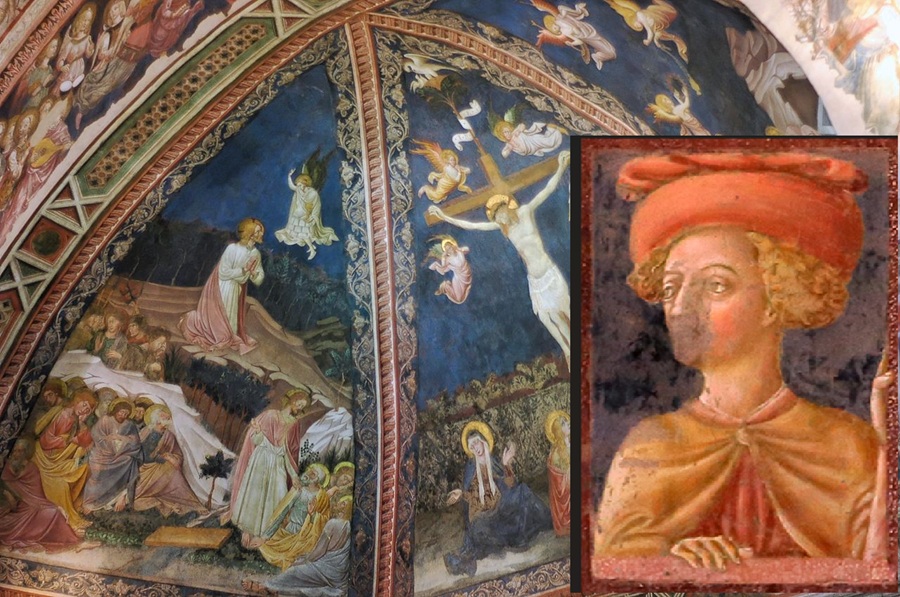
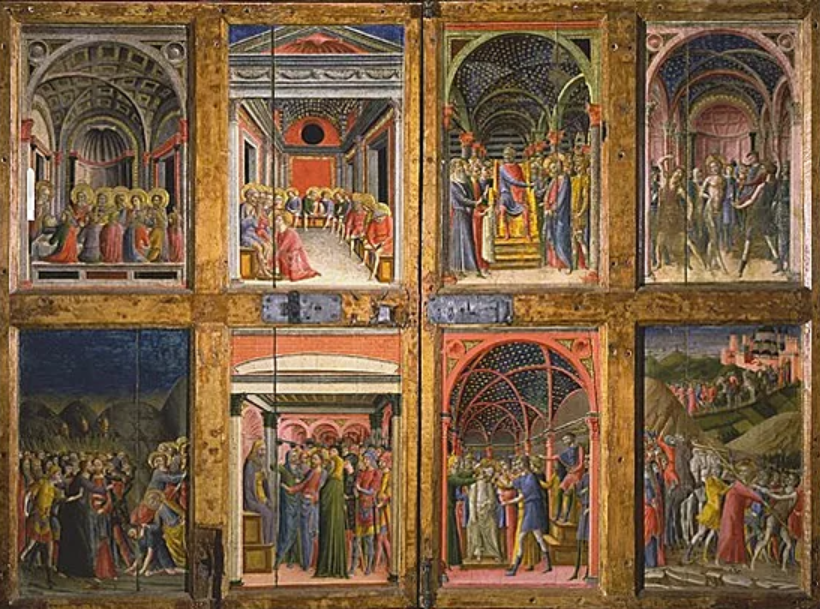
Around 1444, he decorated the Cappella di Sacra Chiodo, the old sacristy, with frescoes of the Annunciation, Nativity and Last Judgement, as well as an Allegory of the Ladder, in which children climb heavenward. The following year he decorated the Arliquiera, a painted wardrobe housing holy relics, for the same sacristy. It is now in Siena’s Pinacoteca Nazionale.
Bronze, marble and devotion
Vecchietta’s sculptural ambitions were no less formidable. In the 1460s he created a large bronze ciborium for the hospital, which was later transferred to Siena Cathedral. For the Church of the Santissima Annunziata within the hospital complex, he cast a signed and dated bronze figure of the Risen Christ in 1476. The work bears the influence of Donatello, whom Vecchietta is believed to have encountered in Siena during the 1450s.
For the church of San Domenico he sculpted a bronze tomb effigy of a Sienese jurist, now held by the Uffizi Gallery in Florence. He also produced life-size figures of Saints Peter and Paul for the Loggia della Mercanzia, and a sculpture of St Martin for the Palazzo Saracini. When St Catherine of Siena was canonised in 1461, Vecchietta created a silver statue in her honour; it disappeared following the siege of Siena in 1555.
Beyond Siena
Vecchietta’s reputation extended beyond Siena. In nearby Pienza, he painted an Assumption in 1461 for Pope Pius II, one of the most culturally ambitious popes of the Renaissance. A panel of the Madonna is in the Uffizi, a Saint Peter Martyr hangs in the Palazzo Cini in Venice, and the British Library in London preserves a manuscript of Dante’s Divine Comedy containing illuminations in his hand.
Between 1447 and 1450, Vecchietta and his pupils — among them Francesco di Giorgio and Neroccio de’ Landi, two artists who would go on to considerable distinction of their own — created frescoes for the Baptistery of San Giovanni at Siena Cathedral.
Vecchietta died in Siena on 6 June 1480, aged nearly seventy. With characteristic foresight, he had already designed a funerary chapel for himself and his wife within Santa Maria della Scala.