
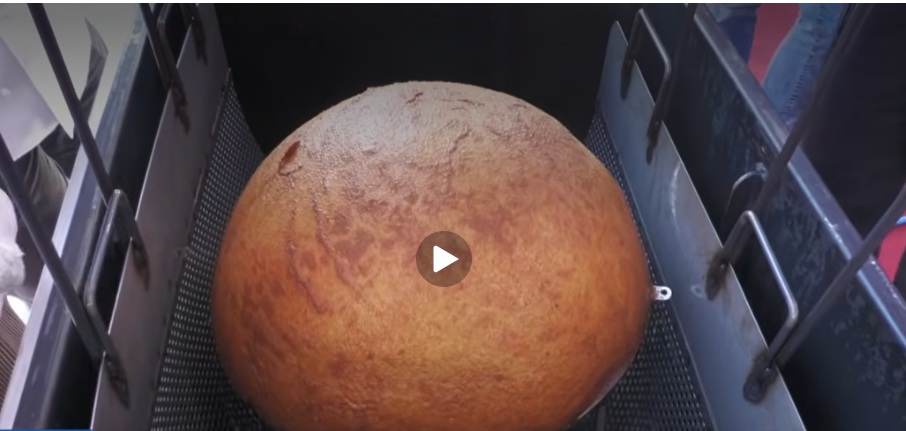
Palermo has claimed its place in the record books with the creation of a giant arancina weighing 62.3 kilograms. Unveiled last Sunday on Palermo’s Mondello beach, it surpasses a previous record set in Messina in 2023.
The feat was the work of Palermo pastry chefs and gastronomes Vincenzo Fiore and Giuseppe Genovese of Bar Igea Lea. They produced a specimen measuring 50 centimetres in diameter with a circumference of 1 metre 57 centimetres. The creation beat the former record, held by a rosticceria in Messina, which had produced an arancino weighing 56.2 kilograms, by more than six kilos.
The event was organised by Carmelo Comandè and Roberto Bruno of Sikania Eventi ETS as part of a three-day festival at Mondello, with the goal of securing an official Guinness World Record.
A tight turnaround
The achievement is all the more remarkable given the preparation time involved, or rather the lack of it. Fiore noted that the team had returned from the Vinitaly wine fair in Verona, which concluded on 16 April, just days before the event, leaving only three days to complete the project.
The filling followed a classic Palermo recipe: Roma Gallo and Roma Blond rice varieties combined with minced veal, peas and a small amount of tomato paste. One of the principal technical challenges was maintaining the structural integrity of the arancino during frying, a process that required an oversized industrial deep fryer and no fewer than 300 litres of cooking oil.
An icon of Sicilian street food
For readers unfamiliar with Sicily’s culinary landscape, the arancina (or arancino) is one of its most beloved and enduring street foods. The name derives from the Sicilian word for “little orange”, a nod to the golden, roughly spherical shape the fried rice ball takes on after cooking. Common fillings include meat ragù with peas and mozzarella, or a version with prosciutto and béchamel.
The origins of arancini are traceable to Sicily’s Arab occupation in the 10th century, when rice and saffron were introduced to the island. It was during the subsequent Norman occupation of the 12th century that these ingredients were breaded and fried into a portable, practical food for long journeys and hunting parties, giving rise to what we now recognise as the arancino in its essential form.
That name, however, is itself a matter of fierce regional pride. In Palermo and the western half of the island, the word takes the feminine form – arancina. In Catania and the east, it is masculine – arancino. The distinction has been debated with considerable passion for centuries. Sunday’s record was set in Palermo, so for the purposes of this article at least, arancina it is.


