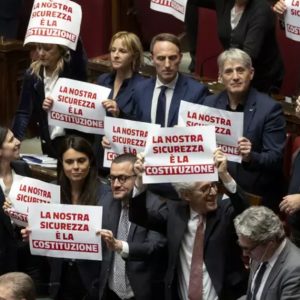
The government is racing against a Liberation Day deadline to salvage its flagship security decree. President Sergio Mattarella signalled he cannot sign off on a controversial €615 incentive for lawyers who secure the voluntary repatriation of migrant clients.
The Quirinale’s intervention has thrown the Meloni government’s new security decree into disarray, with the clock ticking on a parliamentary conversion deadline that falls on 25 April. After that, the entire decree will lapse.
The disputed provision
President Mattarella is keeping a close eye on the €615 per-head incentive to make sure it complies with the Italian Constitution. According to reports, the head of state told Cabinet Secretary Alfredo Mantovano directly that he could not sign off on the measure. Presidential sources characterised his position as one of firm and focused scrutiny. The Quirinale has been focusing its attention on the provision for days, noting that once the law reaches the president’s desk, he will decide whether to sign it, send it back to the Chamber of Deputies, or refer the matter to the Constitutional Court.
Under the draft law, lawyers would be entitled to the bonus for every migrant who agreed to accept voluntary repatriation, but only once an individual had physically returned to their country of origin. Meloni’s ruling coalition is understood to have allocated €246,000 for the scheme this year, with funding expected to double in 2027 and 2028.
The provision has drawn sharp criticism from legal experts and opposition politicians alike. Critics argue the financial incentive creates a serious risk of conflict of interest and a violation of constitutional principles. It places lawyers in the position of being financially rewarded for outcomes that may not be in their clients’ best interests. Democratic Party justice spokesperson Debora Serracchiani called it “a legislative disgrace that undermines the very dignity of professionals.”
A race against the deadline
With Liberation Day falling on Friday, options for the government are narrow. One route under consideration is a new cabinet decree to repeal the specific provision before the April 25 deadline. This would effectively excise the problematic clause from the broader package rather than allowing the entire decree to collapse.
The episode is an embarrassing complication for a government that has made immigration enforcement central to its political identity.
What the rest of the decree contains
The lawyer incentive is not the only contentious element in the security decree package. The decree was fast-tracked by the Meloni government following violent clashes in Turin in which more than 100 officers were injured, with Meloni calling one attack on an officer “attempted murder.”
At the heart of the package is a limited form of preventive detention, allowing police to temporarily stop and hold individuals assessed as posing a concrete threat to public safety during demonstrations. Interior Minister Matteo Piantedosi has stressed the power would apply only in clearly defined situations, such as possession of weapons or prior convictions for violent offences. It would also remain subject to judicial oversight.
The law also introduces stronger self-defence protections for both police officers and civilians, with cases involving use of force now subject to a preliminary legal review rather than an automatic criminal investigation. This approach, the government says, restores the presumption of innocence for those responding to violent attacks. Additional measures include a ban on knife sales to minors and tougher penalties for refusing police orders.
Opposition parties have not been appeased. Left-wing figures have accused the government of exploiting the Turin unrest to restrict civil liberties, while the government has countered that many of its critics were previously attacking authorities for failing to prevent the violence in the first place.
The Mattarella intervention now ensures that, whatever form the decree takes when it finally passes into law, it will do so under a cloud.
ItalyNews.Online covers Italian politics, culture and current affairs for an international audience.