Parliament approved the security decree just hours before its deadline. However, the government simultaneously scrambled to patch a constitutionally contentious clause on lawyer incentives for migrant voluntary returns.
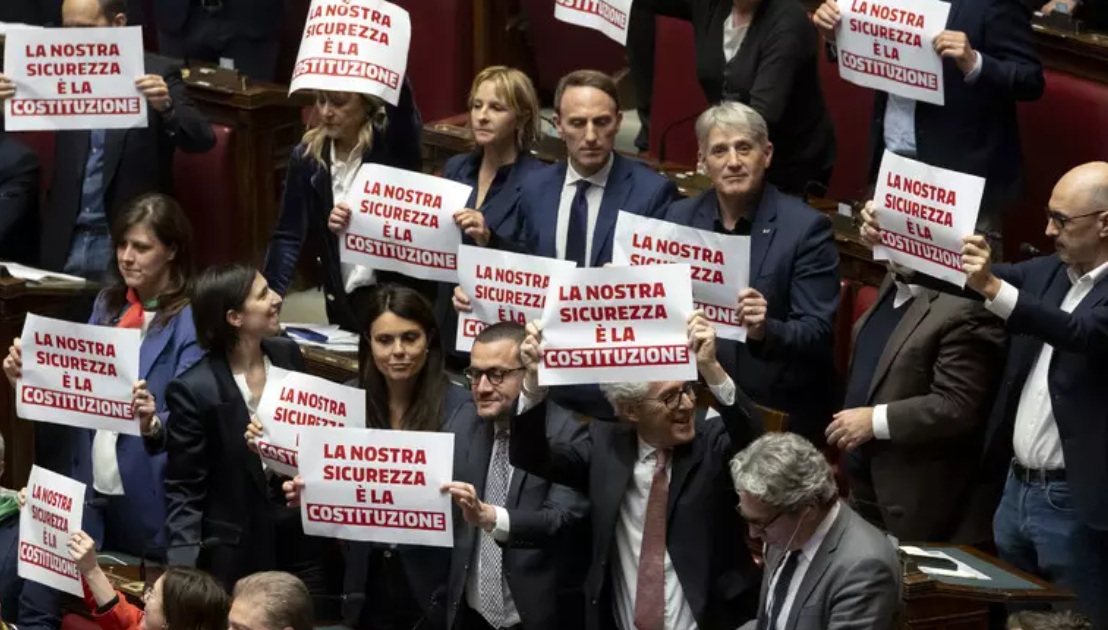
Italy’s lower house of parliament approved a sweeping security decree on Friday in a charged atmosphere that saw opposition politicians sing the Second World War Resistance anthem Bella Ciao. They also waved placards reading “Our security is the Constitution”, and hold up red poppies in symbolic protest. The poppies also chosen to echo Liberation Day, which Italy observes on Saturday, the anniversary of the country’s liberation from Nazi-Fascist occupation.
The final vote in the Chamber of Deputies resulted in 162 votes in favour, 102 against, and one abstention. The decree had to be converted into law by Saturday or it would have automatically lapsed.
But even as the vote was being counted, the government was convening an emergency cabinet session to approve a separate corrective decree. Critics characterised the move as chaotic improvisation, yet Premier Giorgia Meloni’s coalition defended it as an entirely legitimate legislative manoeuvre.
The Contested Clause
At the heart of the controversy is Article 30-bis, which introduces a €615 incentive payment for lawyers who assist migrants through the administrative process of voluntary repatriation. Under the original formulation, the payment would only be triggered upon the migrant’s actual departure from Italy, This condition critics, including senior legal bodies, argued transformed lawyers into instruments of government migration policy rather than independent advocates for their clients.
Italy’s Union of Criminal Lawyers, in a statement entitled “The Apologia of Unfaithful Legal Defence”, said the clause “transforms the defence lawyer into a tool of the government’s re-migration policies”. Furthermore, it described the clause as “incompatible with the Constitution and with the most elementary principles of legal professional ethics.”
The measure drew objections not only from the opposition and the legal profession, but from the highest institutional level. President of the Republic Sergio Mattarella summoned Undersecretary Alfredo Mantovano to the Quirinale on 20 April and made clear he might withhold his signature if the provision were not amended.
The Corrective Decree
Less than an hour after the Chamber’s final vote, the Council of Ministers met in a brief emergency session and approved a new decree-law containing urgent provisions on assisted voluntary repatriation. The corrective instrument is designed to address the objections raised by the Quirinale and the legal profession while preserving the overall framework of the measure.
The corrective decree modifies the original provision in two key ways: the €615 payment will now be tied to the conclusion of the administrative procedure rather than to the migrant’s actual departure. Plus, the pool of eligible professionals has been widened by removing the specification that assistance must be provided exclusively by a lawyer. Mediators and other operators are expected to become eligible, with the Interior Ministry to define the full list by ministerial decree.
Meloni dismissed opposition claims that the double-decree approach amounted to a constitutional and institutional mess. “We’ll transform those considerations into an ad hoc measure, because there was no time left before the decree was converted to amend the law,” she told reporters earlier this week. “But the measure remains, because it’s absolutely a common-sense measure.”
‘Not an attack on migrants’ rights’ says Meloni
The premier also challenged her opponents’ framing of the clause as an attack on migrants’ rights. “I’m not entirely clear on why, if we recognise free legal aid for lawyers assisting migrants who appeal against expulsion orders, we shouldn’t recognise the work of professionals who assist migrants when they voluntarily choose to be repatriated,” she said. “I thought we agreed on this at least. Now I find out we don’t even agree on assisted voluntary repatriation anymore. But we’ll keep moving forward anyway.”
Italy’s criminal lawyers were not persuaded by the corrective measure. Their associations reiterated that the amendments do not resolve the fundamental constitutional problem. They called for the incentive clause to be repealed outright, and demanded that automatic access to legal aid be reinstated for migrants challenging expulsion orders, a right curtailed by a separate provision of the same decree.
What else is in the approved Security Decree
The security package is broader than the repatriation row. Among its provisions, the decree allows law enforcement to preventively detain suspected troublemakers ahead of demonstrations and bans individuals convicted of certain offences from attending public gatherings. It also targets the phenomenon of so-called maranzas — second-generation migrant youth involved in street gang culture. In addition, it introduces a ban on the sale of knives to minors, and contains measures to extend legal protections to police officers acting in legitimate self-defence.
The text as passed runs to 33 articles, or 39 counting additional sub-articles introduced during parliamentary conversion, with total expenditure certified by the State General Accounting Office at just over €50 million for 2026. The largest single outlay, €48 million, relates to urban security measures including municipal video surveillance and a dedicated urban security fund.
A legislative sequence under scrutiny
To accelerate passage of the decree before its expiry deadline, the government had invoked a confidence vote earlier in the week, preventing any further amendments to the text. This left the constitutionally contentious Article 30-bis intact in the final law, necessitating the emergency corrective decree issued simultaneously by cabinet.
The opposition’s theatrical protest, staged on the eve of Liberation Day, was a deliberate provocation. The anthem Bella Ciao and red poppies carry deep resonance for Italy’s centre-left, and the choice of date sharpened the symbolism of a parliament passing legislation the opposition has characterised as an affront to constitutional values. Both the corrective decree and the main security law now await President Mattarella’s signature.
Sources: Sky TG24, Il Post, Euronews Italia, Il Sole 24 Ore, Internazionale, Domani (24 April 2026)