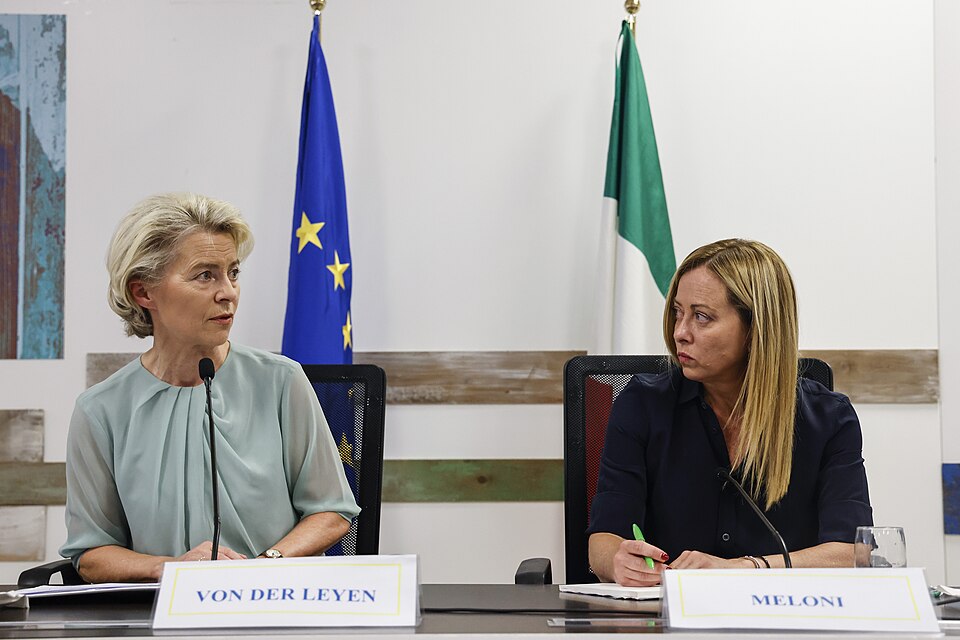
In an unprecedented formal warning to the European Commission president, Italy’s prime minister has put her country’s participation in the EU’s flagship defence spending programme at risk.
Prime Minister Giorgia Meloni has written directly to European Commission President Ursula von der Leyen to deliver Italy’s starkest warning yet over the energy crisis. She says, that unless the fiscal flexibility Brussels granted for defence spending is extended to cover energy emergency measures, Italy will be unable to activate its allocation under the SAFE programme.
The letter, the first time Meloni has set out this position formally in writing, marks a significant escalation in a dispute that has been simmering since at least April’s informal European Council in Cyprus. What had previously been expressed in diplomatic exchanges and international forums is now on the record. In Brussels, the Latin principle of verba volant, scripta manent carries considerable weight: words fly, written words remain.
“Italy considers it necessary to temporarily extend the scope of the National Escape Clause, already provided for defence spending, to investments and extraordinary measures needed to address the energy crisis, without modifying the maximum deficit deviation limits already established,” Meloni wrote. “In the absence of this necessary political coherence, it would be very difficult for the government to explain to the public any recourse to the SAFE programme under the conditions currently foreseen.”
The substance of Italy’s demand
The National Escape Clause is the mechanism that allows member states to deviate from the rules of the Stability and Growth Pact when facing exceptional circumstances. Brussels activated it for defence spending in response to the deteriorating European security environment. Italy is now arguing that the ongoing energy crisis, exacerbated by the unresolved Iranian crisis and persistent pressure on energy prices, constitutes a comparable strategic emergency and should be treated accordingly.
In her letter, Meloni pointed to the crisis in the Middle East and tensions in the Strait of Hormuz, compounding the effects of Russia’s war against Ukraine, as having already produced “extremely heavy and often asymmetric effects on energy prices, on costs for families and businesses, on the competitiveness of our productive system, and on citizens’ purchasing power.”
“We cannot justify to our citizens that the EU allows financial flexibility for security and defence narrowly defined, and not to defend families, workers and businesses from a new energy emergency,” Meloni wrote. She called on von der Leyen to have “the political courage” to recognise that energy security is now a strategic European priority.
Extending the defence exemption to energy would allow Rome to draw on part of the €14.9 billion allocated to Italy under the SAFE programme for energy crisis measures. This is a crucial lever for a government facing almost zero fiscal headroom.
Italy’s narrow margins
The domestic pressure behind the letter is acute. Italy remains subject to an EU excessive deficit procedure, leaving it with virtually no room for independent fiscal manoeuvre. An existing excise duty cut on fuel, a politically sensitive measure for Italian households, expires on 22 May, and without EU cover, extending it or introducing new relief would be extremely difficult. For Meloni, who faces elections, failing to protect consumers from surging energy bills carries serious political costs.
The letter also arrives against a backdrop of internal government friction. Defence Minister Guido Crosetto had written twice to Economy Minister Giancarlo Giorgetti seeking guidance on how to proceed with defence contracts under SAFE — a sign that implementation had stalled pending a clearer signal from above. Meloni’s letter to von der Leyen effectively provided that signal, with League sources noting that the prime minister’s position “fully supports the suggestions” of Matteo Salvini’s party.
Brussels pushes back
The Commission’s response has been firm. Von der Leyen stated in April that, despite the unresolved Middle East crisis, “at the moment there are no conditions” to suspend the Stability Pact. A Commission spokesperson reiterated this week that the National Escape Clause is not among the options currently being offered to member states for addressing the energy crisis.
A theoretical opening exists, however. Rather than creating an entirely new exemption, Italy’s request is framed as an extension of an existing one under the same conditions and limits. Whether that distinction is enough to move the Commission remains to be seen.
Italy’s position places it in a complex triangular dynamic within the EU. France and Greece are pressing for a different instrument altogether — new joint European debt to address the energy crisis — while the so-called “frugal” bloc, led by Germany, opposes any loosening of fiscal rules. Meloni’s approach, seeking to extend existing flexibility rather than create new spending instruments, is distinct from Paris and Athens, but equally unwelcome in Berlin.
The debate is set to move into the European Parliament’s Strasbourg plenary session imminently, with the head of Meloni’s Brothers of Italy delegation to the European Parliament, Nicola Procaccini, describing the prime minister’s initiative as “important” and promising it will be “at the heart” of the proceedings.