
The prime minister insisted the proposed overhaul of Italy’s voting system serves the national interest rather than the centre-right’s electoral prospects. The Electoral Reform bill continues its slow progress through parliament.
Prime Minister Giorgia Meloni made a public defence on Tuesday of her government’s proposed electoral law reform, arguing that its central aim is to guarantee governmental stability. She warned that a failure to change the current system would be “devastating” for Italy.
Speaking at Il giorno de La Verità, an initiative run by the newspaper La Verità, Meloni acknowledged Italy’s transformation under her government’s tenure while drawing a sharp contrast with the country’s recent past.
“Today we are seen as an anchor of stability in Europe; yesterday we were an unstable Italy in a more stable Europe,” she said. “I certainly don’t want Italy to go back to being unstable. It would be a shame to go back.”
She rejected opposition accusations that the law was designed to entrench the centre-right’s advantage ahead of the general election currently scheduled for October 2027. “I don’t think it’s a law that serves the centre-right,” she said, “but whoever wins the elections will have the numbers to govern. So may the best man win, but the electoral law reform is for Italy.”
What the electoral reform proposes
Under the proposed law, Italy would move to a fully proportional system with a majority bonus. Any coalition winning more than 40% of the vote would automatically be guaranteed a parliamentary majority. If no coalition reaches 40%, a run-off would be held between the top two blocs, provided both exceed 35%. The bill as submitted to parliament would deliver bonus seats to the winning coalition that clinches more than 42% of the vote, with the intention of giving future election winners a more stable majority.
The bill is moving slowly through parliament. Meloni has struggled to reach agreement even within her own coalition, with her Brothers of Italy party and its allies the League and Forza Italia clashing over how large a seat bonus should be awarded to the leading party within the winning coalition. She has even reached out to the opposition, which is opposed to the reform, amid inconclusive talks with her allies.
The electoral stakes
The reform has significant implications for next year’s election. A simulation by polling firm YouTrend showed that under Italy’s current system — mostly proportional, with 36% of lawmakers elected in first-past-the-post constituencies — neither the centre-right nor the centre-left bloc would secure a parliamentary majority.
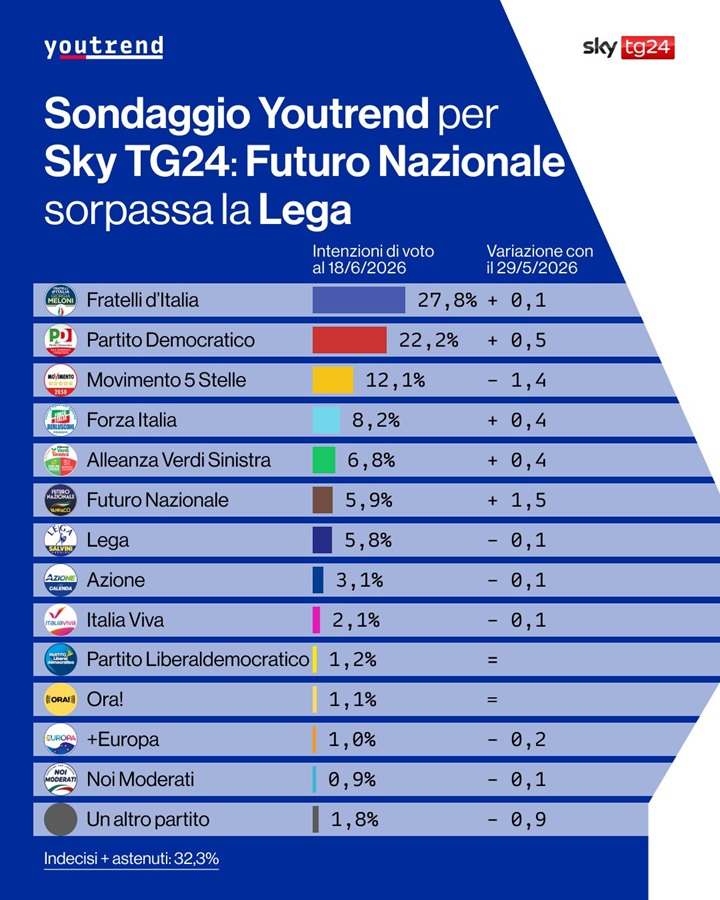
A purely proportional system would instead grant 57% of seats in both houses to Meloni’s Brothers of Italy and its allies.
A study by pollster Noto Sondaggi for La Stampa found that with the centre-right currently ahead by around four percentage points, the proposed law could deliver up to 242 lower house seats to the governing coalition, compared with 152 for the opposition.
However, experts have warned the reform could produce unexpected results, including different majorities in the Chamber of Deputies and the Senate. It is also tailored to the current political landscape in ways that may limit its effectiveness in the longer term. Concerns have also been raised about the removal of preference votes, meaning voters could no longer choose individual candidates within party lists.
Opposition scepticism
The centre-left Democratic Party has accused the government of “fearing defeat under the current electoral system” and “changing the rules of the game without any real debate with the opposition.” The party’s European Parliament lawmaker Stefano Bonaccini offered a pointed historical caution. “Everyone before Meloni who has changed the electoral law for political and personal gain has ended up losing afterwards.”
Meloni’s government is on course to become Italy’s longest-serving in September, a landmark she is expected to use to reinforce her stability argument heading into the 2027 campaign.