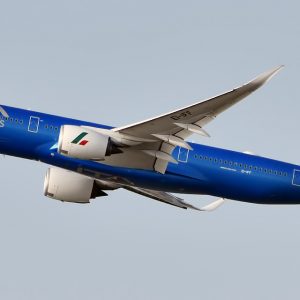
Italy’s flag carrier, ITA Airways, closes 2025 with a net profit of €209 million. It marks a historic milestone for an airline born from the wreckage of one of Europe’s most spectacular aviation collapses.
ITA Airways has recorded its first net profit since the airline’s founding, posting earnings of €209 million for the full year 2025. The result, announced on Wednesday, represents a landmark moment for Italy’s flag carrier, which has spent its short existence trying to prove that Italian state aviation could succeed where Alitalia so spectacularly failed.
Revenues reached €3.2 billion, of which €2.8 billion came from passenger traffic, while EBITDA stood at €404 million and EBIT came in at €25 million, a €22 million improvement on 2024.
CEO and General Manager Joerg Eberhart credited both the airline’s internal transformation and its deepening ties with the Lufthansa Group. “2025 marked a turning point for ITA Airways: we closed with a profit for the first time, confirming that we are on the right path,” he said. “It is the result of the commitment of the entire company and the first tangible effects of the industrial collaboration with the Lufthansa Group.” ITA Airways President Sandro Pappalardo echoed the sentiment, saying the results “confirm the solidity of ITA Airways’ path and the value of the collaboration between its shareholders.”
The Lufthansa buy-in
ITA Airways is jointly owned by the Italian government and the Lufthansa Group. The German aviation giant’s involvement has been central to the airline’s repositioning.
Lufthansa’s entry into ITA was the result of a protracted and at times fractious process. After Alitalia finally ceased operations in October 2021 following years of losses, government bailouts, and failed rescue attempts, ITA Airways launched in the same month as a leaner, state-owned successor. It has a reduced fleet, fewer routes, and a smaller workforce — a deliberate break from the bloated cost structure that had doomed its predecessor.
Lufthansa entered negotiations to acquire a stake in 2022, but talks dragged on for over a year amid disagreements over valuation and conditions imposed by European Union competition regulators. A deal was eventually reached in 2024, with Lufthansa initially acquiring a minority stake with options to increase its shareholding over time. The agreement gave ITA access to Lufthansa’s network, frequent-flyer ecosystem, and operational expertise, advantages that the airline’s management now says are beginning to show in the numbers.
The tie-up was seen as the most credible path to long-term sustainability for Italian aviation, providing the commercial heft and industrial discipline that successive Italian governments had failed to instil in Alitalia through decades of state intervention.
From Alitalia’s ashes
The contrast with Alitalia could hardly be starker. The former flag carrier became a byword for mismanagement and political interference, burning through billions in public funds over several decades. At its peak it employed tens of thousands of staff and operated routes across the globe; by its end, it had shrunk to a shadow of itself, kept alive by emergency loans before the plug was finally pulled.
ITA was designed from the outset to avoid those mistakes — smaller, more focused, and ultimately intended to attract a private strategic partner rather than remain a drain on the public finances. Wednesday’s results suggest that strategy may finally be working.