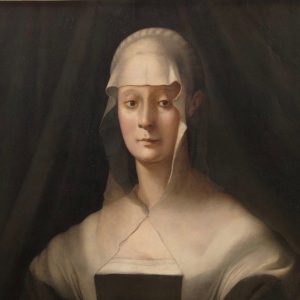
![Francesco I Grand Duke of Tuscany By Alessandro Allori - [2], Public Domain, https://commons.wikimedia.org/w/index.php?curid=99729525](https://italynews.online/wp-content/uploads/2026/03/Francesco-I-Grand-Duke-of-Tuscany.jpg)
Born in Florence on 25 March 1541, the second Grand Duke of Tuscany, Francesco I, left behind a legacy of art, alchemy, political ambiguity, and a death that has puzzled historians for more than four centuries.
On 25 March 1541, Francesco I de’ Medici was born in Florence, the son of Cosimo I de’ Medici and Eleonora of Toledo. He would go on to become the second Grand Duke of Tuscany, a patron of the arts, a devotee of chemistry and alchemy. He was also the central figure in one of Renaissance Italy’s most enduring murder mysteries which even modern forensic science has still not entirely resolved.
Son of a dynasty
Francesco was born into the most powerful family in Florence at the height of its influence. His father, Cosimo I, had been the first to hold the title of Grand Duke of Tuscany. Cosimo had also shaped the role into something formidable — a ruler who combined genuine political vision with an iron will to maintain Florentine independence against the competing pressures of the great European powers.
Francesco inherited the title but not entirely the instincts. Like his father, he could be despotic, and he taxed his subjects heavily. Unlike Cosimo, however, his political loyalties were less clear-cut. Where Cosimo had kept Florence’s interests at the centre of his calculations, Francesco diverted large sums to the imperial courts of Austria and Spain, raising questions about where his true allegiances lay. It was a tension that coloured his reign and contributed to the atmosphere of suspicion that would surround his death.
Patron, alchemist, builder
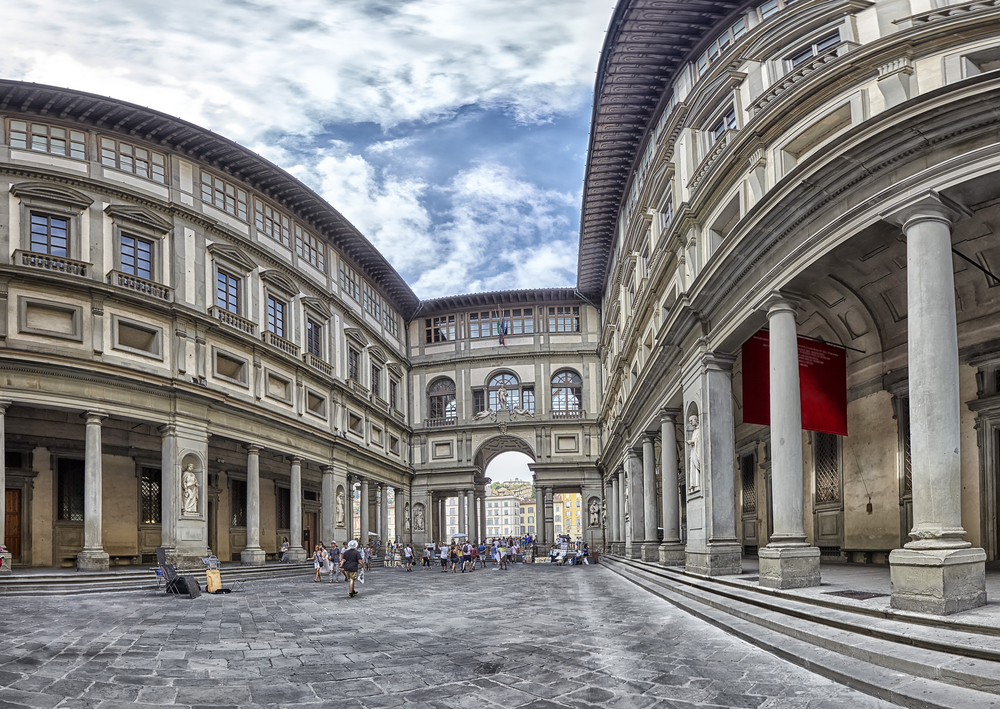
Whatever his political shortcomings, Francesco’s contributions to Florentine culture were substantial and lasting. He continued the Medici tradition of arts patronage, supporting artists and commissioning major building projects. Among the institutions he founded were the Accademia della Crusca — still one of the world’s oldest and most respected bodies dedicated to the study and preservation of the Italian language. Furthermore, and perhaps most famously, he created the Uffizi Gallery, today one of the great art museums of the world and home to an unparalleled collection of Renaissance masterpieces.
He also built the Medici Theatre and constructed the Villa di Pratolino in Vaglia, twelve kilometres north of Florence on the road to Bologna, as a gift for his mistress and later second wife, Bianca Cappello.
Beyond the arts, Francesco had a deep personal interest in chemistry and alchemy, spending long hours in his private laboratory. This was an unusual pursuit for a ruling duke, and one that would later feed the darkest theories about his death.
An unhappy marriage and a scandalous love

Francesco’s personal life was turbulent from the start of his rule. His marriage to Joanna of Austria, the youngest daughter of Ferdinand I, Holy Roman Emperor, and Anne of Bohemia and Hungary, was an unhappy one by most accounts. Joanna was said to be perpetually homesick for Austria, and Francesco made no effort at fidelity. He had already taken a Venetian mistress, Bianca Cappello, with whom he would maintain a relationship for the rest of his life and who bore him a son, Antonio.
Joanna died in 1578, aged just 31. The suddenness of her death, combined with Francesco’s swift remarriage to Bianca shortly afterwards, immediately gave rise to rumours that the couple had hastened her end. The atmosphere was not helped by reports that Francesco’s younger brother Pietro had resolved his own troubled marriage by a more direct method — allegedly killing his wife outright. Murder, in other words, did not seem entirely out of character for the Medici men of that generation.

The Florentines never welcomed Bianca. Despite the Villa di Pratolino and the trappings of legitimacy that marriage to the Grand Duke conferred, she remained an outsider — a Venetian, a former mistress elevated above her station in the eyes of a suspicious public. Francesco and Bianca had no legitimate children together, and when Francesco’s legitimate son Philip de’ Medici died young, Antonio — Bianca’s son by Francesco — was proclaimed heir, a decision that would have profound consequences.
Two deaths, eleven hours apart
In October 1587, Francesco and Bianca fell ill at the Medici family villa in Poggio a Caiano. They died within eleven hours of each other — Francesco first, Bianca shortly after. The official death certificates recorded malaria as the cause.
But almost nothing about the circumstances was straightforward. Francesco’s brother Ferdinando had visited the couple at the villa shortly before they fell ill. Ferdinando was a cardinal who stood to lose the succession entirely now that Antonio had been named heir. When news of their deteriorating condition reached him, he returned immediately and took personal control of the situation. He oversaw the bulletins sent to the Holy See, which reportedly attributed Francesco’s condition to poor eating habits and Bianca’s to anxiety over her husband’s health. Ferdinando also ordered the autopsies on both bodies, which duly concluded that malaria was responsible.
Ferdinando subsequently succeeded as Grand Duke of Tuscany. He renounced his cardinalate and went on to rule Florence until his own death in 1609.
Exhumations, arsenic, and the limits of certainty
The mystery did not rest quietly. When the bodies were exhumed in 1857 — two and a half centuries after their deaths — to be reinterred in the basement of the Medici Chapel at the Basilica di San Lorenzo, reports emerged of unusually well-preserved remains, fuelling theories of arsenic poisoning. Arsenic is well known to slow the process of putrefaction. Furthermore, its symptoms — fever, stomach cramps, vomiting — could plausibly be mistaken for a malarial infection.
A team from the Universities of Florence and Pisa conducted a new examination of the exhumed remains in 2005. The results were intriguing and ultimately contradictory. Testing of Francesco’s skeletal remains found the parasite plasmodium falciparum, which causes malaria, lending support to the official account. Analysis of his facial hair detected only low levels of arsenic, apparently ruling out chronic exposure.
A different hypothesis for Bianca
Bianca’s case, however, told a different story. Her remains were not in the family chapel but in broken terracotta jars buried under the crypt of the Church of Santa Maria a Bonistallo, near Francesco’s villa, a curious resting place for a Grand Duchess. Testing of her remains supported the theory of arsenic poisoning. Subsequent analysis of organs from Francesco also returned findings consistent with arsenic exposure.
The reconciliation of these results led researchers to a troubling hypothesis: that both Francesco and Bianca had been administered small doses of arsenic over several consecutive days. The quantities were too small to register clearly in hair analysis, but cumulatively lethal. The symptoms would have been indistinguishable from a severe malarial episode.
Yet Gino Fornaciari, professor of forensic anthropology and director of the Pathology Museum at the University of Pisa, remained unconvinced. His assessment, that malaria was by far the more probable cause of death, serves as a reminder that even modern science, applied to centuries-old remains, cannot always deliver a verdict beyond reasonable doubt.
The legacy is clear, the death unresolved
Francesco I de’ Medici left Florence the Uffizi, the Accademia della Crusca, and a body of artistic patronage that still shapes how the world understands Renaissance culture. He also left historians an unsolved murder case that has now occupied forensic scientists, archivists, and storytellers for more than four centuries. Whether he was a victim of political calculation by a brother who stood everything to gain, or simply a man who died of the same disease that killed millions in Renaissance Italy, may never be known with certainty.