On 14th July 1902, a pile of rubble lay where the St Mark’s campanile (bell tower) had once stood in Venice. Almost 1,000 years old, the building’s collapse was viewed as a tragedy by Venetians.
The bell tower in St Mark’s Square collapsed at around 9.45am that Monday morning. Remarkably, no-one was killed, the only reported casualty was the caretaker’s cat, and the Basilica of St Mark, standing just metres away, escaped without damage. The Biblioteca Marciana, however, did suffer structural harm in the collapse.
A crack, then catastrophe
A few days earlier, a crack had appeared in one of the tower’s walls, prompting authorities to establish a safety perimeter around the structure. It was not enough to save it. Shortly before 10am, the entire tower gave way, collapsing in on itself and burying the square in debris.
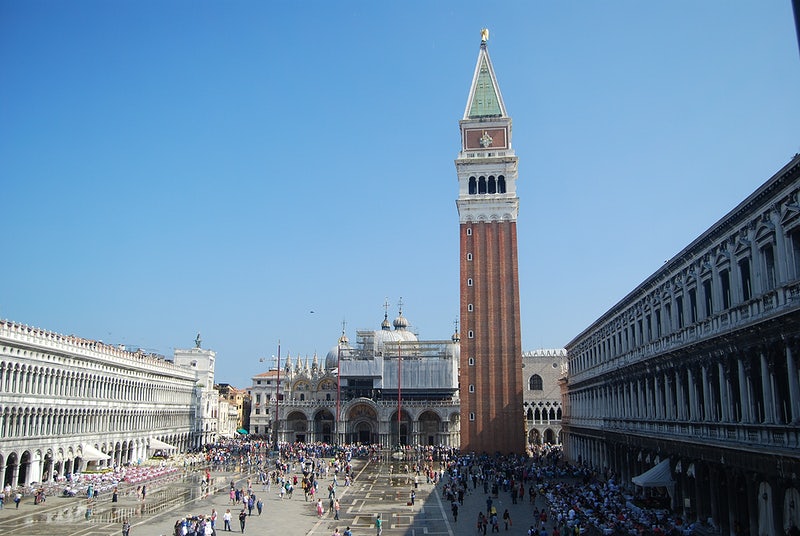
That same day, the Venice authorities approved funding for the reconstruction of the campanile on exactly the same spot in the piazza. It was to be rebuilt to resemble its appearance following 16th-century improvements to the original ninth-century design; a promise Venetians would later sum up in a phrase still used today: com’era, dov’era, “as it was, where it was”.
A tower with a long history of near misses
The campanile that fell in 1902 was not, in fact, the original. An earlier tower on the site had itself collapsed in 1080, prompting the Doge of the time, Domenico Selvio, to commission a replacement a few metres away. That structure, completed in the 12th century, reached almost 100 metres and served for centuries as both lighthouse and watchtower, guiding ships into the lagoon.
The tower survived a fire in 1489 and an earthquake in 1511, taking on the form Venetians would come to know only after 16th-century restoration work. It was fitted with a lightning rod in 1776, following further fire damage over the centuries. In an earlier age, the tower had also served scientific purposes: in the 16th century, Galileo is said to have used it to make observations that fed into his development of the telescope, even giving a demonstration from its summit.
Symbolic loss
Venetians regarded the 1902 collapse as a genuine tragedy. Standing just short of 100 metres, the campanile was seen as symbolic of the city itself. Its downfall, though, was perhaps inevitable; the tower had been built on foundations of wood and mud, leaving it vulnerable to instability as the centuries wore on.

The rubble was cleared from the square and dumped in the sea, around five miles offshore from the Venice Lido.
The new tower, designed with internal reinforcement to prevent any repeat of the disaster, incorporated a lift for visitors — a modern addition the original had never had. The rebuild took almost ten years to complete. The new campanile was finally inaugurated on 25th April 1912, chosen deliberately to fall on St Mark’s feast day, and has stood watch over the square ever since.