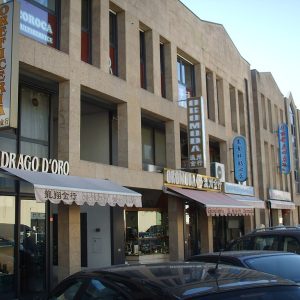
Italian investigators have dismantled an illegal shadow bank in Prato that allegedly channelled up to €100 million a year through an untraceable hawala payment network for Chinese, Albanian and Italian organised crime groups,. There were 41 arrests and €60million seized.
A major anti-mafia operation announced on 15 June 2026 has dismantled what investigators describe as a sophisticated illegal shadow bank operating out of Prato, the Tuscan city that is home to Europe’s largest Chinese-run textile district. The operation, codenamed Easy Money and coordinated by Florence’s Anti-Mafia Investigative Directorate (DDA) and the Prato Prosecutor’s Office, was conducted by investigators from the State Police’s Central Operational Service and the Prato mobile unit. It resulted in 41 precautionary measures and a court-ordered preventive seizure of more than €60 million.
Three separate criminal organisations are alleged to have used the bank as their financial infrastructure. The first specialised in laundering drug money; the second in international drug trafficking; the third in the smuggling of Chinese nationals into Italy. Between them, prosecutors estimate the illegal network moved between €80million and €100million a year for at least three years.
The Hawala System
The shadow bank’s core mechanism was the hawala system. This is a value transfer method of Islamic origin, centuries old, that operates on trust between agents rather than on any physical movement of money or paper trail. In China the same system is known as ‘chop-shop’, or ‘fei ch’ien’ (flying money). A drug trafficking organisation wishing to pay for a consignment abroad, for example, would hand cash to a hawala broker in Italy; a corresponding agent in the destination country would release an equivalent sum to the recipient, with the brokers settling their own accounts separately. No money crosses a border, no bank record is created, and the transaction is effectively invisible to law enforcement.
The Prato network’s top managers operated as professional financial brokers, offering this service at what investigators describe as “high levels of professionalism and risk.” Albanian groups with prior criminal records functioned as the network’s stable international brokers.
Textile companies as cover
To further insulate drug money from seizure during routine police checks across European borders, the network embedded its transactions within the legitimate-seeming cash flows of Chinese fast-fashion textile businesses. Prato has for decades been the centre of a major Chinese-run garment manufacturing industry, with hundreds of factories supplying fast-fashion retail across Europe. The organisation exploited the commercial relationships between these Prato factories and their counterpart firms on the Iberian Peninsula — companies in Madrid, Malaga, Valencia and Seville — to move entirely undeclared cash through ostensibly commercial channels.
A dense network of couriers and cash collectors moved between Italy and Spain, France and Portugal to physically facilitate the payments. All the cash involved was, in prosecutors’ language, entirely “black” — undeclared and untaxed at every stage.
The Italian Mafia connection
The investigating judge found the aggravating circumstance of mafia facilitation, given that three named Italian organised crime groups used the shadow bank as a payment channel. The Briganti clan of Lecce is among them, as is the ‘ndrina Fiare-Razionale-Gasparro of San Gregorio d’Ippona in the Calabrian province of Vibo Valentia, a branch of the ‘Ndrangheta. The Camorra clan Aquino-Annunziata, from Campania, also allegedly availed itself of the bank’s services.
The involvement of all three of Italy’s main criminal organisations — ‘Ndrangheta, Camorra and Sacra Corona Unita — in a single financial infrastructure is significant. It illustrates the degree to which Chinese underground banking networks have become the preferred financial service providers for Italian and international organised crime. Investigations in recent years have repeatedly shown this pattern: a 2023 probe found that ‘Ndrangheta affiliates used shadow Chinese brokers to transfer €8 million from Italy to Colombian drug suppliers without moving a single physical banknote across a border.
The people-smuggling network
The third criminal arm uncovered by Operation Easy Money was a people-smuggling operation moving Chinese nationals into Italy. The route exploited a legal gap: Serbia is not part of the Schengen area and does not require visas for Chinese citizens. Migrants were flown or transported to Belgrade, housed in Chinese-run hotels in the Serbian capital, and then moved overland through Hungary and Slovenia into Italy.
Their destinations in Italy were Prato, Turin and Sommacampagna, near Verona. The smugglers charged €9,500 per person.
The suspects in Operation Easy Money are charged with a range of offences including criminal association for the purpose of money laundering, international drug trafficking and facilitation of illegal immigration.