Il Sole 24 Ore’s annual generational quality of life index reveals a country of deep regional inequalities, declining fertility, rising antidepressant use, and a generation of young people poorly served by both the labour market and the education system.
A new edition of Il Sole 24 Ore‘s Quality of Life by Age Group survey, previewed at the Trento Economics Festival, paints a detailed and at times troubling portrait of Italy across its generations. It maps where children, young people, and the elderly thrive, and where they do not.
Florence has emerged as the best Italian province in which to grow up, while Bolzano leads the rankings for young people’s quality of life. Meanwhile, Trieste tops the table for the elderly. Trento places second in both the generational index for the elderly and for young people, though it falls to thirteenth in the rankings for children.
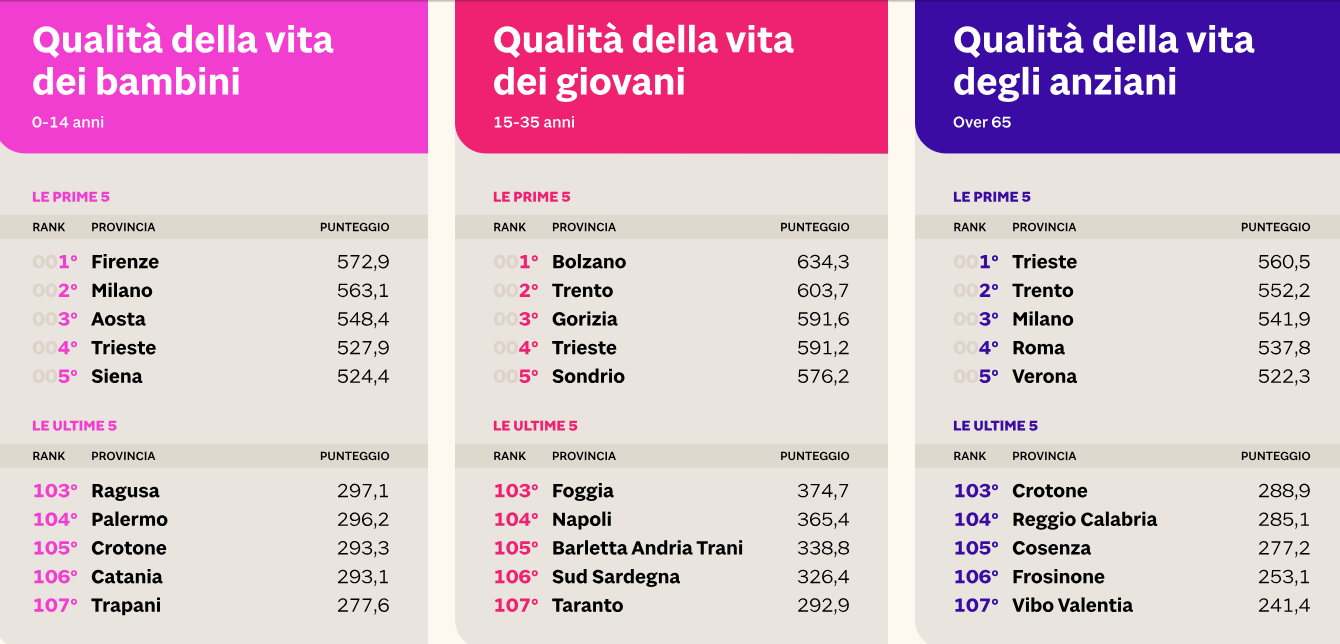
Children: fertility gaps and overcrowded cities
In the children’s index, Bolzano records Italy’s highest fertility rate, at 1.55 children per woman — well above the national average. At the other end of the spectrum, Cagliari holds the record for the density of paediatricians but simultaneously registers one of the country’s most critical birth rates, at just 0.75 children per woman. Milan scores well for local services, schools equipped with gymnasiums, and paediatric nursing provision, but falls to the bottom of the rankings for average living space available to families, at just 56.6 square metres per household.
The national picture is stark. Italy’s fertility rate has fallen to 1.14 children per woman, the average age of first-time mothers has risen to 32.7, and the marriage rate has dropped to 2.8 per thousand inhabitants.
Young people: a labour market that fails the south
The employment data for Italy’s under-35s reveal some of the sharpest regional divides in the entire survey. In Taranto, youth unemployment stands at 44% — more than ten percentage points higher than in Agrigento, itself no exemplar of opportunity. Bologna, meanwhile, confirms its position as Italy’s university capital: one in two young people in the city holds a degree.
The picture is compounded by broader indicators of social stress. The number of people living alone is rising, up 7.9%, and the use of antidepressants has increased by 3.3%. Academic performance, as measured by INVALSI standardised tests, remains below pre-pandemic levels: 44% of students have inadequate numerical skills and 39.9% fall short in literacy.
Alessandro Rosina of the Università Cattolica del Sacro Cuore in Milan frames the challenge in broader terms. “Today, we want to live a long life, but with quality of life. We must therefore think more carefully about how we educate young people, how we use new technologies, how we promote adequate wages, but also about everything that allows people to feel at home. What makes one region more competitive than others? And what should we be concerned about when we look at Italy, even in international comparison?”
The elderly: pensions, proximity, and civic life
Among Italy’s older population, Trento leads on home care provision and levels of civic participation, while Milan records the highest average pension payments in the country at €26,300 per year. Bari, Naples, and Palermo stand out in a perhaps unexpected area: the quality and proximity of local services dedicated to those over 65.
Trieste’s position at the top of the elderly index reflects a combination of welfare provision, social infrastructure, and — notably — access to services within a 15-minute walk. This “proximity” metric is one of the new additions to the survey’s methodology, which has been expanded from 15 to 20 territorial indicators per generational group, bringing the total to 60 certified provincial statistics. The new indicators also capture the presence of family or social support networks that can be relied upon in times of need.
A country in demographic transition
Taken together, the survey’s findings sketch a country in the midst of profound demographic and cultural change — ageing rapidly, fragmenting socially, and struggling to equip its youngest generations with the skills and opportunities they need. The north-south employment divide remains as entrenched as ever, civic and family networks are fraying in many areas, and the classroom data suggest the educational recovery from the pandemic years remains incomplete.
The full rankings will be published in the new edition of Il Sole 24 Ore‘s Quality of Life by Age Group report.