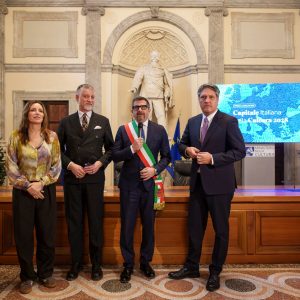
L’Aquila is set to become Italy’s Capital of Culture 2026 on 17 January, spotlighting a city defined by history, creativity and remarkable resilience. The title brings a year-long cultural calendar, investment and fresh attention to this Abruzzo capital, long recovering from the devastating 2009 earthquake. Our quick guide to L’Aquila highlights some of the top sights in and around the city.
L’Aquila sits in a wide basin of the Abruzzo Apennines, surrounded by dramatic mountain scenery. It combines medieval walls, elegant Baroque churches and a compact historic centre that travellers can explore on foot. The city’s cultural revival and restoration efforts are part of its modern identity.
The Capital of Culture year 2026 will feature about 300 events across roughly 300 days, with programmes spread across L’Aquila, nearby towns and partner cities under the theme “One territory, a thousand capitals.” Enjoy our quick guide to L’Aquila.
Must-see sights
Basilica di Santa Maria di Collemaggio

A symbol of L’Aquila, this 13th-century basilica is known for its striking pink and white stone façade and its role in the Perdonanza Celestiniana, a medieval rite recognised by UNESCO.
Fountain of the 99 Spouts

In the heart of the historic centre, this fountain is said to represent the 99 villages that founded the city.
Forte Spagnolo
A massive 16th-century fortress built during Spanish rule. Its walls now house part of the Museo Nazionale d’Abruzzo.
Baroque treasures
Don’t miss Santa Maria del Suffragio and reconstructed historic palazzi that reflect the city’s artistic heritage.
Cultural highlights in 2026
- World-premiere opera by Nicola Piovani to mark an 80th anniversary celebration.
- A major artistic project for the 800th anniversary of Saint Francis’s death.
- The first International Conducting Competition for young maestros.
- A Fabio Mauri exhibition at MAXXI L’Aquila for his centenary.
- Marinella Senatore’s participatory dance and performance project in May.
- The ItARTS – Back to L’Aquila festival at the A. Casella Conservatory.
Things to do
Wander the historic centre – Discover cobblestone lanes, baroque churches, and piazzas framed by mountain views.
Attend cultural events – In 2026, streets, squares and courtyards will serve as performance spaces for music, theatre and art.
Enjoy the university ambience – L’Aquila’s academic institutions — including a fine arts academy and conservatory — lend a lively, creative energy.
Food and drink

Food in L’Aquila reflects its mountain setting and long agricultural traditions. Abruzzo’s inland cuisine is robust, seasonal and rooted in pastoral life, with recipes shaped by shepherding, legumes and local produce rather than coastal seafood. Meals here tend to be simple but deeply flavoured, built around quality ingredients and slow cooking.
The city is also at the heart of some of Abruzzo’s most prized food products, many of which appear on menus during festivals and cultural events. Eating out is generally relaxed and good value, with unfussy trattorias sitting alongside wine bars and cafés that stay lively thanks to the city’s university population.
- Lamb and ragù dishes in local trattorie.
- Abruzzo saffron, a prized regional product.
- Caciofiore cheese and aged salumi.
- Local wines, often served at tastings and alongside cultural events.
Exploring the surroundings
Nature lovers can head into the Gran Sasso and Monti della Laga National Park for hiking, wildflower meadows and panoramic views. Slightly gentler trails await in the Sirente-Velino area, leading to limestone gorges and medieval hamlets.
The Adriatic coast — including beaches near Pescara and Francavilla al Mare — lies about 1.5–2 hours away by car for a day trip.
Practical tips
- Getting around: L’Aquila is compact and best explored on foot.
- When to go: 2026 is an ideal year, with cultural events throughout the seasons.
- Nearby travel: Rome is reachable by train for day trips, but stay longer to enjoy L’Aquila’s slower pace.
If you found our quick guide to L’Aquila useful, head to the Travel in Italy section for other city and regional guides.