While Rome was convulsed by resignations and referendum fallout, Giorgia Meloni slipped quietly to Algiers for what may be the most consequential meeting of her premiership. The visit underlines how Italy has built an irreplaceable energy and security partnership in North Africa — and how the Iran war has made Algeria more valuable than ever.
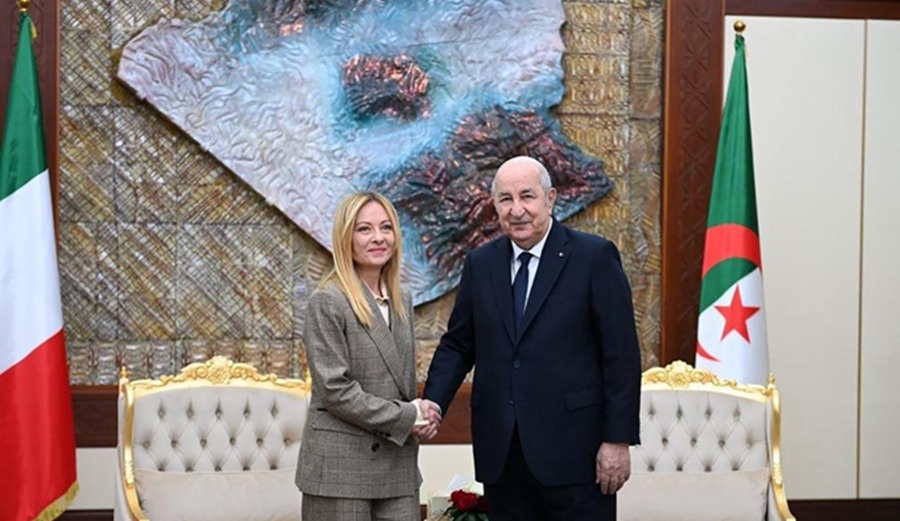
On the same day that Daniela Santanchè was submitting her letter of resignation and Rome’s political class was absorbed entirely in the referendum fallout, Giorgia Meloni was sitting across from Algerian President Abdelmadjid Tebboune in the presidential palace in Algiers for what has become one of the most important bilateral meetings Italy holds each year. The visit — Meloni’s second official trip to Algeria in under four years, her first having come within three months of taking office — was billed as a “working and friendship” visit. Its substance was considerably more strategic than that phrase implies.
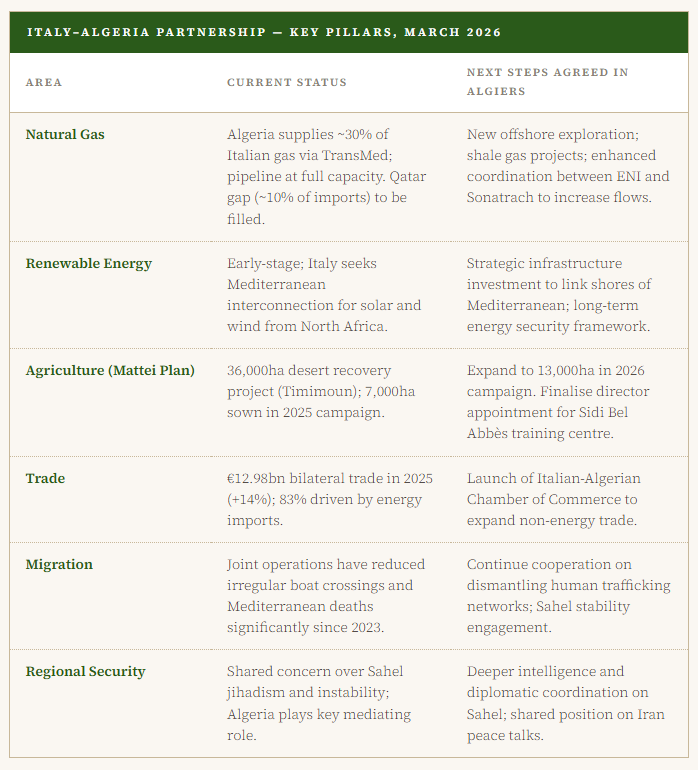
Algeria supplies approximately 30% of Italy’s natural gas, primarily through the TransMed pipeline — the same subsea infrastructure known in Italy as the “Mattei gas pipeline” after the pioneering industrialist Enrico Mattei, who first envisioned the connection in the 1960s. The pipeline, which runs from Algeria through Tunisia and beneath the Mediterranean to Sicily, has been the bedrock of the relationship for decades. It is now running at full capacity. And the geopolitical context that currently surrounds it has made Algeria’s reliability as an energy partner more economically critical to Italy than at any point since the 1970s oil crisis.
Iran war cuts Qatar gas supply to Italy
Qatar, which before the Iran war provided around 10% of Italy’s gas imports, has been unable to fulfil contracts since repeated Iranian strikes disrupted its major LNG production site. Italy, which generates more than 40% of its electricity from natural gas, has been urgently negotiating substitute supplies. Algeria is the obvious answer. At the Algiers press conference, Meloni announced that the two countries had agreed to strengthen cooperation through new offshore exploration and shale gas extraction projects that would, over the medium term, increase gas flows from Algeria to Italy. Tebboune, for his part, reaffirmed Algeria’s willingness to “honour all commitments” and described Italy as “a strategic and reliable partner.”
The energy dimension is the most urgent, but it is by design no longer the only one. Meloni has been explicit in framing the Italy-Algeria relationship as a model for the broader ambition encoded in her government’s signature foreign policy initiative: the Mattei Plan for Africa. Named after the ENI founder who built the original Algeria partnership, the plan envisages Italy positioning itself not as a post-colonial donor but as a genuine industrial and development partner for African nations — combining energy infrastructure with agricultural investment, digital cooperation, vocational training, and migration management.
What is the Mattei Plan for Africa?
Launched by Meloni in January 2024, the Mattei Plan for Africa is Italy’s attempt to reframe its relationship with the African continent as a partnership of equals rather than a relationship defined by migration management and development aid. Named after Enrico Mattei — the ENI founder who built Italy’s first energy relationships in North Africa in the 1950s and 60s — the plan commits Italy to a portfolio of concrete, bilateral, co-financed projects across energy, agriculture, digital infrastructure, health, and education.
Algeria has emerged as the plan’s flagship partner. Two major joint initiatives are already under way. Firstly, a desert agriculture project developed with the Italian company BF International, which aims to recover more than 36,000 hectares of land in the wilaya of Timimoun for the production of cereals and legumes (the 2026 planting campaign will expand from 7,000 to 13,000 hectares). Then, the “Enrico Mattei” Italian-Algerian Centre of Excellence in Sidi Bel Abbès, designed as a pan-African hub for agricultural vocational training and innovation.
Critics, including Italian analysts and some academic economists, have questioned whether the Mattei Plan amounts to a genuine paradigm shift or a repackaging of Italy’s existing bilateral relationships with more politically resonant branding. The answer, in Algeria’s case, appears to be somewhat both. The bilateral trade increase of 14% in 2025 and the concrete projects under way in Timimoun suggest real momentum. Whether the plan succeeds in shifting Italy’s image in Africa from migration gatekeeper to industrial partner remains a longer-term question.
Migration cooperation
The migration dimension of the relationship has been perhaps the least publicly discussed but most operationally significant. Meloni referenced it directly in Algiers, thanking Tebboune for a cooperation she described as “a model for the region.” By her account, Italian-Algerian coordination since 2022 has materially reduced the number of irregular boat crossings from Algeria toward Italy’s coasts, and has contributed to a decrease in Mediterranean deaths. The mechanism involves Algerian border and coastguard cooperation, joint intelligence sharing on trafficking networks, and what Italian officials describe as a “whole-route” approach, i.e. disrupting migration flows before they reach the sea.
The Algiers visit also touched on geopolitical matters that extend well beyond the bilateral relationship. Both leaders addressed the Iran war: Meloni said she welcomed reports of possible US-Iran peace talks and that Italy would “support any initiative for peace and stability,” while also expressing concern about escalation in Lebanon.
For Meloni personally, the timing of the visit carried a certain political utility. On a week when the domestic crisis dominated nearly every Italian headline, the Algeria trip served as a reminder that her government is also conducting active, consequential foreign policy on an issue — energy security — that matters directly to Italian households. It is a dimension of her record that her critics have been slow to acknowledge and that her supporters have been eager to promote. Whether the Mattei Plan ultimately lives up to its ambition is a question the next several years will answer.