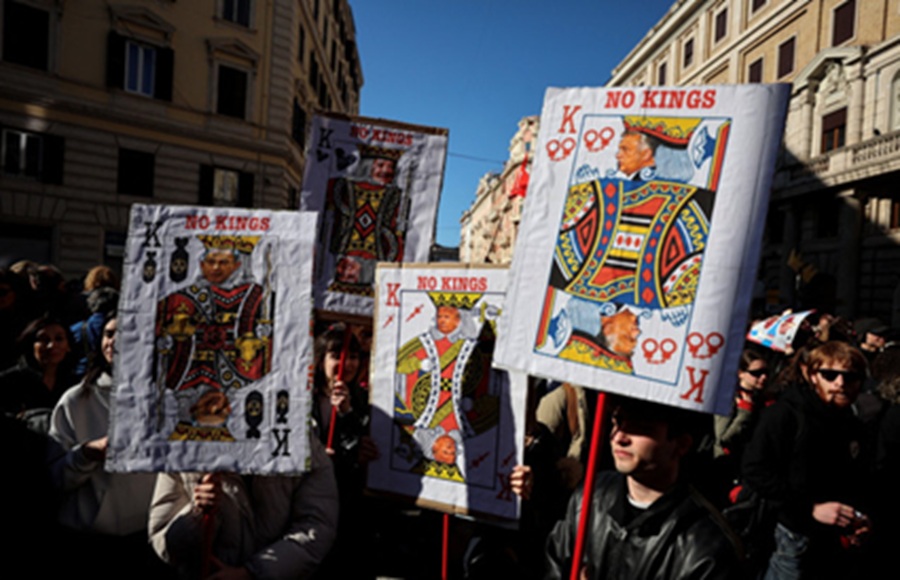
Part anti-Trump, part anti-Meloni, part anti-war – tens of thousands took to the streets of Rome on Saturday in the Italian chapter of the ‘No Kings’ movement. It drew, what organisers say could be the largest day of domestic political protest in US history, with more than nine million participants worldwide.
Thousands of demonstrators filled Rome’s Piazza della Repubblica on Saturday and marched toward Piazza di Porta San Giovanni in a demonstration that wove together three distinct threads of protest: anger at Donald Trump, opposition to Giorgia Meloni’s government, and fury at the ongoing US and Israeli war against Iran. The Rome march was Italy’s most significant chapter of the global No Kings movement — the third round of coordinated international demonstrations since Trump returned to the White House in January 2025, and by far the largest.
Under a heavy police presence, marchers carried banners in Italian and English: “For a World Free from War” stretched across an enormous cloth at the front of the column. Behind it came the familiar hand-lettered placards of anti-government protest: “No Kings,” “No Tyrants,” “Hands Off Democracy.” At this gathering, the Italy-specific anger was palpable. Protesters directed chants at Meloni, whose government had suffered its first major domestic defeat only days earlier when voters overwhelmingly rejected her referendum on judicial reform — a vote that critics had framed as an assault on the independence of Italy’s courts.
The Italian protest
The Italian “No Kings” event had its own distinct character, unlike the explicitly US-facing protests in Paris where several hundred Americans living in France gathered at the Bastille alongside French labour unions. The Rome march was organised primarily by Italian civil society and Italian political groups, with the international No Kings framing applied to a domestic agenda. The permit application for a separate US citizens’ protest had been refused by the Rome police authority, reportedly because the existing Italian No Kings event had exhausted available authorisations for the weekend. Democrats Abroad Italy instead organised an alternative “No Tyrants” gathering in Todi.
Beyond the referendum, protesters also focused on Italy’s foreign policy posture. Banners protested the Israeli and US strikes on Iran, calling for a “world free from wars” and targeting what demonstrators described as Meloni’s alignment with the Trump administration on both migration policy and the Middle East. The prime minister has been careful to maintain diplomatic relationships with Washington while nominally supporting multilateral solutions to the Iran conflict, a balance the protests implicitly challenged.
The Global “No Kings” picture
he Rome march was one node in a vastly larger mobilisation. Across the United States, organisers from the progressive nonprofit Indivisible said they expected more than nine million participants at over 3,300 events in all 50 states. The flagship rally took place in Minneapolis-St Paul, Minnesota, scene of the aggressive ICE enforcement operations that killed two people, Renee Good and Alex Pretti, in incidents that galvanised the movement. Bruce Springsteen performed. Senator Bernie Sanders and actor Jane Fonda appeared. Oscar-winning actor Robert De Niro addressed the crowd in New York, calling Trump “an existential threat to our freedoms.” Around 40,000 marched in San Diego alone.
In Europe, around 20,000 people demonstrated in Amsterdam, Madrid and Rome combined. Berlin saw significant turnout. In London, protesters carried “Stop the Far Right” and “Stand Up to Racism” banners. The movement has become, in less than a year, one of the most visible and geographically dispersed grassroots protest networks in recent memory.
The White House dismissed Saturday’s demonstrations as “leftist funding networks” with “little real public support,” with spokesperson Abigail Jackson characterising them as “Trump Derangement Therapy Sessions.” Organisers pointed out that two-thirds of RSVPs came from outside major US cities — from states like Idaho, Wyoming and Louisiana, from conservative-leaning suburbs, from communities that did not vote for the Democratic Party in 2024.