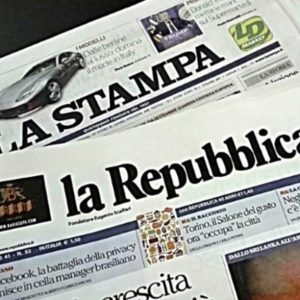
Italy’s two most prominent left-leaning national newspapers have changed hands, as the Agnelli family’s GEDI media group completes the sale of both la Repubblica and La Stampa.
GEDI announced on Monday that the sale of la Repubblica to Greek media conglomerate Antenna has been finalised. La Stampa, the Turin-based liberal newspaper that has been a fixture of Italian public life for over a century, is also being sold, with GEDI confirming it will pass to SAE, an Italian group that owns a portfolio of regional titles. In December last year, the government stepped in over the proposed sales.
Elkann defends the decision
John Elkann, the Agnelli heir who had been the driving force behind GEDI, broke his silence on the sales in an interview with Italian news agency ANSA. He insisted the move was the right one for both publications and for the journalists who work at them.
“Publishing is a profession that can be practiced independently only if you have your accounts in order,” Elkann said, pointing to the difficult economics of the newspaper industry as the central reason behind the decision to sell.
He was candid about his frustrations with the way media ownership is perceived in Italy. “My family and I have always considered publishing a profession that thrives on its readers, but unfortunately in Italy, owning a newspaper is considered a tool of influence and power, not a profession.” He said he was convinced that both buyers would “guarantee a future of development and freedom for the journalists of the two publications.”
Who are the new owners?
Antenna is one of Greece’s largest and most established media groups, with interests spanning television, radio and digital platforms. Its acquisition of la Repubblica represents a significant expansion into the Italian market and marks the first time the paper — founded in Rome in 1976 — has passed out of Italian ownership.
SAE is an Italian publishing group with roots in regional and local journalism. Its purchase of La Stampa, which is based in Turin and has been published since 1867, places the paper in the hands of a company with experience in the Italian market but a very different profile to the industrial dynasty that previously owned it.
Concerns over independence and jobs
The sales have not been welcomed without reservation. Journalists at both papers have publicly voiced anxiety over two issues: editorial independence and the prospect of redundancies. Staff at la Repubblica and La Stampa fear that new ownership structures could bring pressure on editorial lines, and that cost-cutting measures may follow the change of hands.
Both Antenna and SAE have offered assurances on these points, pledging to protect the editorial integrity of the titles and to approach any restructuring responsibly. Whether those pledges will satisfy staff in the longer term remains to be seen.
End of an era
The exit of the Agnelli family from Italian media closes a significant chapter in the country’s press history. GEDI had long been one of the most influential publishing groups in Italy, and la Repubblica in particular has played a central role in shaping the country’s political and cultural debate for five decades.
The sales come at a moment of acute pressure across the Italian newspaper industry, with print circulation in long-term decline and advertising revenues continuing to migrate online. Elkann’s comments suggest he concluded that the papers needed owners for whom publishing was a core business, rather than one strand of a broader industrial empire.