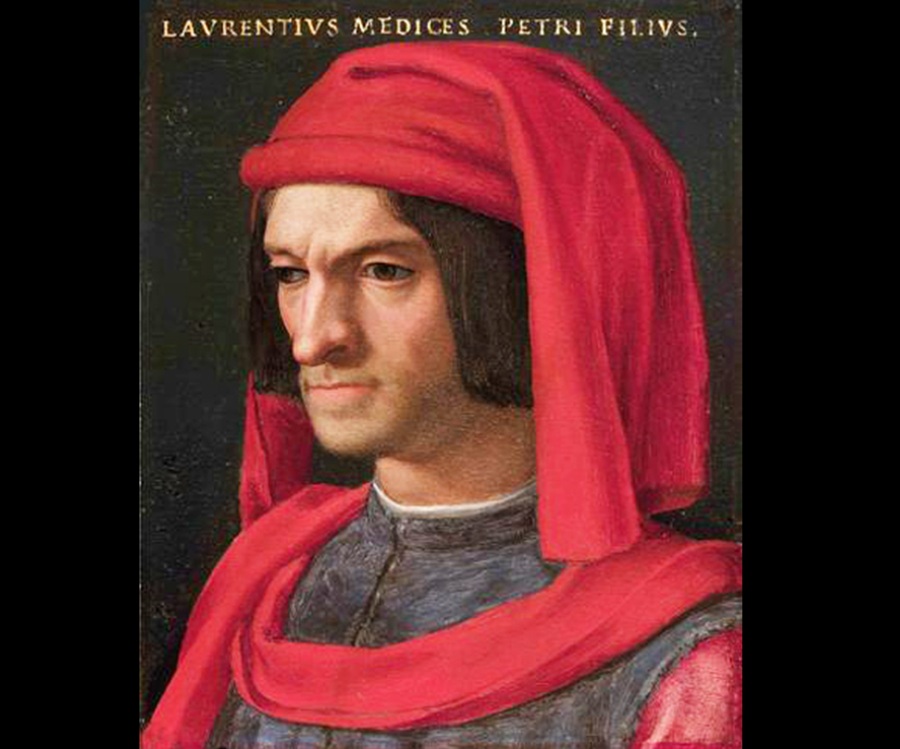
8 April 1492 — Lorenzo the Magnificent, the man who made Florence the centre of the Renaissance world, took his last breath at the villa of Careggi, aged just 43.
In March 1492, Lorenzo de’ Medici was carried by litter from his palace on the Via Larga to his villa at Careggi, where he died on 8 April, at the age of forty-three. In spite of his long illness, his death was a shock to Florence.
For twenty-three years, Lorenzo had been the animating force of his city: its diplomat, its protector, its impresario. The contemporary diarist Luca Landucci lamented the loss, writing that Lorenzo was “the most illustrious, the richest, the most stately and the most renowned among men.”
In the final months of his life, Lorenzo had difficulty walking. He also suffered from constant fevers and pains all over his body. Lorenzo knew he was dying, and he went to Careggi, the family villa where his father and grandfather had also gone to die. He died from gangrene caused by an ulcer on his leg, a condition worsened by the gout that had plagued Medici men for generations.
His friend and poet Poliziano recorded his last moments: Lorenzo embraced those gathered around him, humbly asked pardon of anyone he had caused annoyance during his illness, and received extreme unction. The Gospel of the Passion was read aloud and he showed that he understood, by moving his lips, raising his eyes, or sometimes moving his fingers.
Many signs and portents were claimed to have taken place at the moment of his death: the dome of Florence Cathedral struck by lightning, ghosts appearing in the streets, and the lions kept at Via Leone fighting one another. An era was ending.
The “benevolent tyrant”
Lorenzo the Magnificent had come to power young and unexpectedly, the grandson of the great Cosimo de’ Medici and the son of Piero the Gouty, so called for the same inherited affliction that would eventually kill Lorenzo himself. He was twenty years old when he took the reins of Florence in 1469.
According to the historian Francesco Guicciardini, Lorenzo’s regime was “that of a benevolent tyrant in a constitutional republic.” It was a characterisation Lorenzo would probably not have disputed. He understood that power in Florence required both the appearance of civic virtue and the reality of firm control. In 1480, he reorganised the city’s government through a new Council of Seventy. Packed with allies, it consolidated his authority more openly than ever.
What distinguished Lorenzo from other rulers of his day was not merely the exercise of power, but what he did with the peace he created. He worked carefully to maintain the Peace of Lodi, the treaty first signed by his grandfather Cosimo between the major Italian states, which kept the peninsula in a period of relative stability for decades. Florence, shielded from destructive wars, could turn its energies elsewhere.
The Renaissance Patron
No aspect of Lorenzo’s legacy endures more brilliantly than his role as the great patron of the Italian Renaissance. He understood, with an almost uncanny instinct, that the artists, poets and philosophers gathering in Florence were doing something extraordinary. He gave them the conditions — the money, the encouragement, the social status — to flourish.
His friendship with artists was not the detached condescension of a wealthy benefactor. Rare for his era was his custom of treating artists with “the affectionate and warm-hearted familiarity that allows a protégé to stand erect at the side of his protector.” At the villa at Careggi, he held gatherings of poets, scholars and painters, the so-called Platonic Academy. It was less a formal institution than a circle of extraordinary minds. It included the philosopher Marsilio Ficino, the humanist Giovanni Pico della Mirandola, and the poet Poliziano, who would be at his bedside at the end.
Michelangelo and Botticelli
It was at his sculpture school that Lorenzo spotted a fifteen-year-old boy of remarkable talent, whom he took into the Medici household and raised almost as a son – Michelangelo Buonarroti. The New Sacristy at San Lorenzo church was designed by Michelangelo to hold four Medici tombs. However, the grand monument with the tombs of both Lorenzo and his brother Giuliano. was not completed. Lorenzo and Giuliano rest together beneath the altar.
It is argued that Sandro Botticelli wove the Medici into his art, using Medici family members (as well as himself) as models in his great religious paintings. In fact, a lineage of Medici men are in the Adoration of the Magi.
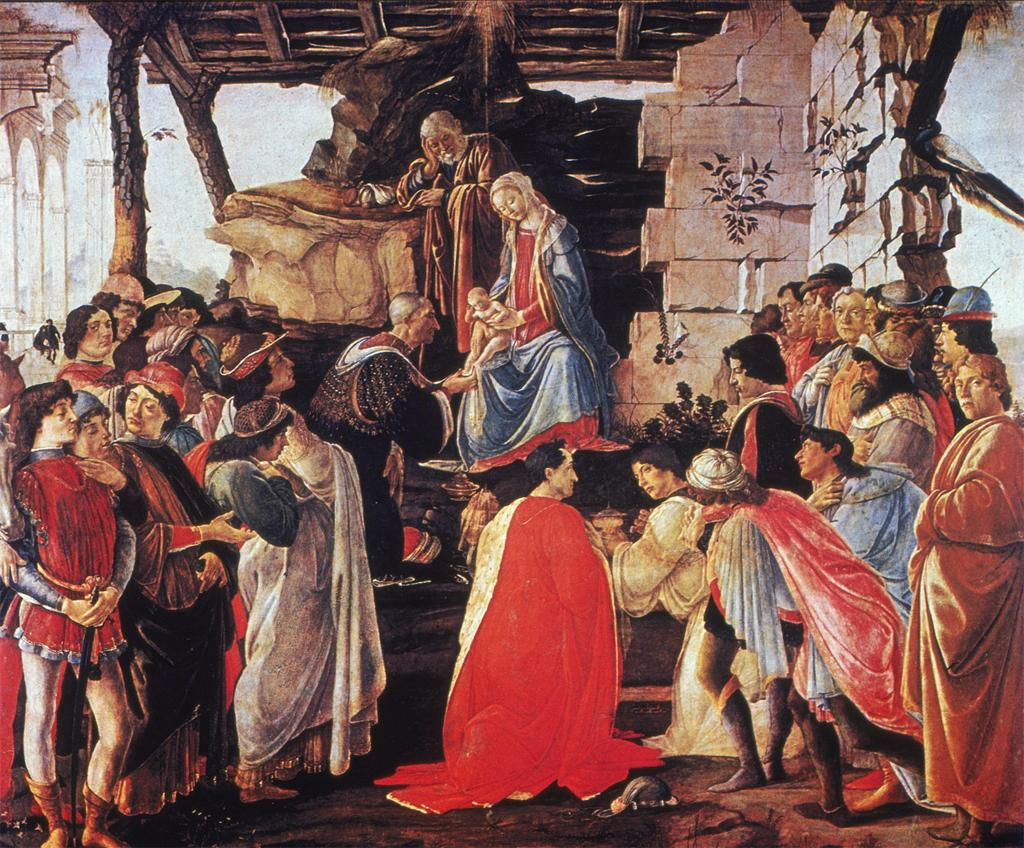
Piero the Gouty: Cosimo’s son, kneeling in the centre wearing a red cloak.
Giovanni di Cosimo de’ Medici: Standing next to Piero in white.
Giuliano de’ Medici: Positioned on the left in a red, gold-chained robe.
Lorenzo de’ Medici (the Magnificent): Often identified as the young man with dark hair on the right.
Lorenzo also expanded the collection of manuscripts and classical texts begun by Cosimo, commissioning copies to be made of ancient works retrieved from the East and sharing them across Europe.
The Pazzi Conspiracy
Power invites enemies. In 1478, the Pazzi family, rival bankers who had long chafed under Medici dominance, hatched a conspiracy with the support of Pope Sixtus IV. They wanted to destroy Lorenzo and his brother Giuliano in a single, violent stroke.
They chose the most audacious setting imaginable – High Mass at Florence’s Cathedral on Easter Sunday. As the bell rang for the elevation of the Host, the assassins struck. Giuliano de’ Medici was stabbed nineteen times and died on the cathedral floor. Lorenzo, wounded in the neck, escaped into the sacristy, where he and his companions barricaded the doors. The coup failed.
What followed was swift and merciless. Around eighty conspirators and their associates were captured and executed. The archbishop of Pisa was hanged from the windows of the Palazzo della Signoria, still in his vestments. Lorenzo emerged from the crisis not weakened but stronger. His grief for Giuliano channelled into a consolidation of power more complete than anything he had achieved before. He also wrote an elegy for his brother.
The Lorenzo the Magnificent legacy
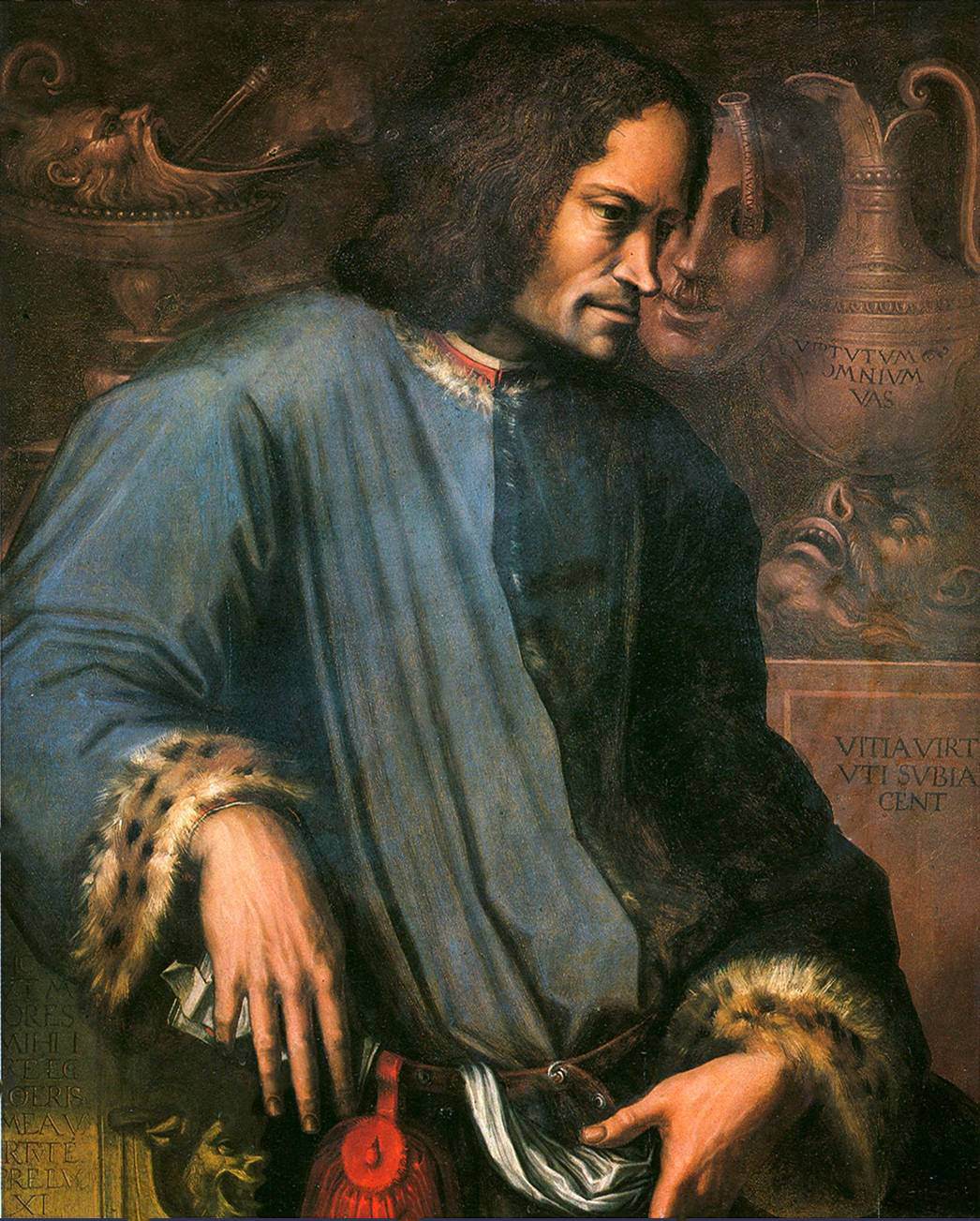
Lorenzo’s death at forty-three was a tragedy in the classical sense: a great man brought low at the height of his powers. His son Piero inherited Florence but not his father’s gifts. Within two years the Medici were in exile, swept aside by the French invasion and by the thunderous preaching of Girolamo Savonarola. Ironically, it was Lorenzo who had invited the firebrand priest to Florence.
And yet the dynasty proved more resilient than its critics imagined. Just before Lorenzo’s death, his sixteen-year-old son Giovanni had been made a cardinal. In 1512, the Medici returned to Florence from exile, and in the following year, Giovanni was elected Pope Leo X. The family that Lorenzo had so carefully positioned across the chess board of Italian power would eventually produce two popes, two queens of France, and the Grand Dukes of Tuscany.