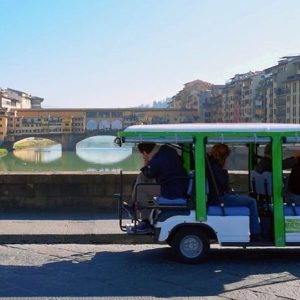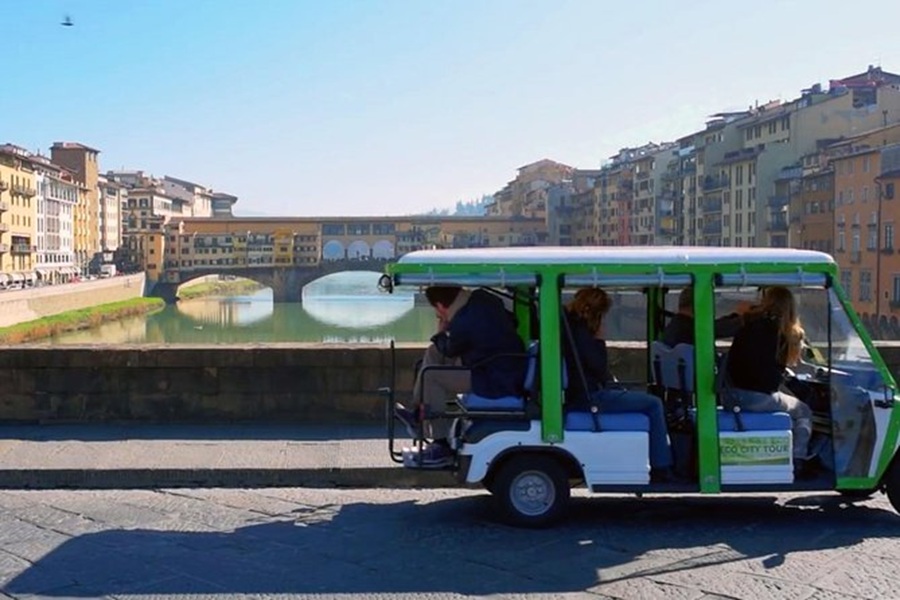
Six months after clearing rickshaws and caddies from its UNESCO streets, Florence begins issuing permits for a new, guided shuttle system. It is designed to bring order to the historic centre’s tourist transport chaos.
Florence has taken its first concrete steps towards bringing regulated tourist transportation to the streets of its UNESCO-designated historic centre. The city issued the first four operating permits on 15 April to two travel agencies as part of a closely controlled pilot scheme.
The initiative, authorised by a public notice released in October 2025, allows for up to 12 permits for tourist shuttle operations along two municipally designated routes. There is a maximum of 24 vehicles in total — 12 per route — to be permitted once the programme reaches full capacity. For now, the four newly authorised shuttles represent the opening phase of what the city is treating as an experiment to be carefully observed before any wider rollout.
Each participating shuttle must carry an onboard guide or tour assistant — a requirement that distinguishes the new service from the informal, unregulated vehicles it replaces. It is also intended to ensure that visitor experience, rather than simply crowd movement, remains at the heart of the operation.
Exception to the ‘unconventional’ vehicle ban
On 15 October 2025, when Florence prohibited tourist transportation using rickshaws, caddies, golf carts and other unconventional vehicles across the entire UNESCO area. The only exception to that blanket prohibition is the new officially permitted shuttle service.
In a joint statement, economic development and tourism councillor Jacopo Vicini and mobility councillor Andrea Giorgio clarified the permit situation. “By issuing these permits, we are starting operations for the first four shuttles along predefined routes, following last summer’s ban on atypical vehicles such as caddies, golf carts and rickshaws across the UNESCO area.”
The previous model had drawn sustained criticism on multiple grounds: pedestrian safety concerns, the degradation of the visual character of streets in one of the world’s most visited historic centres, and the broader sense that informal tourist transport had colonised public space in ways that were neither safe nor appropriate to Florence’s urban fabric. Opponents of the old regime argued that the proliferation of golf carts and rickshaws had transformed some streets into informal tourist corridors at the expense of residents and ordinary pedestrian life.
The Routes of the guided shuttle system
The pilot programme operates across two distinct circuits, both designed to pass through areas of high tourist interest while minimising disruption to the historic centre’s most congested streets.
The West Lungarni route traces the city’s famous riverside embankments on both sides of the Arno. Beginning at Piazzale Vittorio Veneto, it runs via Viale Fratelli Rosselli and Via Curtatone to Lungarno Vespucci before crossing the Arno over the elegant Ponte Santa Trinità. It then continues along Lungarno Guicciardini and Lungarno Soderini on the Oltrarno side, looping back via Ponte Vespucci and Corso Italia to its starting point — offering passengers sweeping views of the river and the city’s most iconic skyline.
The Piazzale and East Lungarni route climbs above the city to its celebrated panoramic terraces. Departing from Piazza Ferrucci, it ascends via Viale Michelangelo to Piazzale Michelangelo — Florence’s most famous viewpoint. It then continues through Viale Poggi, Via dei Bastioni, Via del Monte alle Croci, Viale Galilei and Via delle Porte Sante before returning to the start. This route gives visitors access to the elevated hillside perspective over the city.