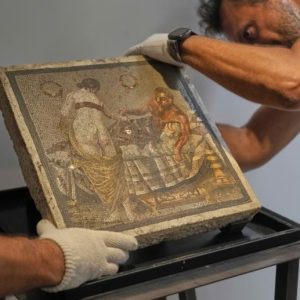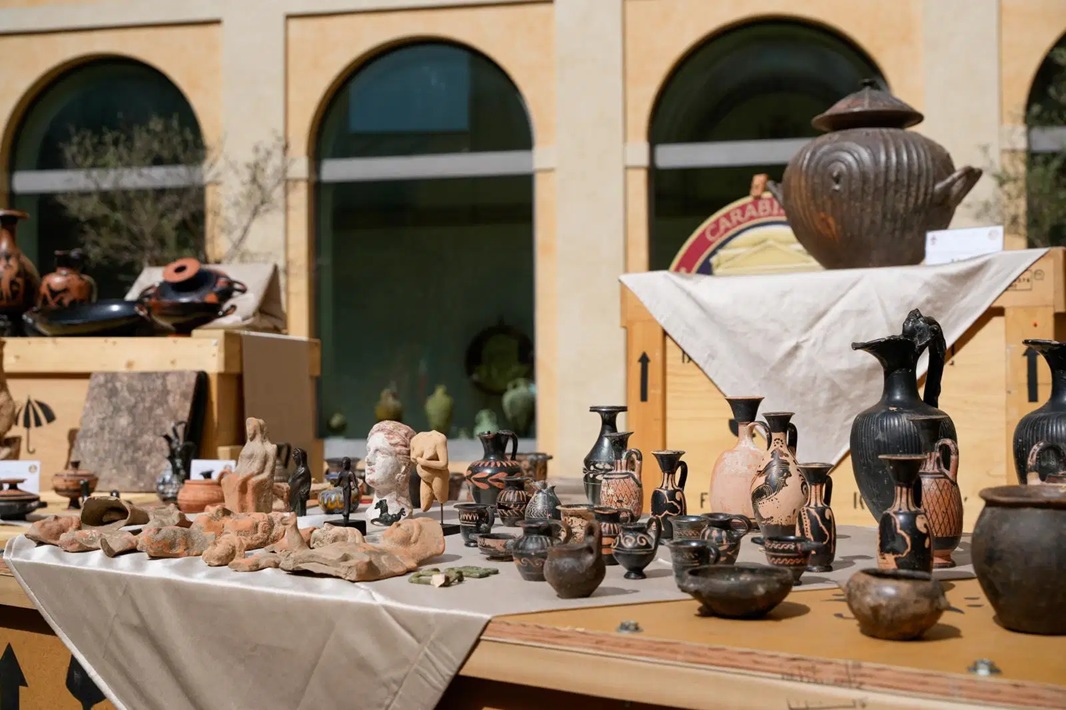
From a first-century head of Alexander depicted as a sun god to a Renaissance letter from a duke to his poet, a landmark repatriation of artefacts marks 25 years of Italian-American cooperation against the global art trafficking trade.
Italian art police and American law enforcement officials joined forces on Wednesday evening at Rome’s Caserma La Marmora to unveil 337 ancient artefacts repatriated from the United States over recent months. It is one of the most significant single returns of looted cultural property in recent Italian history.
The objects span more than a thousand years of Italian civilisation — Roman, Byzantine, Magna Graecia. The treasure trove includes sculptures, bronzes, ceramics, goldwork, archival documents and works of art, most of them originating from clandestine excavations or stolen outright from Italian institutions before finding their way onto the international art market.
“Culture is not lost, it is not forgotten,” Culture Minister Alessandro Giuli said at the ceremony, attended by United States Ambassador to Italy Tilman J. Fertitta. “It is protected, recovered, and above all returned to the community. Our culture will not be lost.”
The 337 objects were recovered in two distinct tranches. Of the total, 221 were returned through collaboration with the Manhattan District Attorney’s Office — which under successive district attorneys has maintained one of the most active antiquities trafficking investigation units in the world. The remaining 116 were recovered on 10 April through a joint operation involving the FBI, Homeland Security Investigations and the District Attorney’s Office. Christie’s New York auction house contributed to the identification and return of at least one object.
However, Carabinieri TPC Commander General Antonio Petti stressed that operations of this kind require a sustained and coordinated international strategy. Art trafficking, he noted, is “a global and complex phenomenon” that cannot be combated through isolated national efforts.
Alexander the Great as Helios
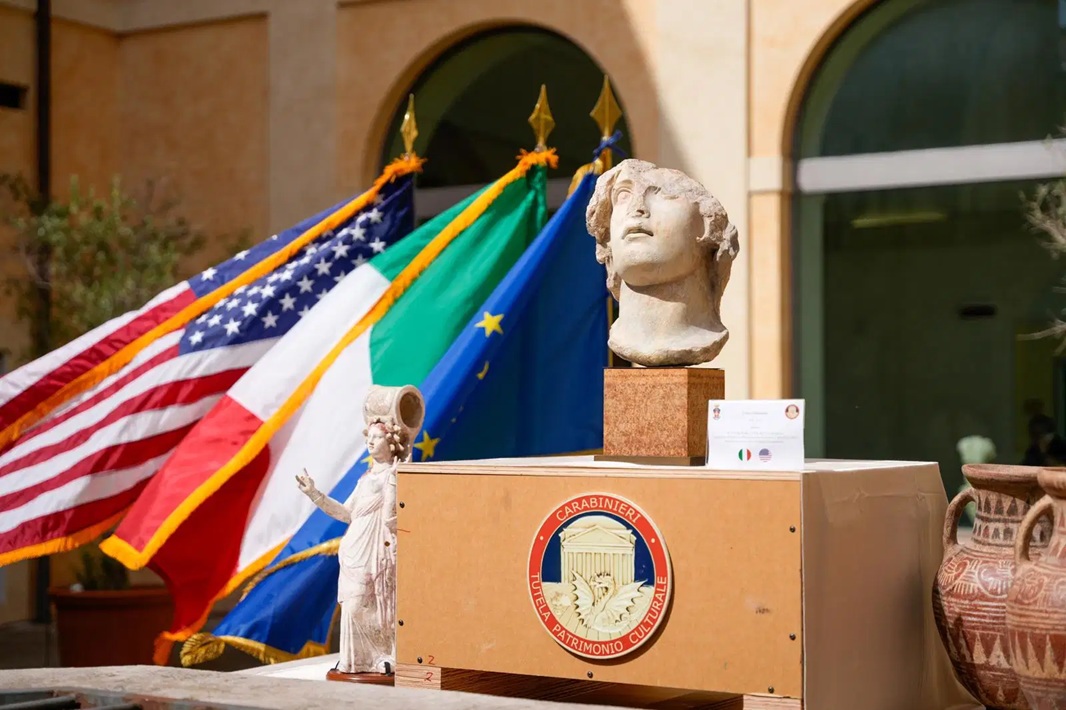
The object drawing the most attention is a marble head of Alexander the Great, dating to the first century AD. It depicts the Macedonian conqueror in the guise of Helios, the Greek sun god. The head was originally uncovered in the Basilica Aemilia in the Roman Forum, and its return to Italy closes a chapter that began when it was illicitly removed and trafficked abroad.
Alongside it, among the most significant individual finds, are a bronze sculpture looted from Herculaneum, the town buried alongside Pompeii by Vesuvius in 79 AD, and two Egyptian basalt sculptures. The core of the returned collection also spans the period from the 5th century BC to the 3rd century AD and includes sculptures, bronzes, ceramics and goldwork from across the ancient Mediterranean world.
The FBI haul comprises bronzes and terracottas from the Iron Age to the Hellenistic period, while objects recovered with the assistance of Homeland Security Investigations include a ship’s rudder, a Canosa vase and a set of Roman coins.
A Renaissance letter delivered to Italy
Among the most historically poignant of the 337 artefacts is a letter written in 1524 by Alfonso I d’Este, Duke of Ferrara, to the poet Ludovico Ariosto — author of the Orlando Furioso, one of the towering works of Italian Renaissance literature.
The letter will be returned to the State Archives of Massa, where it belongs. “This document will finally be returned to its original context, reconstructing the unity of a heritage and restoring the full meaning of the sources,” said Antonio Tarasco, Director General of the Archives. “It is also thanks to these operations that the Archives strengthen their function: preserving and transmitting over time authentic testimonies, essential for a full understanding of our history and our institutional order.”