While many Italian cities boast Roman foundations, Ferrara is a rarity: a city that came into its own during the Middle Ages and reached its zenith during the Renaissance. Known as the “City of the Bicycle” for its flat terrain and pedal-friendly culture, Ferrara remains one of Europe’s best-preserved examples of “modern” town planning, a legacy that earned it UNESCO World Heritage status in 1995.
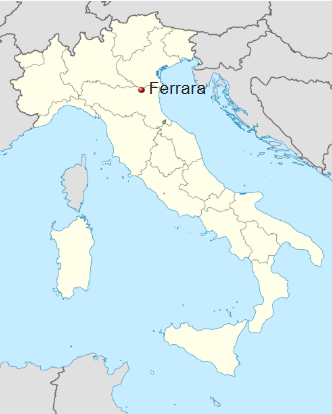
Ferrara is located in the Emilia-Romagna region of northern Italy, sitting on a vast, fertile plain known as the Po Valley. It lies just north of Bologna and south of the Po River, which has historically dictated the city’s fortune.
The geography is characterised by reclaimed marshlands. Over centuries, massive drainage projects transformed a swampy delta into some of Italy’s most productive agricultural land. Today, this landscape is dominated by the Po Delta, a labyrinth of waterways, lagoons, and woods that serves as a vital ecological hub.
The Rise of the House of Este
The history of Ferrara is not merely the history of an Italian city; it is the chronicle of a singular dynasty, the House of Este, which transformed a marshy outpost into the first modern city in Europe. To understand Ferrara is to understand the tension between the sublime and the macabre, a place where the finest courtly poetry was written just floors above the damp dungeons where family rivals were left to rot.
The Este family did not begin as sovereigns of Ferrara, but as feudal lords from the Veneto region. Their arrival in the 13th century marked the end of a chaotic period of communal infighting. Unlike the Medici in Florence, who rose through banking and maintained a veneer of republicanism, the Estensi were aristocrats and warriors from the outset. They secured their power through a combination of strategic marriages and a ruthless pragmatism that allowed them to navigate the treacherous waters between the Holy Roman Empire and the Papacy.
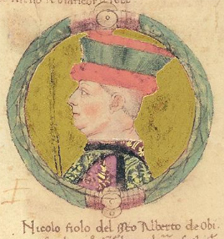
By the time of Niccolò III d’Este in the early 15th century, the court had become a centre of international diplomacy. Niccolò was a man of immense appetites, credited with fathering hundreds of illegitimate children, but he also solidified the Este reputation for intellectual patronage. However, the shadow of the Este family was never far behind. It was Niccolò who famously ordered the execution of his wife, Parisina Malatesta, and his own eldest son, Ugo, after discovering their illicit love affair. It was a tragedy that later inspired poets from Byron to D’Annunzio.
Cultural peak under Este family
The dynasty reached its cultural peak under the trio of Leonello, Borso, and Ercole I. Leonello was the quintessential “Prince of the Humanities,” a man who corresponded with the greatest scholars of the age and transformed the court into a center for Latin and Greek studies.
His successor, Borso d’Este, was the master of image. He was the first to be granted the title of Duke of Ferrara by the Pope, and he celebrated this elevation by commissioning the extraordinary frescoes in the Palazzo Schifanoia. The “Room of the Months” remains one of the most significant cycles of secular painting in the world, blending astrological symbols with scenes of daily life at the Este court, showing a world where the Duke’s every public act was a choreographed display of “magnificenza.”
Ercole I and the birth of modern urbanism
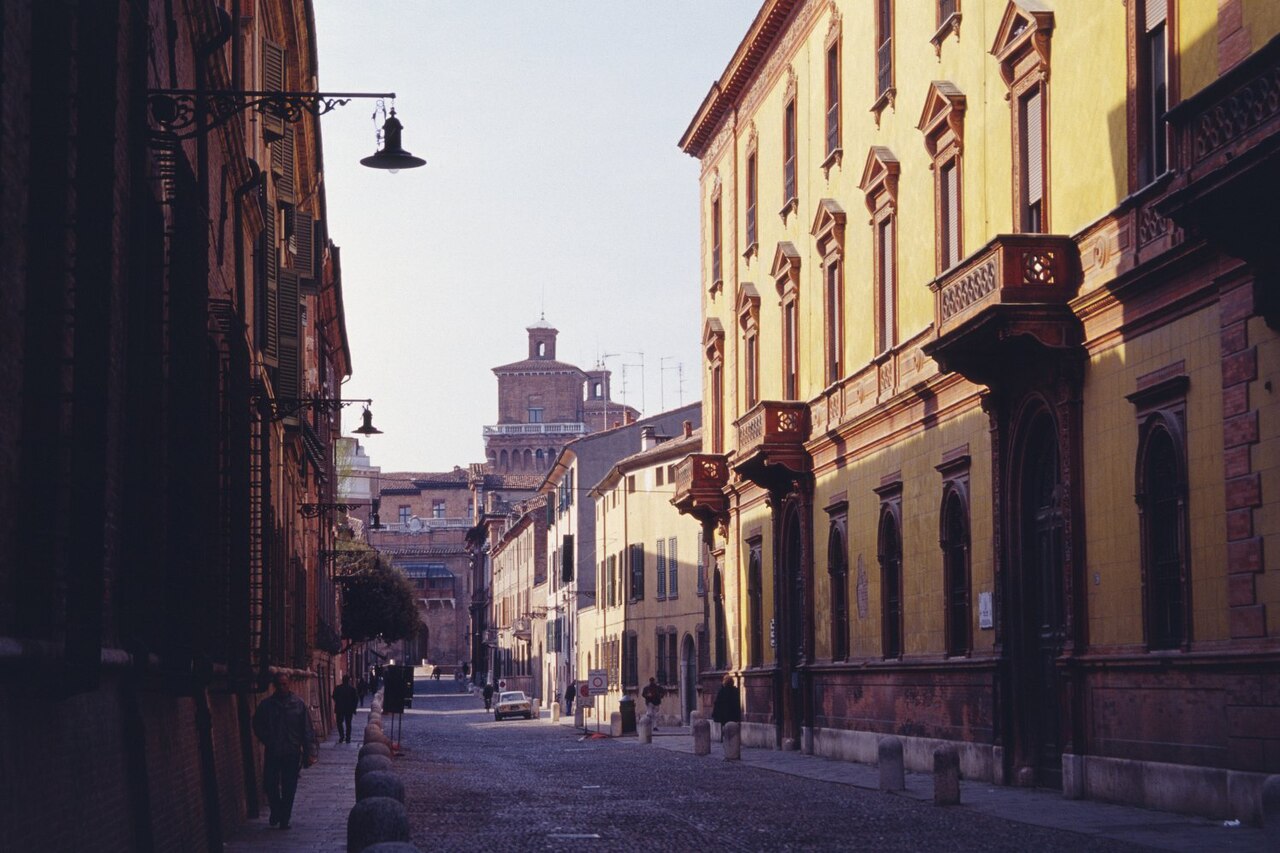
If Borso provided the image of the city, Ercole I d’Este provided the bone and stone. Ercole is perhaps the most significant figure in the city’s history because of the Addizione Erculea. In 1492, as the rest of Europe was looking toward the New World, Ercole was looking at the limitations of medieval urban design. He commissioned the architect Biagio Rossetti to double the size of the city, not with the cramped, winding alleys of the Middle Ages, but with wide, straight avenues that followed a rational, geometric logic.
This expansion was not merely an aesthetic choice; it was a political statement. It signaled that the Duke was the master of the landscape, capable of imposing order on nature itself. The most famous intersection of this expansion is the “Quadrivio degli Angeli,” where the Palazzo dei Diamanti stands.
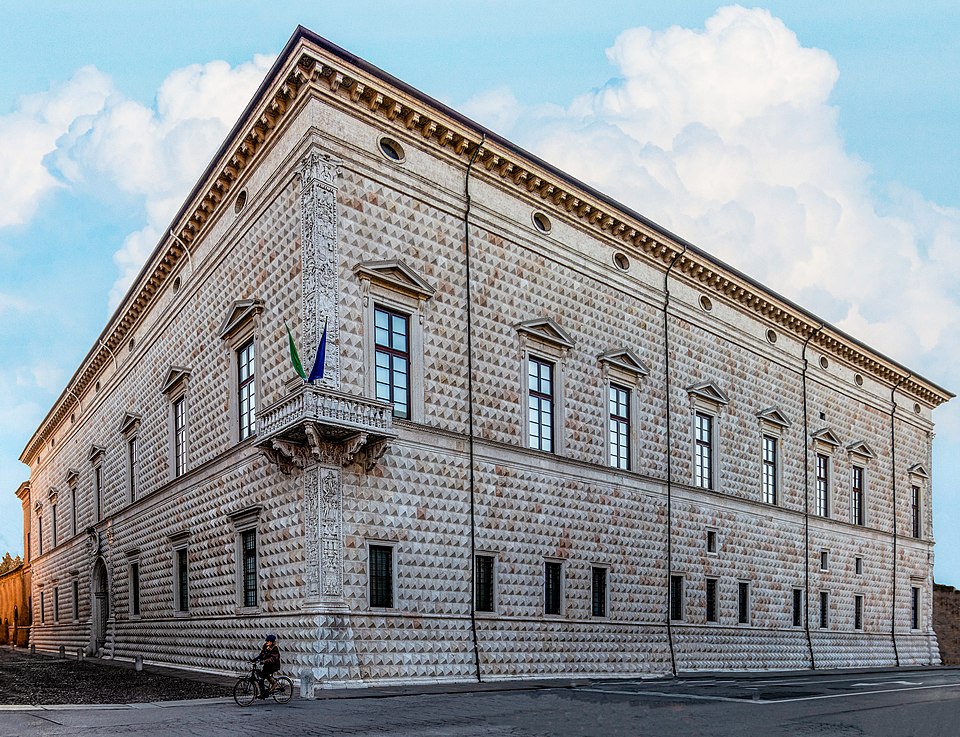
Its facade, covered in over 8,500 diamond-tipped marble blocks, was designed to capture light at different angles throughout the day, symbolising the “clarity” and “radiance” of Este rule. This made Ferrara the first planned city in modern Europe, a place where the architecture was designed to serve the movement of people and the visibility of the sovereign.
The prophet in the court: Girolamo Savonarola

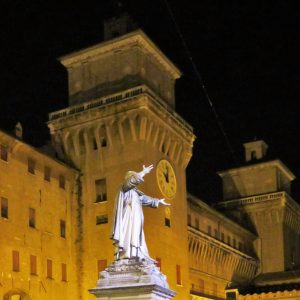
While the Este family was building palaces, a very different voice was being formed in the streets of Ferrara. Girolamo Savonarola, the man who would eventually bring the Renaissance in Florence to a standstill with his “Bonfire of the Vanities,” was born in Ferrara in 1452. He was the grandson of Michele Savonarola, a renowned physician to the Este court.
Young Girolamo grew up in the shadow of the Este’s opulence, but he felt an increasing revulsion for the decadence he witnessed. He saw the Duke’s lavish spending as a sin against the poor and a distraction from the spiritual life. His early writings in Ferrara, such as the poem De Ruina Ecclesiae (On the Ruin of the Church), reveal a man already tormented by the perceived corruption of his age.
Although he eventually fled to a Dominican monastery in Bologna and later achieved fame and infamy in Florence, his radicalism was rooted in the Ferrarese environment. He was the antithesis of the Este court, the ascetic shadow to their golden light. The irony remains that while the Este family sought to immortalise themselves through art, their most famous son sought to burn it.
The geography of the Po Delta and the trade of power
The prosperity that funded these palaces was tied inextricably to the geography of the Po Valley. Ferrara sat at the heart of a vast hydraulic network. The Po River was the highway of northern Italy, and the Este family controlled the tolls and the movement of goods between the Adriatic Sea and the inland cities of Milan and Mantua.
The economy of Ferrara was built on salt, silk, and soil. The nearby salt pans of Comacchio were a vital strategic resource, as salt was the primary preservative of the age. Trade in silk and textiles flourished under court protection, but the true foundation was the land.
The Estensi were pioneers in land reclamation (bonifica). By draining the marshes of the Po Delta, they created vast tracts of arable land that produced grain and fruit in abundance. This agricultural wealth allowed Ferrara to remain independent for centuries, even as larger neighbours like Venice and the Papal States looked on with envy.
Trade in Ferrara today
Nowadays, the province is a leader in fruit production, specifically pears, apples, and peaches, alongside cereals and sugar beets. This has led to a robust food processing industry, producing everything from sugar to local specialties like cappellacci di zucca (pumpkin-filled pasta) and the iconic coppia ferrarese bread.
Following World War II, Ferrara became a significant industrial centre. It is home to one of Italy’s largest chemical complexes, specialising in plastics and polymers.
Today, the University of Ferrara (founded in 1391) drives innovation in biotechnology and environmental restoration. Simultaneously, cultural tourism has become a primary trade, as the city’s intact Renaissance walls and grand palaces attract visitors from across the globe.
Literary circle of Ferrara
The court of Ferrara was the crucible for the two greatest epic poems of the Italian Renaissance. Ludovico Ariosto’s Orlando Furioso is a sprawling, imaginative masterpiece that captures the spirit of the Ferrarese court, its wit, its obsession with chivalry and its sophisticated irony. Ariosto lived in a modest house in the city, famously remarking that while his poems described marble palaces, he lived in a house of brick because “words are cheaper than stones.”
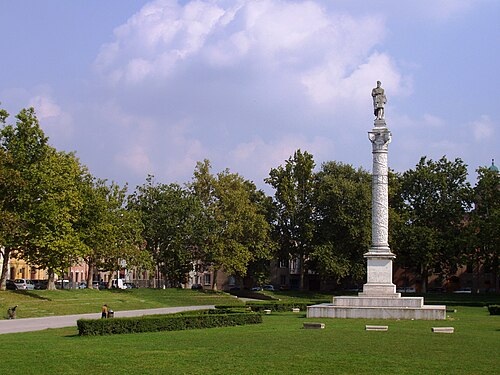
A generation later, Torquato Tasso arrived in Ferrara to write Gerusalemme Liberata. Where Ariosto was full of light and irony, Tasso was a figure of the Counter-Reformation. He was intense, religious, and eventually, mentally unstable.
His life in Ferrara became a tragic legend. Suspected of heresy and suffering from delusions, he was imprisoned for seven years in the Ospedale di Sant’Anna by Duke Alfonso II, who feared Tasso’s erratic behaviour would draw the ire of the Inquisition. The image of the “mad poet” in his cell became a centrepiece of Romantic literature, turning Ferrara into a destination for later writers like Goethe and Lord Byron.
The end of the Este line: The Devolution of 1597
The golden age of Ferrara ended not with a conquest, but with a lack of an heir. In 1597, Duke Alfonso II died without a legitimate son. Despite the family’s attempts to secure the succession for a cousin, Cesare d’Este, Pope Clement VIII declared the city a vacant fief. Because the Este family had originally received Ferrara from the Pope, the Papacy claimed the right to take it back.
This event, known as the “Devolution,” was a catastrophe for the city. The Este family was forced to move their court to Modena, taking with them their archives, their library, and as much of their art collection as they could carry.
Overnight, Ferrara went from being a sovereign capital of European culture to a provincial outpost of the Papal States. The population dwindled, the economy stagnated, and the great palaces were often left to decay or converted into warehouses.
The modern identity of Ferrara

It was not until the 20th century that Ferrara rediscovered its voice, largely through the literature of Giorgio Bassani. His masterpiece, The Garden of the Finzi-Continis, captured the life of the city’s Jewish community during the dark years of Fascism. The Jewish Ghetto, established in 1627 and lasting until the unification of Italy, remains one of the most evocative quarters of the city. It is a reminder of a community that was protected by the Este dukes but marginalised under Papal and later Fascist rule.
Today, Ferrara is a city that lives at a different pace. It is famously the most bicycle-friendly city in Italy, with the medieval and Renaissance walls serving as a 9-kilometer elevated park. The geography that once made it a fortress now makes it a haven for “slow tourism.”
The university continues the Este tradition of intellectual inquiry, particularly in the sciences, while the city’s cuisine, from Salama da Sugo to Pasticcio di Maccheroni, serves as a living link to the banquets of the Renaissance dukes.
Ferrara remains a place where the past is not a museum, but a rational, lived-in landscape that still follows the lines laid down by Biagio Rossetti over five centuries ago.