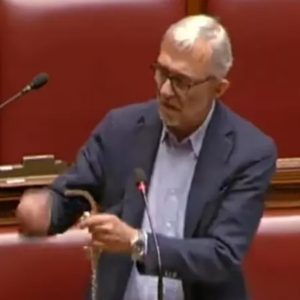
Barbara Floridia accuses the ruling majority of holding public broadcasting “hostage” as she and every opposition member on the Rai oversight commission resigned within hours of one another. Centre-right members resign hours later, blaming the Left.
The parliamentary commission responsible for overseeing Italy’s state broadcaster Rai was left in disarray on Thursday after its president and every opposition member resigned within hours of one another, plunging the body into what one senator called a state of paralysis.
Barbara Floridia, the Five Star Movement (M5S) senator who has chaired the Vigilanza Rai commission, announced on Facebook that she had handed her resignation to the presidents of the Senate and the Chamber of Deputies. She described the decision as painful but unavoidable, saying she had concluded that “remaining and denouncing” the situation had achieved nothing.
A two-year standoff over the Rai presidency
At the heart of the dispute is the stalled appointment of a new Rai president. Under Italian law, the position requires a two-thirds majority vote in the oversight commission — a threshold the governing coalition has been unable to meet with its preferred candidate, Simona Agnes, whom Rai’s own board designated some time ago.
Floridia said the ruling majority had for almost two years deliberately obstructed the commission’s ordinary business because the opposition would not back its candidate. She called this “not a difference over the merits of the issues” but straightforward “blackmail.” She said no regulatory body had ever before been held hostage in this way in the history of the Republic.
Floridia was joined in her resignation by Italia Viva’s Maria Elena Boschi, the commission’s vice-president, along with members from the Democratic Party, M5S, Italia Viva and the Greens and Left Alliance (AVS).
Majority members follow suit
Within hours, centre-right members of the commission announced their own resignations, framing the crisis in starkly different terms. They accused the opposition of having “occupied, seized and irresponsibly exploited” the commission.
They argued that the two-thirds rule had been cynically used to block a presidential nomination that would otherwise carry majority support. Furthermore, they said they were willing to see a new commission and a new president installed quickly.
The impasse leaves Rai in an unusual position: its board has continued to make appointments, commission programming and spend public money raised through the licence fee, while the body meant to scrutinise those decisions has been unable to function. Antonio Marano, a board member aligned with the League, has been acting as de facto president in the interim.
President Sergio Mattarella had previously and unsuccessfully urged the commission to resume its work. Floridia noted separately that Italy risks EU infringement proceedings for failing to implement the Media Freedom Act, which has been in force for roughly a year.
Departures at Rai under the Meloni government
Floridia’s resignation lands as Rai unveils its new season schedules, and she used her statement to renew long-standing opposition criticism of editorial appointments at the broadcaster under Premier Giorgia Meloni’s government, in office since 2022.
She said management had rewarded political affiliation “almost exclusively,” at the expense of merit, quality and editorial independence. She also accused the broadcaster of driving out experienced professionals while red carpets were rolled out for programmes that went on to fail. Numerous high-profile presenters and journalists, many associated with the Left, have left Rai in that period.
“Those who were able to have gone, including the viewers,” Floridia wrote. “Others were brutally shown the door.”