Roberto Giachetti, an Italia Viva lawmaker’s 12-day hunger strike culminated in a dramatic act of self-imprisonment inside the Chamber of Deputies. It forced a concession from the ruling majority on the long-paralysed parliamentary watchdog of Italy’s public broadcaster.
Roberto Giachetti, a deputy for the opposition centrist party Italia Viva, ended his protest at the Chamber of Deputies on Friday. He managed to extract a commitment from the ruling centre-right coalition that it would ensure a quorum at the next sitting of the RAI parliamentary oversight commission — a body that has been effectively paralysed for 20 months.
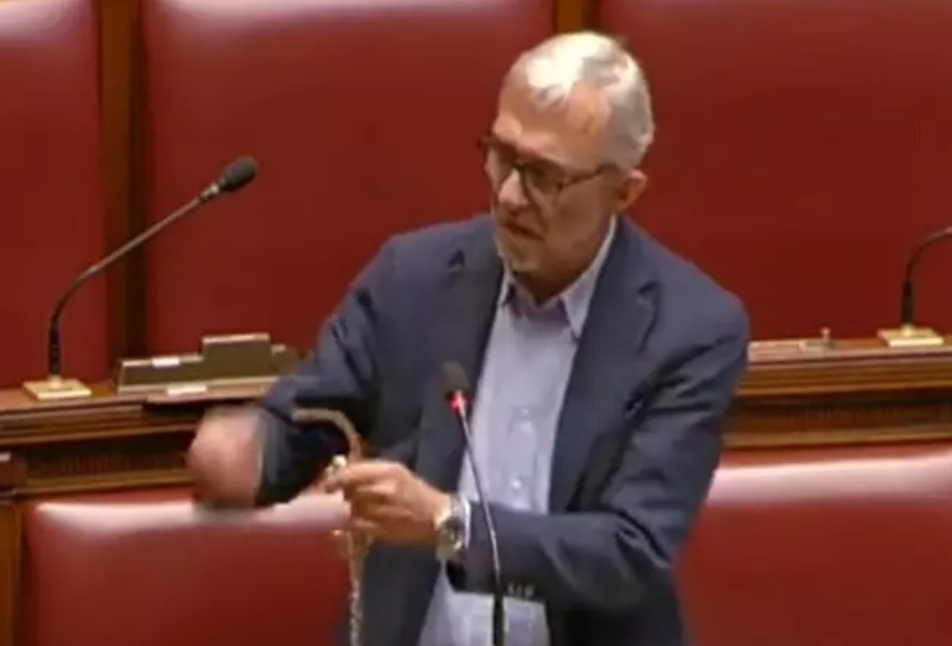
Giachetti had been on hunger strike for 12 days when, on Friday morning, he took the dramatic decision to chain himself to his bench inside the Montecitorio chamber and add a thirst strike to his protest. He had purchased the handcuffs from a sex shop — the only place where such items can be freely bought in Italy. As he told the Rai Radio 1 programme Un Giorno da Pecora, he had come fully prepared for a long siege. “I put on a nappy. I thought of everything,” he said.
His declared intention was to remain in the chamber until the majority gave a public commitment to attend the commission and allow it to function. He remained chained to his bench for some five hours.
What broke the deadlock
The breakthrough came after Premier Giorgia Meloni made a personal phone call to the protesting deputy. Four centre-right members of the oversight commission — Francesco Filini of Brothers of Italy (FdI), Roberto Rosso of Forza Italia, Giorgio Maria Bergesio of the League, and Maurizio Lupi of Noi Moderati — subsequently issued a joint statement saying that, while they disagreed with Giachetti’s methods, they were committed to ensuring a quorum at the next commission meeting.
Giachetti was careful in his assessment of Meloni’s role. “I also thank the Prime Minister, who called me today, to whom I explained my reasons, which I believe she understood,” he said. “I believe she somehow facilitated the majority’s position.” He added that Meloni had expressed concern about his health, to which he replied that the health of democracy was the more pressing matter.
Roberto Giachetti announced he was suspending both strikes, though he was clear that not all of his objectives had been met. “I am suspending the thirst strike and I am suspending the hunger strike, knowing full well that some of the objectives have not yet been achieved,” he said. “However, they cannot take back the majority’s willingness and decision, which certainly runs completely counter to what they have done to date.”
His original three-point demand had included not just the unblocking of the oversight commission, but also the appointment of a new RAI president and the resumption of Senate debate on RAI governance reform. On the presidency question, he noted that Economy Minister Giancarlo Giorgetti had signalled a willingness to be heard by the relevant committee in the coming weeks.
Having lost five kilograms over his 12-day fast, Giachetti said he would break it gently. “We always start over light, so I think baby food, as I have done on other occasions.”
The RAI governance crisis in context
The commission’s paralysis has its roots in a dispute over the appointment of a new RAI president. Since Marinella Soldi vacated the post in 2024, the broadcaster has been without a permanent head. The role has been filled provisionally, first by Roberto Sergio and then by Antonio Marano. Under the relevant regulations, confirming a new president requires a two-thirds majority within the commission, a threshold the centre-right cannot reach alone. Negotiations over the candidacy of Simona Agnes, put forward by Economy Minister Giorgetti, have stalled. The majority has been boycotting commission sittings, rendering it inquorate and unable to conduct any business.
President Sergio Mattarella has previously appealed publicly for the deadlock to end, without result.
The journalists’ union USIGRAI welcomed the outcome of Giachetti’s protest, while making clear that the situation should never have come to this. “It is a disturbing sign of the times when people resort to extreme measures to demand respect for a normal democratic principle,” the union said in a statement.
Commission chair Barbara Floridia, a senator for the Five Star Movement, responded to the majority’s commitment by convening the oversight body for Wednesday, 27 May. “I acknowledge the majority’s willingness to guarantee a quorum and I convene the commission for next Wednesday,” she said. “It is very disappointing that Giachetti had to make such an extreme decision to have something as normal as a commission meeting.”
Floridia added that she hoped the majority’s concession would not be limited to a single session, but would mark a genuine return to the commission’s ordinary functioning.