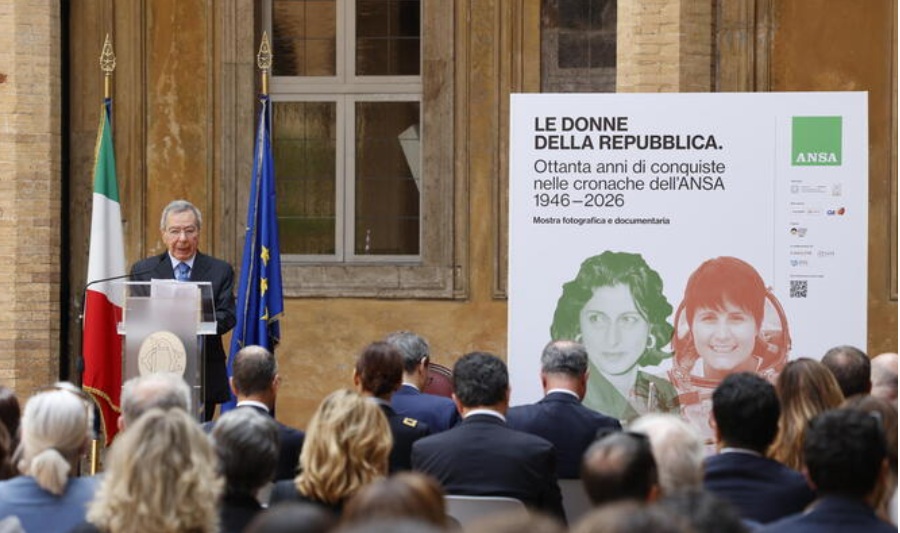
From the first female mayors elected in 1946 to the introduction of femicide as a specific criminal offence, a new ANSA exhibition opening in Rome traces the long road of women’s rights. However, those who walked it caution against complacency.
An exhibition marking eighty years of women’s rights in Italy opened this week in Rome, bringing together 122 photographs and the stories of 135 women whose struggles, legal battles and historic firsts shaped the country’s slow progress towards gender equality. Women of the Republic: Eighty Years of Achievements in the ANSA Chronicles, 1946–2026 is on free display until 30 June at the Vicolo Valdina Complex in Piazza Campo Marzio, before moving to the Auditorium Parco della Musica Ennio Morricone from 1 July. A selection of images will be projected onto buildings across Italy on 2 June, Republic Day.
The exhibition, created in collaboration with the Cinecittà archives and the Istituto Luce and sponsored by the Ministry of Foreign Affairs and ANCI, was inaugurated in the presence of three of the women it depicts: astronaut Samantha Cristoforetti, the first Italian woman in space; Rosa Oliva, whose appeal to the Constitutional Court opened the door to women in senior public administration; and Debora Corbi, Italy’s first female soldier.
“I never saw becoming the first female astronaut as a goal,” Cristoforetti said. “I just wanted to be an astronaut.” Corbi recalled a different kind of barrier. “In the nineties, I was an ordinary girl who had a special, seemingly unattainable dream: to wear the uniform.” Oliva offered the sharpest assessment of where Italy still stands: “We’re told it will take five generations for real equality — an infinite amount of time.”
Don’t be complacent
The warning against triumphalism was a consistent thread through the opening ceremony. ANSA president Giulio Anselmi noted that only a little over half of Italian women today are in stable employment, compared to seven in ten men, and that despite the introduction of femicide as a specific criminal offence, the number of femicides has not fallen.
Chamber of Deputies President Lorenzo Fontana acknowledged that “inequalities and discrimination persist in everyday life, and the serious and unacceptable violence against women in its many forms continues to weigh heavily.”
ANSA director Luigi Contu described the breadth of the exhibition’s cast: alongside the well-known figures are Italy’s first female municipal cleaner, its first female bus driver, and the first woman to work in the Sulcis mines in Sardinia. “Every time a law was passed or one of these people achieved a result, an ANSA journalist or photographer was there to witness it,” he said.
Among the voices in the exhibition is that of Maria Gabriella Luccioli, one of the first eight women admitted to the Italian judiciary following the law of 9 February 1963 — and the first woman to be appointed President of a section of the Court of Cassation. “When I entered the judiciary, I was completely alone in the Rome district,” she recalled. “I had to always be excellent.” Today, women make up 57% of Italian judges — but Luccioli noted that at the most senior levels, underrepresentation persists. “It’s crucial for new generations to believe in themselves and commit,” she said, “because they can do it.”
You can enjoy an online magazine celebrating the exhibition (in Italian) here.