On 30 December 39AD, the future Roman Emperor Titus was born. He was the eldest son of Vespasian and a ruler later remembered for compassion, rebuilding and decisive leadership.
Vespasian earned early prestige during the Roman invasion of Britain in AD 43 under Emperor Claudius. His success laid the foundations for the Flavian dynasty.
Born Titus Flavius Vespasianus, likely in Rome, Titus grew up close to power and military life. He later served alongside his father in Judea during the first Jewish–Roman war. The campaign stalled after Emperor Nero’s death in AD 68, which triggered civil war across the empire. Vespasian soon emerged as a contender for supreme power.
When the army proclaimed Vespasian emperor in July AD 69, Titus remained in Judea. He received command of Roman forces tasked with crushing the rebellion. In AD 70, Titus besieged Jerusalem and captured the city after a brutal campaign. Rome later built the Arch of Titus to commemorate the victory.
The monument still stands today, depicting Roman soldiers carrying spoils from the Second Temple. It remains one of Rome’s most powerful imperial symbols.
Succeeds father as emperor
After Vespasian’s death from infection, Titus succeeded his father in AD 79. He became the first Roman emperor to inherit power directly from a biological parent.
Before his accession, Titus had developed a controversial reputation in Rome. He served as prefect of the Praetorian Guard and maintained a public relationship with Berenice, a Jewish queen. Many Romans feared he might rule like Nero, whose reign ended in chaos and repression. Those fears quickly faded once Titus took power.
Just two months into his reign, disaster struck southern Italy. On 24 August AD 79, Mount Vesuvius erupted in Campania. The eruption destroyed Pompeii, Herculaneum and surrounding towns. Thousands died as ash and pyroclastic flows buried entire communities.
Emperor Titus responded swiftly and decisively. He appointed officials to coordinate relief efforts across the region. He also donated large sums from the imperial treasury to support survivors. Titus personally visited the affected areas twice.
Another disaster followed in AD 80, when a major fire devastated large parts of Rome. Titus again organised aid and reconstruction.
His actions earned widespread praise and reinforced his reputation as a humane ruler. Ancient sources, such as Suetonius, highlight his generosity and empathy.
Completion of the Flavian Amphitheatre

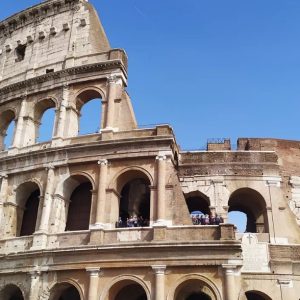
During his reign, Titus completed the Flavian Amphitheatre, now known as the Colosseum. Construction began under his father’s rule in AD 70.
Titus inaugurated the arena in AD 80 with lavish games lasting 100 days. Events included gladiatorial combat and mock naval battles.
His reign, though brief, brought stability after years of turmoil. Titus ruled for barely two years. He died suddenly of a fever on 13 September AD 81. He was 41 years old.
Rumours later circulated about possible poisoning. Suspicion fell on his brother Domitian, who succeeded him as emperor.