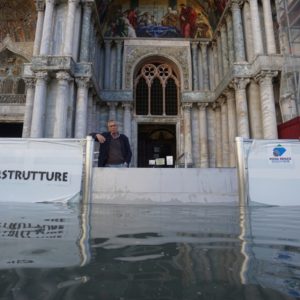
Venice has recorded an unusually high number of extreme high tides at the start of the year, with growing concerns about rising sea levels and the long-term vulnerability of the lagoon city.
With 15 high tides in just nine days, ten of which exceeded 110 centimetres, the city has reached what the director of the Venice Tides Centre, Alvise Papa, described on Friday as “a record for the period”. Ten of the tides were high enough to trigger the MOSE flood barrier system.
Papa said the spike is closely linked to the steady rise in average sea level, which he attributed to climate change. “Today we are at about 40 centimetres,” he told ANSA, referring to the baseline sea level, “while in the early 2000s it was around 21 to 23 centimetres.”
As a result, much weaker weather systems are now capable of producing dangerously high tides. “In the past, very strong winds were needed to raise the tide by 80 centimetres,” Papa said. “Now much weaker ones are enough to reach one metre.”
The figures mark a sharp increase compared with recent years. During the same period last year, only one high tide was recorded. In the past 15 years, the number reached double figures only once, in 2014, when 11 high tides were logged.
Recent weather conditions exacerbate the problem
Papa noted that recent weather conditions have not been particularly severe, making the data more striking. Sea levels remained above one metre for a record 42 hours, compared with just four hours during the same period last year. In 2024, the figure stood at 13 hours, while in 2023 it was 16.
The trend is expected to worsen, Papa warned. If the average sea level continues to rise, increasingly modest disturbances will be enough to flood large parts of the city. “This is where the MOSE system comes in,” he said, stressing that keeping water levels below one metre is now essential to protect Venice.
The MOSE system
The MOSE system — an acronym for Modulo Sperimentale Elettromeccanico — was conceived after devastating floods in 1966, when Venice was submerged under nearly two metres of water. Planning began in the 1980s, but construction did not start until 2003, following decades of political debate, environmental objections and legal disputes.

The project consists of 78 mobile barriers installed at the three inlets connecting the Venetian Lagoon to the Adriatic Sea: Lido, Malamocco and Chioggia. In normal conditions, the barriers rest on the seabed, allowing tidal flows and maritime traffic to pass. When high tides are forecast, the gates are raised by pumping compressed air into them, temporarily isolating the lagoon from the sea.
MOSE was first successfully tested during a severe tide event in October 2020 and has since been used repeatedly to prevent acqua alta from flooding the historic centre. Its activation has spared Venice from damage during several high-tide events that would previously have inundated St Mark’s Square and surrounding districts.
Despite its effectiveness, the system has been controversial. Costs have risen to more than five billion euros, and the project has been marred by corruption scandals, technical challenges and concerns over maintenance. Environmental groups have also warned that frequent closures could affect the lagoon’s delicate ecosystem.
As high tides become more frequent, MOSE is being activated far more often than originally envisaged. Experts warn this could accelerate wear on the system and raise questions about its long-term sustainability.
For now, however, city officials see MOSE as indispensable. As Papa noted, with rising sea levels making Venice more vulnerable even in moderate weather, the barrier system remains the city’s primary defence against increasingly frequent flooding.