The maiden voyage of the European Sleeper night train from Brussels to Venice was unexpectedly halted at the Italian border, forcing passengers to transfer to another train to complete their journey.
The Brussels-Venice night train, which had been described as a “significant milestone” for European Sleeper’s mission to reconnect cities with sustainable night travel, was due to reach Venice. However, it stopped in Innsbruck, Austria, 313km short of its final destination. Innsbruck had been intended as a “prominent stop” rather than the terminus.
Sudden Change in Italian Railways’ Decision
Elmer van Buuren, co-founder of European Sleeper, expressed frustration at the last-minute setback. Speaking to Dutch newspaper De Telegraaf, he explained:
“It took nine months, hundreds of phone calls and meetings to start this project. We had arranged separate agreements with five different rail operators across each country. It seemed everything was in place when, last week, the Italians changed their minds and informed us we could not go beyond Bolzano. Now, it turns out we couldn’t even enter Italy. No reason was provided. This is a common issue with European railways.”
Why Was the Train Stopped?
Rail travel expert Mark Smith, known for running The Man in Seat 61 website, was on board and reported that the issue stemmed from locomotive availability.
“The train was scheduled to terminate in Verona, as two locomotives are required to ‘top and tail’ the train into Venice due to restrictions on light engine movements there. European Sleeper was informed only on 4 February, one day before departure, that the necessary engines were unavailable.”
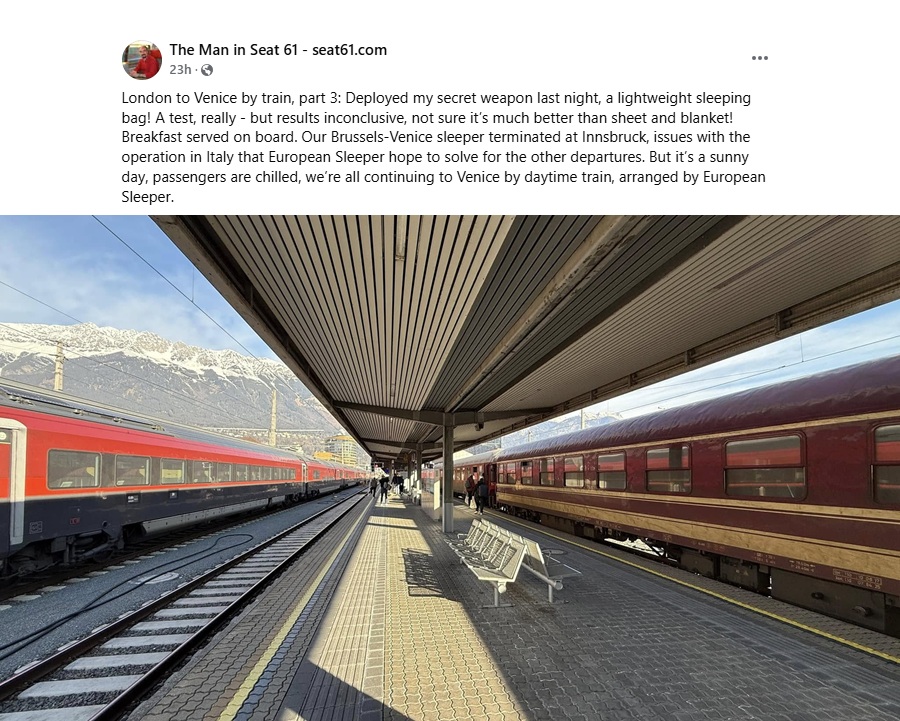
European Sleeper then received a further call informing them that their Italian operator could not take the train south of Innsbruck. The company remains hopeful that future departures will not face the same issues.
Impact on Future Journeys
The Brussels-Venice night train is currently scheduled to run twice weekly throughout February and March, offering travellers a sustainable alternative for winter sports trips, city breaks, and the Venice Carnival. However, the disruption has raised concerns over the reliability of cross-border rail travel.
European Sleeper and the Italian Ministry of Transport have not yet commented on whether a resolution has been reached for upcoming services.
The Challenges of Cross-Border Train Travel in Europe
This disruption highlights the long-standing challenges of cross-border rail travel in Europe. Unlike flights, international train services require extensive coordination between national rail operators, making seamless travel difficult. A European Commission report found that the number of long-distance cross-border rail journeys has remained stagnant since 2001, accounting for only around 7% of all train travel in Europe.
The EU is working on a solution through the Multimodal Digital Mobility Services legislation, which would create a unified ticketing system for cross-border train travel. The proposal, delayed last year, is expected to be revisited in the near future, potentially easing the complexities of international rail travel.
![New European Sleeper train to Venice from brussels. Image shows aerial view of Venice. Photo By: @karamintheworld [IG]](https://italynews.online/wp-content/uploads/2024/08/aerial-view-of-venice-2-300x300.jpg "New European Sleeper Night Train to Connect Brussels to Venice")