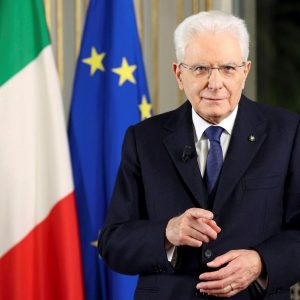
ROME — President Sergio Mattarella used his year-end address to review 80 years of Italian history and urge young people not to give up on their future. The address was broadcast live on all national TV channels. Mattarella spoke against the backdrop of an iconic image of the 1946 referendum that led to the birth of the Italian Republic.
The President opened his 15-minute year-end address by speaking about global conflicts and the failure of peace.
“The refusal of those who deny peace because they feel stronger is repugnant.
Faced with the bombing of Ukrainian cities and the devastation of Gaza, faced with the homes and dwellings devastated by the bombing of Ukrainian cities, faced with the destruction of power plants, leaving children, the elderly, women, and men to endure the freezing winters of those territories, faced with the devastation of Gaza, where newborns are freezing to death, the desire for peace is ever greater, and the refusal of those who deny it because they feel stronger becomes ever more incomprehensible and repugnant.”
Mattarella then turned to Italy’s post-war foundations and the work of the Constituent Assembly.
“The Constituent Assembly, elected in conjunction with the referendum that sanctioned the republican choice, was able to find a highly valuable synthesis while the political debate unfolded amidst convergences and disagreements, some of which were very strong.
In the morning, the constituents discussed—and disagreed with—the concrete measures of government; in the afternoon, together, they assembled the pieces of our Constitutional Charter.”
He described the Constitution as a lasting guide for the country.
“The Italian Constitution, which has inspired and guided the country for all these decades.”
The president also highlighted Italy’s role in post-war European reconstruction.
“The images of the signing of the Treaties of Rome in 1957 signal a success and another decisive moment, with Italy at the forefront of building the new Europe. Europe and transatlantic relations, with the Marshall Plan, are the two pillars of reconstruction.
The European Union and the Atlantic Alliance have consistently represented—and constitute—the coordinates of our international action.”
Mattarella stressed that Italy’s progress was rooted in unity and democracy.
“Our true strength, social cohesion in freedom and democracy, has allowed us to make Italy the great country it is today.
The legitimate debates between the various positions have contributed to concrete achievements that have changed people’s lives for the better. Rights and duties have gradually become facts and no longer remained abstract statements.
Reflecting on what we have achieved together is the basis for looking to the future with confidence and renewed shared commitment.
Awareness of this history can give us the strength to calmly face the challenges and pitfalls of our time.”
In the closing section of his address, Mattarella paid tribute to the national health service, public broadcaster Rai, anti-Mafia judges Giovanni Falcone and Paolo Borsellino, the arts, sport, and the recent UNESCO recognition of Italian cuisine.
He ended with a direct message to young Italians.
“I would like to address the younger generation in particular.
Some—who judge you without really knowing you—describe you as distrustful, detached, angry: don’t give up.
Be demanding, courageous.
Choose your future. Feel responsible like the generation that, eighty years ago, built modern Italy.”
Mattarella closed the address with a traditional greeting.
“Best wishes! Happy 2026!”