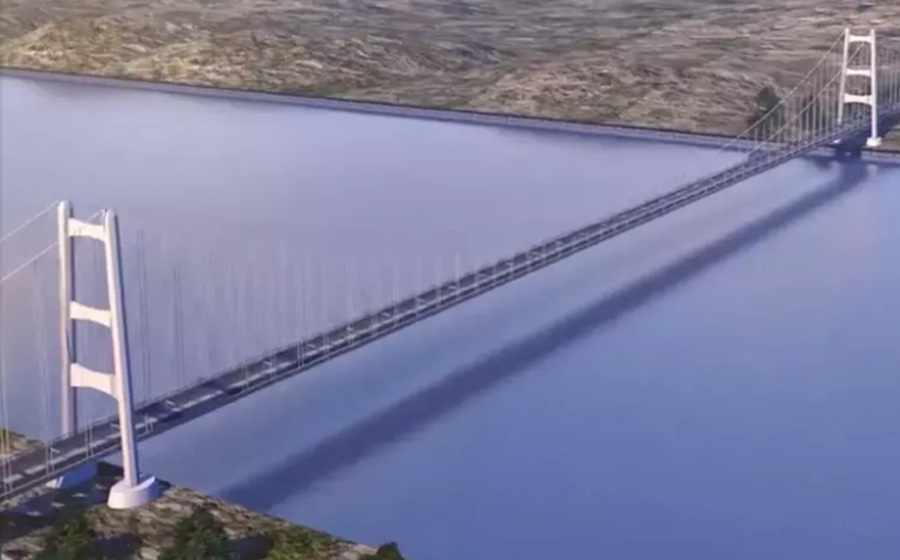
The Chamber of Deputies has approved the decree resetting the legal framework for the Strait of Messina Bridge. However, buried in the legislation is a funding delay with the bulk of investment pushed to 2030–2034. Therefore, the bridge itself is no closer to becoming reality.
Italy’s lower house gave final approval to the so-called Commissioners’ Decree on 7 May, passing it 160 votes to 110 with seven abstentions. The government had imposed a confidence vote the previous day to block amendments and push the text through unchanged from the Senate version, ensuring the bill converted into law before its 11 May deadline. The decree is now on the statute books. The bridge, however, remains as distant a prospect as it has ever been.
The headline figure buried in the legislation tells the real story. The decree shifts €2.787 billion earmarked for the bridge from the 2026–2029 period to the 2030–2034 period. Total allocated resources remain at €14.442 billion on paper, but the effective spending horizon has been pushed back substantially. The bridge that Deputy Prime Minister Matteo Salvini has described as the defining infrastructure project of the Meloni era will not see the bulk of its funding deployed for at least another four years.
Why a new law was needed
The government was forced to act after Italy’s Court of Auditors delivered serious objections to the CIPESS deliberation approving the bridge’s definitive project, rejecting the proposal in October 2025. The decree was the government’s response to that institutional blockage, essentially resetting the administrative pathway and appointing new commissioners to push the process forward.
Once the preliminary formalities have been completed and a new CIPESS resolution has been adopted, the Infrastructure Ministry will be able to proceed with signing the additional deed to the agreement with the concessionaire company, including the updated economic and financial plan, and transmit the relevant documents to the Court of Auditors for a legitimacy audit.
The New Commissioners
The chief executives of ANAS and RFI, Claudio Andrea Gemme and Aldo Isi respectively, become extraordinary commissioners for the main road and rail works. Thye have expanded powers to coordinate authorisations, overcome bureaucratic delays, and guarantee delivery timelines. Both operate under the powers of the Sblocca Cantieri framework, enabling them to bypass standard public contracts regulations.
The decree also redesigns the governance of railway works, with a clear centralisation under RFI. In order to speed up construction and completion of projects such as Brescia-Verona, Rome-Pescara, and Salerno-Reggio Calabria, CEO Aldo Isi will take over from the extraordinary commissioners already appointed, with the same tasks, functions, and powers. The RFI chief specifically takes on the role of commissioner for the railway infrastructure works complementary to the bridge. It is, at least, a recognition that a bridge without efficient rail connections on both sides of the Strait would be a stranded infrastructure asset.
The parliamentary debate was sharp. Democratic Party MP Marco Simiani argued that the bridge was effectively dead, contending there is no act confirming the project can continue its administrative process. Nicola Fratoianni of the Green and Left Alliance accused the government of deploying the bridge as an ideological choice to mask structural problems in the south rather than addressing more urgent needs.
FdI MP Aldo Mattia defended the decree from the government benches: “This measure has multiple areas of intervention, primarily the Messina Bridge, but one single purpose: to build and modernise our infrastructure to drive growth. Behind public works there are entrepreneurs, engineers and workers.”
Decree stretches beyond the Messina bridge
The decree is considerably broader than its name suggests. It also contains measures for the safety of the Gran Sasso tunnel and the A24 and A25 motorways, acceleration of Rome’s Metro C line, protection of the Venice lagoon, reconstruction works following the Morandi Bridge collapse in Genoa, and works on the tunnel and outer harbour dam in Genova.
Provisions for Milan-Cortina 2026 and UEFA Euro 2032 infrastructure are also included.
The project was cancelled in 2006 under Prime Minister Romano Prodi, revived in 2009 under Silvio Berlusconi, and cancelled again in 2013 under Mario Monti, before being resurrected under Giorgia Meloni in 2023. The Messina Bridge has been announced, cancelled, revived, and restructured so many times since it was first seriously proposed in the 1960s that each new legislative milestone generates less excitement than the last.
What is new this time is the combination of a Court of Auditors rejection, a funding timeline pushed to the mid-2030s, and a commissioner structure designed to bypass the normal rules of public procurement. A new CIPESS resolution is expected to be finalised by September 2026 and submitted for prior validation by the Court of Auditors, potentially enabling the effective start of construction work. Whether that combination ultimately produces a bridge, or merely produces another chapter in a saga that has outlasted dozens of Italian governments, remains to be seen.
Let us hope, that the infrastructure work outlined aside from the Messina bridge is tackled. After a period which has seen the Adriatic transport links severed, the Transport and Infrastructure minister, Matteo Salvini, has plenty of pressing matters to deal with.
ItalyNews.Online is an independent English-language news service covering Italian current affairs, politics, culture, and society.