
A 25-year-old man from Calabria who boarded a KLM flight with a passenger who later died from the Andes strain of hantavirus is displaying symptoms consistent with the disease. Biological samples are being rushed to Rome’s leading infectious disease hospital as Italy monitors four citizens caught up in the outbreak.
Biological samples from the Calabrian man, already in precautionary quarantine, are being sent to the Istituto Nazionale per le Malattie Infettive Lazzaro Spallanzani in Rome for analysis, sources confirmed on Tuesday. The Spallanzani, Italy’s foremost infectious disease hospital, will carry out testing to determine whether the man has contracted the virus.
The hospital moved to correct circulating media reports, clarifying that the patient himself will not be transferred to the Spallanzani. He remains in quarantine while his samples make the journey in his place.
As recently as Monday, the man told Sky TG24: “I’m fine, I have no symptoms.” That his condition appears to have since changed has inevitably heightened concern among Italian health authorities.
The case connects Italy to what has rapidly become a major international public health event. In April 2026, an outbreak of hantavirus caused by the Andes virus was identified on the Dutch cruise ship MV Hondius, which had left Ushuaia, Argentina, on 1 April. A passenger died from the virus on 11 April; his wife later disembarked at Saint Helena and died in hospital in Johannesburg two days later, on 26 April. A third passenger also died on board.
KLM Connection
On 25 April 2026, one of the Dutch nationals who died had briefly boarded KLM flight KL592 at Johannesburg’s O.R. Tambo International Airport, bound for Amsterdam. Due to her medical condition, the KLM crew decided not to allow her to travel, and she was removed from the aircraft before departure. She died in Johannesburg the following day.
Italy’s Ministry of Health triggered active surveillance measures on 9 May for four travellers who had transited Rome’s Fiumicino Airport after sharing the KLM flight segment with the passenger. The four, located in Calabria, Campania, Tuscany and Veneto, were placed in precautionary quarantine. The ministry said all four remained asymptomatic and in good health as of Sunday.
The Hantavirus Outbreak
As of 12 May, 11 cases have been reported in total, including nine confirmed and two probable. After the MV Hondius arrived at Tenerife in the Canary Islands on 10 May, disembarkation and repatriation of passengers was completed on 11 May.
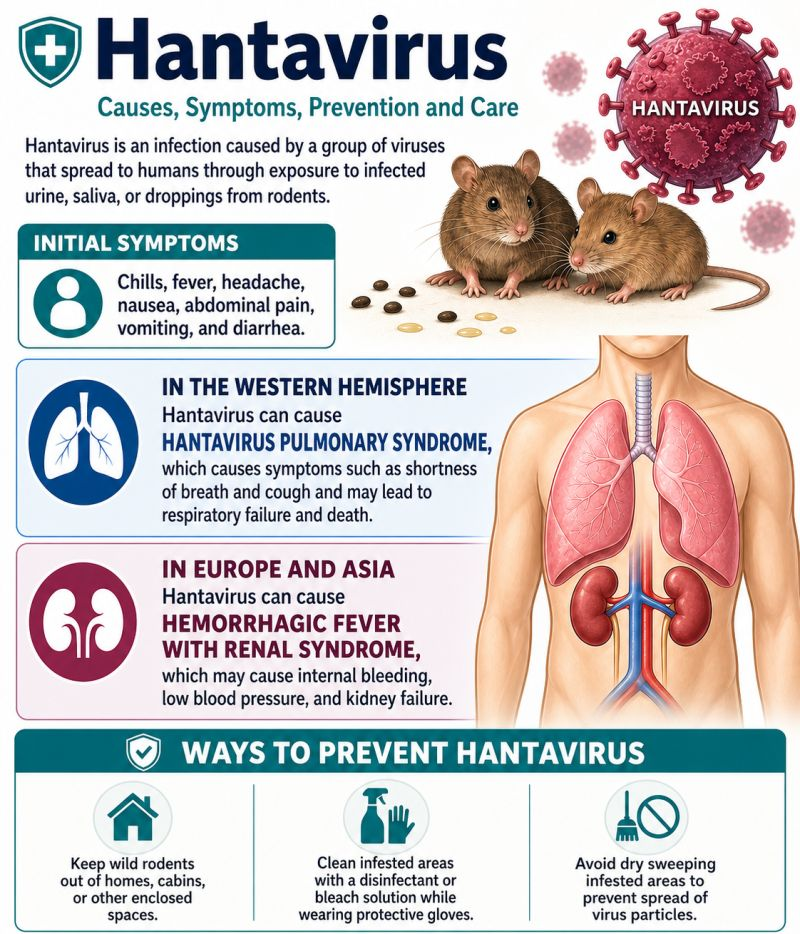
The outbreak has prompted concern precisely because of the strain of hantavirus involved. The virus has been identified as the Andes hantavirus — the only hantavirus known to be transmissible from person to person, typically requiring close, prolonged contact. According to the RIVM, the Dutch public health authority, the time between infection and first symptoms can range from a few days to up to 60 days, with an average incubation period of two to four weeks.
The outbreak’s reach has extended well beyond Italy. A French woman placed in isolation in Paris tested positive on Monday, confirmed by France’s Health Minister Stéphanie Rist. A KLM flight attendant who had brief contact with the Dutch passenger has been hospitalised in Amsterdam UMC with mild symptoms and is being tested for the virus.
WHO Director-General Tedros Adhanom Ghebreyesus, speaking at a press conference in Madrid on Tuesday, addressed the situation directly, noting that almost 150 people from 23 countries had been on the ship for weeks “in what must have been a very frightening situation.” He added that calls for passengers to be kept on board for the full quarantine period had been rejected, “Our view was that it would have been inhumane and unnecessary.”