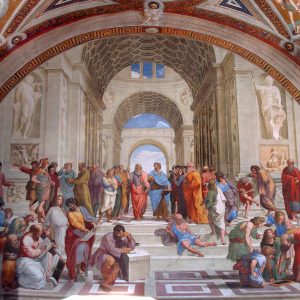
Born 28 March 1472 in Savignano di Prato, Tuscany, Fra Bartolommeo, a Dominican friar and High Renaissance master, whose figures were said to move “with a seraphic grace that must have struck the young Raphael with the force of revelation.”
Fra Bartolommeo was ranked alongside Michelangelo, Raphael and Leonardo. He threw his own paintings into the bonfire. He went silent for four years. Then he returned and changed the course of European art. On the 554th anniversary of his birth, INO tells the story of the most underrated great painter of the Italian Renaissance.
Early life and training
The son of a mule driver from a small town near Prato, Bartolommeo grew up to be ranked among the four greatest painters of his age, alongside Michelangelo, Raphael and Leonardo da Vinci. Then, in the grip of a religious crisis so profound it silenced him for the better part of four years, he threw his own works into a public bonfire and became a friar. When he returned to painting, he did so not as a private artist but as a servant of his monastery, producing works that would shape the direction of High Renaissance art across all of Italy.
His secular name was Bartolommeo di Pagholo del Fattorino. He acquired the nickname Baccio della Porta because his family home in Florence lay near the city gate then known as the Porta San Pier Gattolini. By his early teens he had been recommended to the workshop of Cosimo Rosselli by the sculptor Benedetto da Maiano and by 1490 or 1491 he had entered into a studio partnership with a fellow Rosselli pupil, Mariotto Albertinelli. The two made an unlikely pair. Albertinelli was, by all accounts, considerably more worldly than his partner, and their friendship was periodically strained by Bartolommeo’s deepening piety. But their collaboration produced work of great elegance, and Bartolommeo in particular was quickly recognised as one of the most gifted painters of his generation in Florence.
Silenced by Savonarola’s execution

The four-year silence that followed Savonarola’s execution is one of the most extraordinary episodes in the history of Renaissance art. Here was a man judged by his contemporaries to stand alongside the greatest painters alive and he simply stopped. What brought him back was not a change of heart about Savonarola’s theology, but an instruction from his superior at San Marco, who pointed out that the monastery’s finances depended on the sale of artworks. Bartolommeo returned to the studio in obedience, and in doing so assumed the leadership of the workshop that had some 50 years earlier been run by another Dominican painter-friar, Fra Angelico.
The works that followed his return represent one of the most rapid stylistic evolutions in Renaissance painting. His Vision of St Bernard, completed in 1507 for the Badia Fiorentina in Florence and now in the Uffizi, marks the precise moment when Florentine painting made the transition from the restrained elegance of the Quattrocento to the full grandeur of the High Renaissance. The figures, as one scholar memorably put it, “move with a seraphic grace that must have struck the young Raphael with the force of revelation.”

Bartolommeo and Raphael
The relationship between Bartolommeo and Raphael, who was 11 years his junior, is one of the most productive artistic friendships of the age. When Raphael came to Florence in the mid-1500s, he visited Bartolommeo at San Marco, and the two are recorded as having influenced each other deeply. Bartolommeo’s mastery of composition, his monumental groupings of figures, his use of flowing, non-specific drapery that gave his holy figures a quality of timeless gravity all left their mark on the younger man. Raphael, in turn, showed Bartolommeo what was possible in terms of scale and dramatic movement. When Raphael left for Rome in 1508, he completed two works that Bartolommeo had left unfinished in Florence, an almost unheard-of act of collegial reciprocity between painters of that rank.
Bartolommeo’s time in Venice, around 1508, gave his palette a richness it had not previously possessed. He encountered the mature work of Giovanni Bellini and the emerging Titian, and their saturated use of colour showed itself immediately in his altarpiece for the Dominicans of San Pietro Martire in Murano, a work representing God the Father with St Catherine and Mary Magdalene. When the Dominicans declined to pay, Bartolommeo took the painting back to Lucca, where it remains in the Museo Nazionale di Villa Guinigi. It is one of the most eloquent examples of how his late style fused Florentine monumentality with Venetian warmth.
Arrival in Rome
He finally arrived in Rome in 1513, and what he saw there — Raphael’s mature frescoes in the Vatican Stanze, and above all Michelangelo’s Sistine Chapel ceiling — produced a final surge of energy. His subsequent works, including the Madonna della Misericordia of 1515, the large frescoes of St Mark and St Sebastian in San Marco, and the Pietà of circa 1515, achieve a power of dramatic expression unlike anything in his earlier career. The St Sebastian, a particularly striking work, was purchased by King Henry I of France.
The lost works of Fra Bartolommeo
Perhaps no aspect of Bartolommeo’s legacy is more poignant than its incompleteness. Among the works he burned in Savonarola’s bonfire were paintings from a career that had, by the late 1490s, already produced work of the highest quality. The fresco of the Last Judgment he had been commissioned to paint for Santa Maria Nuova was left unfinished, completed by Albertinelli and Giuliano Bugiardini. Across his active years he made over 1,000 preparatory sketches and drawings; around 500 of them were discovered, entirely by chance, in 1722 at the convent of Santa Caterina in Florence, where the nuns had been entirely unaware of their significance. These drawings — many of them pure landscape sketches that represent the earliest examples of this genre in Italian art — are now considered among the most important of the period.
He died on 31 October 1517, at the age of just 44, in the convent of San Marco where he had lived for 17 years. Giorgio Vasari reported that he died of a “violent fever” after eating figs; scholars have generally concluded that malaria is the more likely cause. He was buried in San Marco. Raphael would follow him within three years.
Key sites to visit to view works by Fra Bartolommeo
Whilst the majority of Fra Bartolommeo’s works were created and remain in Florence, there are other places where his works are on display.

From famed to almost forgotten
Fra Bartolommeo’s relative obscurity today, compared to the towering fame of Michelangelo, Leonardo and Raphael, is partly a consequence of the choices he made. He did not go to Rome when Rome was the making of reputations. Bartolommeo only produced religious works for religious institutions, not papal commissions or ducal portraits. He burned his early paintings. He was, as the Renaissance scholar John Van Dyke bluntly put it, something close to a religious zealot, a man for whom prayer and painting were the same devotion expressed in two different languages.
Yet his influence, threading through Raphael and thence through the entire tradition of High Renaissance and Baroque painting, is immeasurable. The flowing draperies he pioneered, giving his holy figures an otherworldly gravity, became the visual language of sacred painting for a century. His approach to composition, grouping figures in calm, balanced arrangements that nonetheless convey deep spiritual weight, defined what an altarpiece could be. He was the painter’s painter of the Renaissance; admired most deeply by those who actually knew how difficult it was to do what he made look effortless.

![Annibale Carracci (cropped) By Annibale Carracci - [2], Public Domain, https://commons.wikimedia.org/w/index.php?curid=35333992](https://italynews.online/wp-content/uploads/2025/11/Annibale_Carracci_Autoritratto_-300x300.jpg "On this day in history: Baroque artist Annibale Carracci born")